


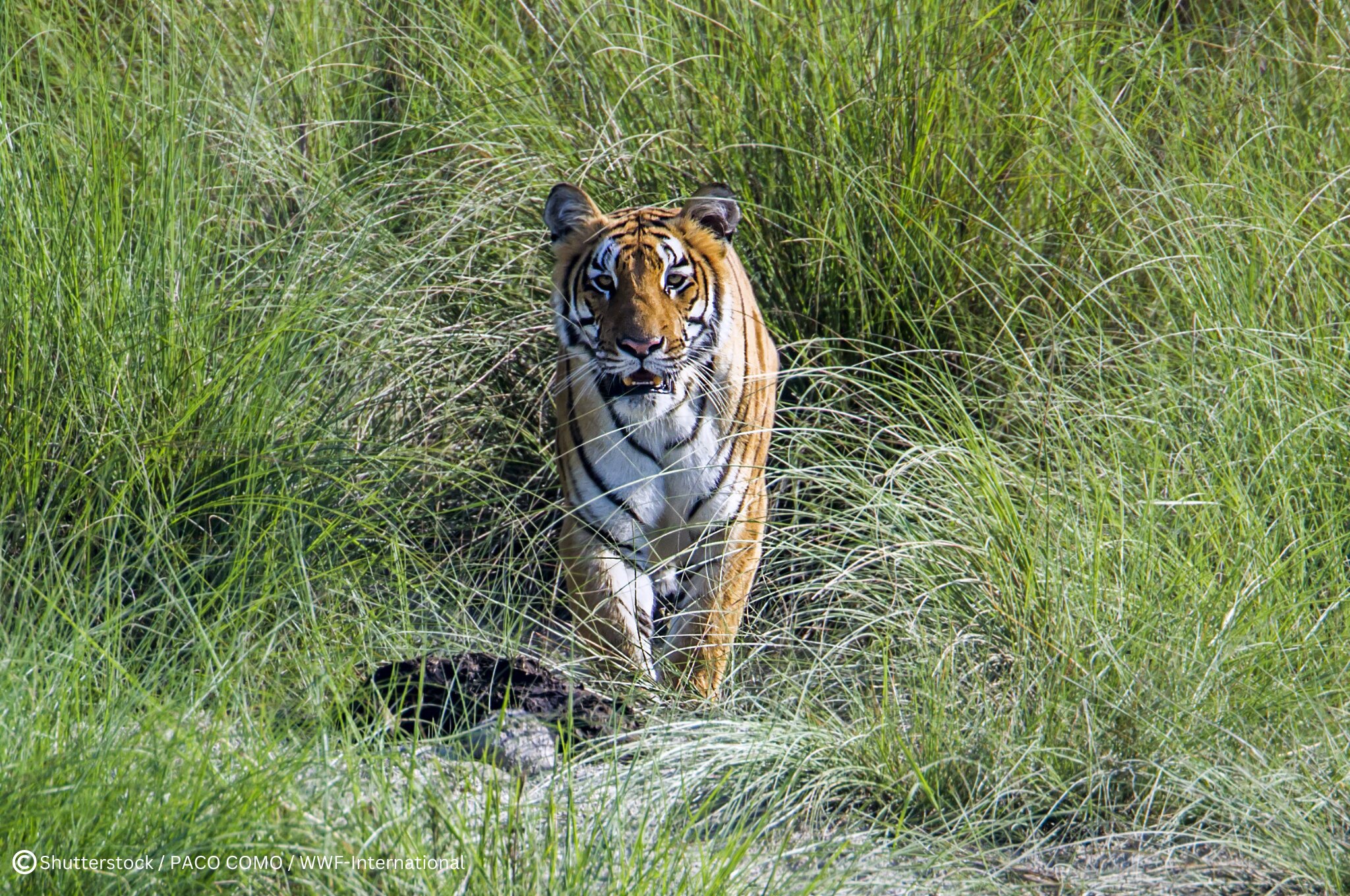
- Nepal’s tiger count hit a record 429, but growth is concentrated almost entirely in the country’s newer national parks. Meanwhile Bardiya, the second-oldest park, declined 10%.
- Researchers point to three drivers behind the split: drought pushing tigers toward parks with better water infrastructure, cross-border habitat connectivity with India, and invasive weeds degrading grazing land in the older parks.
- Prey density doesn’t track with tiger growth the way expected — Bardiya’s prey density actually rose 74% (the largest gain of any park) even as its tiger numbers fell, suggesting water management, not food scarcity, is driving movement across park boundaries.
- Amid ongoing protests over human-wildlife conflict, some Bardiya residents suspect the government undercounted tigers there, while researchers flag a related emerging concern tigers displacing leopards into human settlements.
KATHMANDU — Nepal is now home to an estimated 429 wild tigers, up from 355 four years ago and nearly four-fold from 16 years ago, the country’s conservation officials reported on the occasion of World Tiger Day.
As the country celebrates this historic achievement, a closer look at the latest numbers reveals an uneven recovery. Nepal’s youngest national parks are driving nearly all the growth, while Bardiya, the country’s second-oldest park, has fewer tigers. This could lead to more conflict between not just people and tigers, but people and leopards as well in and around the new national parks, according to recent studies.
Three factors appear to be behind this split: water availability, animal movement both within and outside the country, and spread of invasive species.
“The results from theflect the positive outcomes of ongoing efforts in the field of tiger conservation in Nepal, such as habitat conservation and management, poaching control, conservation of prey species, and biological corridor conservation,” said Bed Kumar Dhakal, spokesperson for the Department of National Parks and Wildlife Conservation.
Chitwan, the country’s oldest national park, still leads by far in raw numbers. But the newer parks (Banke, Parsa and Shuklaphanta) are where growth is concentrated, while the country’s two oldest parks, Chitwan and Bardiya, are showing the slowest growth or an outright decline.

The numbers are rooted in a global pledge made in November 2010. With wild tiger numbers at an all-time low at roughly 3,200, leaders from the world’s 13 tiger range countries gathered in St. Petersburg, Russia, for the first international tiger summit, where they signed the St. Petersburg Declaration and committed to double the global wild tiger population by 2022. Nepal, then home to an estimated 121 tigers, accepted the pledge and met it by reporting 355 tigers in 2022.
A cursory reading of the latest survey data suggests that while older parks are reaching stagnation, newer ones are emerging as areas of potential growth, said researcher Saneer Lamichhane, a PhD candidate at the wildlife ecology and conservation department, University of Florida, U.S.
Chitwan, whose name translates to “heart of the jungle,” was designated as a national park in 1973. Bardiya followed in 1988. Data from both parks now show the slowest-growing, or even shrinking, tiger populations in the country, Lamichhane said.
In 2010, the government set up Banke National Park, previously part of a community forest, as an eastward extension of Bardiya’s habitat. Parsa, adjacent to Chitwan, and Shuklaphanta were both recognized as lower-protection wildlife reserves before being upgraded to full national park status in 2017.
Three theories
Researcher and conservationist Santa Raj Jnawali pointed to three factors — water availability, spread of invasive weed species, and improved connectivity with potential habitats in India — rather than any administrative or managerial change following the parks’ upgrade in status.
“We have seen that some areas of Bardiya, especially the banks of the Geruwa River, and Chitwan (west) are facing droughts due to changing river course,” Jnawali, who is from Bardiya, told Mongabay. This could be pushing tigers, and their prey, toward areas with better water availability, he said. These areas are Banke in Bardiya’s case and Parsa in Chitwan’s, where wildlife officials have invested significantly in artificial ponds and wetlands.

Connectivity across the border plays a role too, particularly for Shuklaphanta and Parsa, according to Jnawali. “In the case of Shuklaphanta, measures by Indian officials to improve habitats in Lagga-Bagga area, and Suhelwa in the case of Parsa, [both along the Indo-Nepal border] have also facilitated the movement of tigers from old habitats to new ones,” he said.
The third factor is the spread of invasive plants such as bitter vine (Mikania micrantha) and common lantana (Lantana camara) in both Chitwan and Bardiya, Jnawali said. “The younger national parks, to some extent, don’t face the problem, as until recently their grasslands were used for livestock grazing, which helped keep the invasives out,” he added. That grazing history left better grasslands for tiger prey like deer, and where prey goes, predators follow, he said.
A resettlement campaign in Parsa may also have left an impact, according to researcher Babu Ram Lamichhane (no relation to Saneer Lamichhane). Two settlements inside the protected area — Rambhori Bhata and Ramauli Pratappur (combined 190 hectares, or 470 acres, with 473 household) — were voluntarily resettled between 2009 and 2013. “Although the settlement wasn’t big, the impact of its relocation was significant because it was adjacent to a large population in Bardiya,” he told Mongabay. “This helped reduce human disturbance, potential poaching, and retaliatory killings.”
A 2025 studyled by Saneer Lamichhane found Bardiya’s tiger population rose from 49 in 2013 to 122 in 2022 and argued that Banke’s seven-fold density increase over the same period was due to intensified conservation efforts, and not only through in situ reproduction. That dispersal also maintained a high survival rate back in Bardiya, by giving crowded tigers somewhere to go instead of fighting for space, the study suggested.
Prey numbers don’t add up
A comparison of prey data from 2022 and this year’s numbers suggests the drivers of population change are more complex than the age of the park age alone. Prey density (the number of prey animals such as deer per square kilometer) doesn’t sort by park age the way tiger counts do: Parsa and Shuklaphanta, two of the fastest-growing tiger populations, actually saw decline in prey over this period, while Banke and Bardiya registered growth.
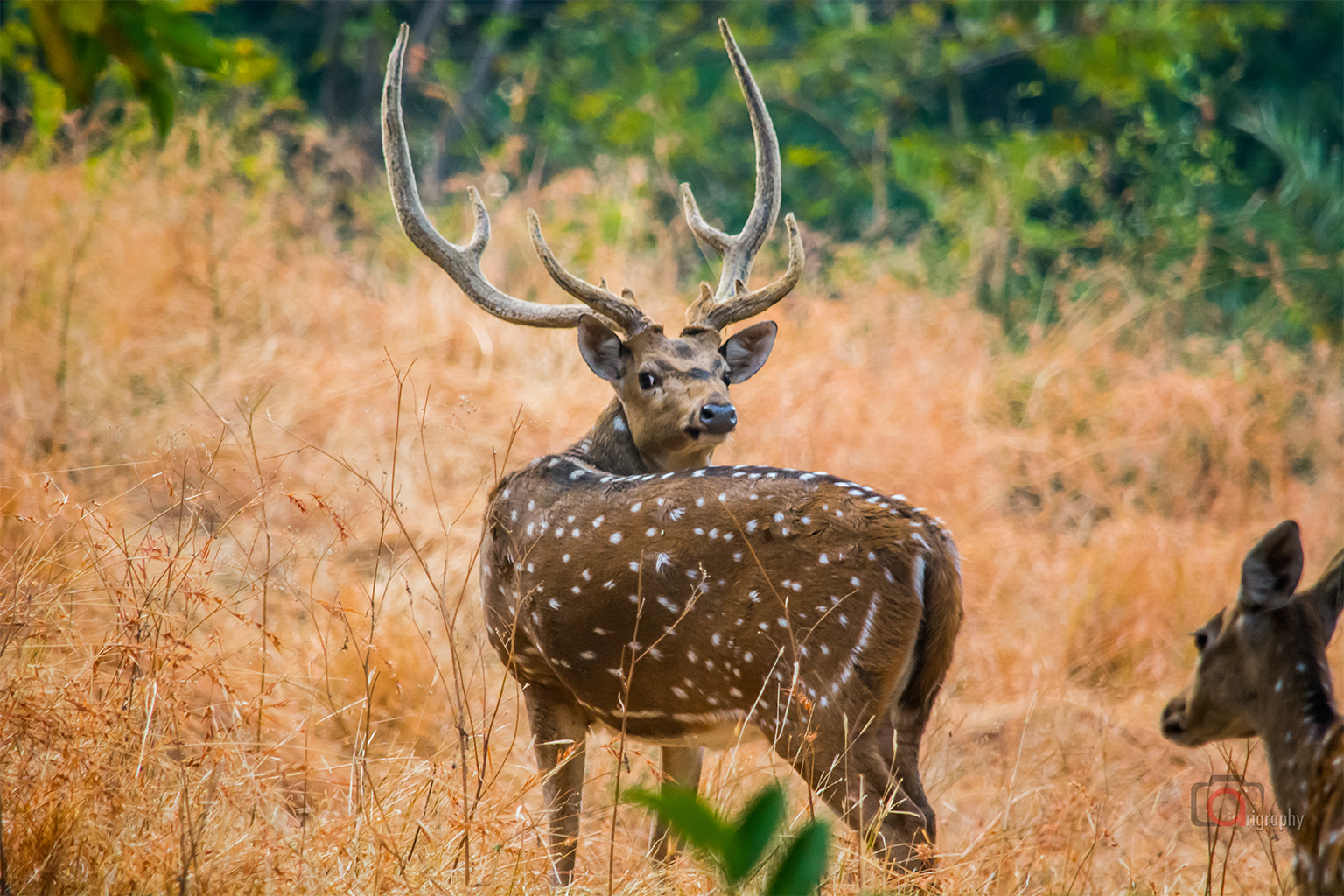
Bardiya is the clearest case where the increase in prey base increases population theory doesn’t hold up. While its prey density rose 74%, the largest increase of any park, its tiger population and tiger density both fell.
Recent research suggests that availability of water may be a better indicator of tiger numbers than the amount of prey available. A 2025 study that modeled tiger habitat found that distance to artificial waterholes was the strongest predictor in the model, stronger than prey abundance itself. No equivalent statistical model exists yet for Chitwan-Parsa, but anecdotal evidence suggests that wild animals, including rhinos (Rhinoceros unicornis) and tigers are moving east due to declining water availability in eastern areas. Parsa sits east of Chitwan.
A shared pattern in two park pairs
Camera-trap data reveals similar patterns in both the Bardiya-Banke and Chitwan-Parsa landscapes. According to survey data, Bardiya’s cameras photographed tigers nearly nine times more often than Banke’s, and its estimated tiger density was more than four times higher.


A similar, though less dramatic, pattern appears in the Chitwan-Parsa complex: Chitwan recorded about 45% more tiger photos than Parsa and a density roughly 60% higher. Viewed together, these patterns suggest that, while the newer parks drive population growth, the older ones remain the core tiger strongholds where the big cats are more concentrated, hence more frequently detected.


New areas of population growth mean tigers are expanding into places they weren’t present before. But in both the newer parks, core tiger habitats remain separated from human settlements. The real emerging challenge, said Saneer Lamichhane, is leopards: As tigers expand and displace leopards from core habitat, leopards are pushed into human settlements in search of food, a problem that still needs to be addressed.
Parsa’s leopards and roads
Water has been one of Parsa’s defining constraints, said Jnawali. More than 70% of the park faces water scarcity through the dry season due to porous soil, a 2018 study found. Invasive alien plants, including species ranked among the world’s worst invasives, are spreading along roads, trails and other dispersal corridors, with abundance rising near human settlements and reducing tree regeneration, according to a 2026 study. A major highway connecting trade centers in India and Nepal passes through the park obstructing movement of animals, including tigers.
Similarly, common leopard density in Parsa (3.09 per 100 square kilometers, or 38.6 square miles) is more than double the tiger density (1.25 per 100 km²); the two predators avoid each other’s peak activity periods to limit conflict, but competitive pressure on leopards is building as the tiger population recovers, according to a 2025 study published in Ecology and Evolution.
Shuklaphanta’s tigers squeeze leopards
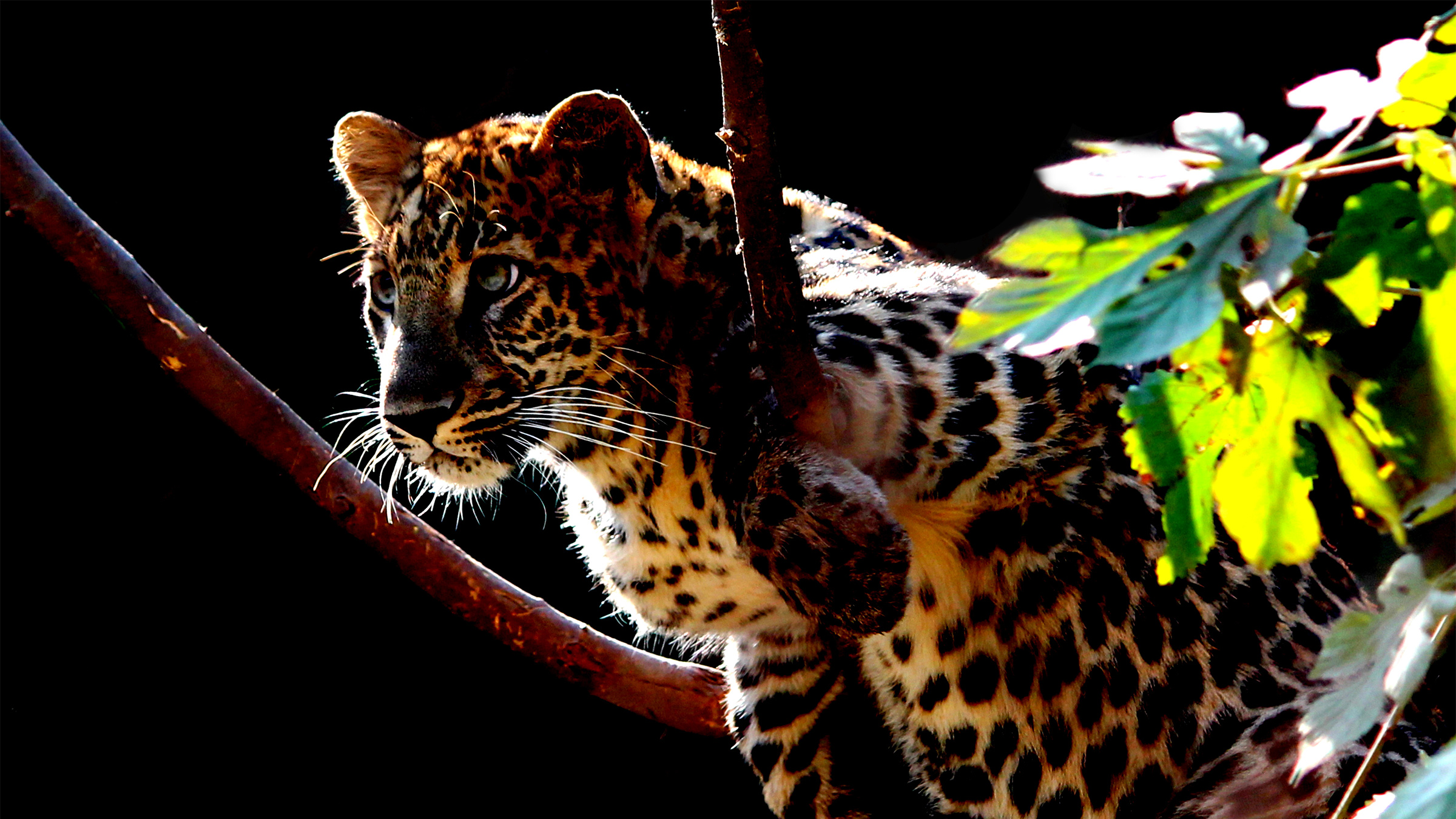
Shuklaphanta’s tiger recovery is squeezing its leopard habitat. A 2025 occupancy study found leopard detection was negatively correlated with tiger presence, and leopard occupancy was higher near human settlements. This suggests that as Shuklaphanta’s tiger population grows, leopards may be getting pushed toward the park’s human-dominated edges. A six-year study of the park’s buffer zone, conducted in 2016-2021, recorded 92 livestock killed by leopards.
Banke’s growth defies carrying capacity
Banke’s growth story already defies its estimated carrying capacity calculated based on available prey density. Modeled ecological carrying capacity for the park, based on prey density, is just 28 tigers, according to a 2024 study published in Global Ecology and Conservation — a ceiling the park’s confirmed 2026 count of 51 already exceeds.
Banke’s conservation infrastructure is comparatively young: The park was only established in 2010, versus four decades of habitat management in neighboring Bardiya, a factor the same study links to its lower carrying-capacity ceiling. However, forests around the national park could provide suitable habitats for tigers, said researcher Babu Ram Lamichhane. Besides, a highway that separates the settlements from prime habitats also helps control human-tiger encounters, he added.
While sporadic media reports detail leopard attacks have increased in the area, no specific records substantiate it.
Skeptical response
Community members in Bardiya view the numbers, especially the decline in Bardiya, with suspicion. Despite the government’s announcement, local communities in Bardiya aren’t convinced. The announcement comes on the heels of local protests demanding prompt government action on human-wildlife conflict, and a Bardiya resident working in conservation told Mongabay on condition of anonymity, fearing retribution, that they believe the government manipulated the numbers to make it appear that tiger numbers are declining in Bardiya, anticipating that conflict cases will now rise as a result. This is a claim the government denies.
Nationwide, tiger attacks have killed 85 people over the last eight fiscal years, according to National Trust for Nature Conservation (NTNC) data. The annual death toll fell for four straight years before rising again in fiscal year 2025-26, when 10 people were killed nationwide — four near Banke, three in Parsa, two in Bardiya and one near Chitwan.
Banner image: A Bengal tiger in Nepal’s Terai Arc Landscape.
Tiger-centric conservation efforts push other predators to the fringes
Fear and hardship for the last community inside Chitwan, Nepal’s tiger central
Citations
Lamichhane, S., Pathak, A., Karki, A., Khatiwada, A. P., Pokheral, C. P., Hines, J. E., … Oli, M. K. (2025). If you build it, will they come? Assessing the response of tiger populations to elevated conservation efforts in lowland Nepal. Global Ecology and Conservation, 60, e03632. https://doi.org/10.1016/j.gecco.2025.e03632
Lamichhane, B. R., Pokheral, C. P., Poudel, S., Adhikari, D., Giri, S. R., Bhattarai, S., … Subedi, N. (2018). Rapid recovery of tigers Panthera tigris in Parsa Wildlife Reserve, Nepal. Oryx, 52(1), 16–24. https://doi.org/10.1017/S0030605317000886
Shah, S. K., Karki, J. B., Bhatta, B., Subedi, N., Lamichhane, B. R., K. C., R. B., Karki, A., & Amin, R. (2024). Recovery of tigers (Panthera tigris): Assessing ecological carrying capacity in Bardia-Banke Complex, Nepal. Global Ecology and Conservation, 56, e03326. https://doi.org/10.1016/j.gecco.2024.e03326

