


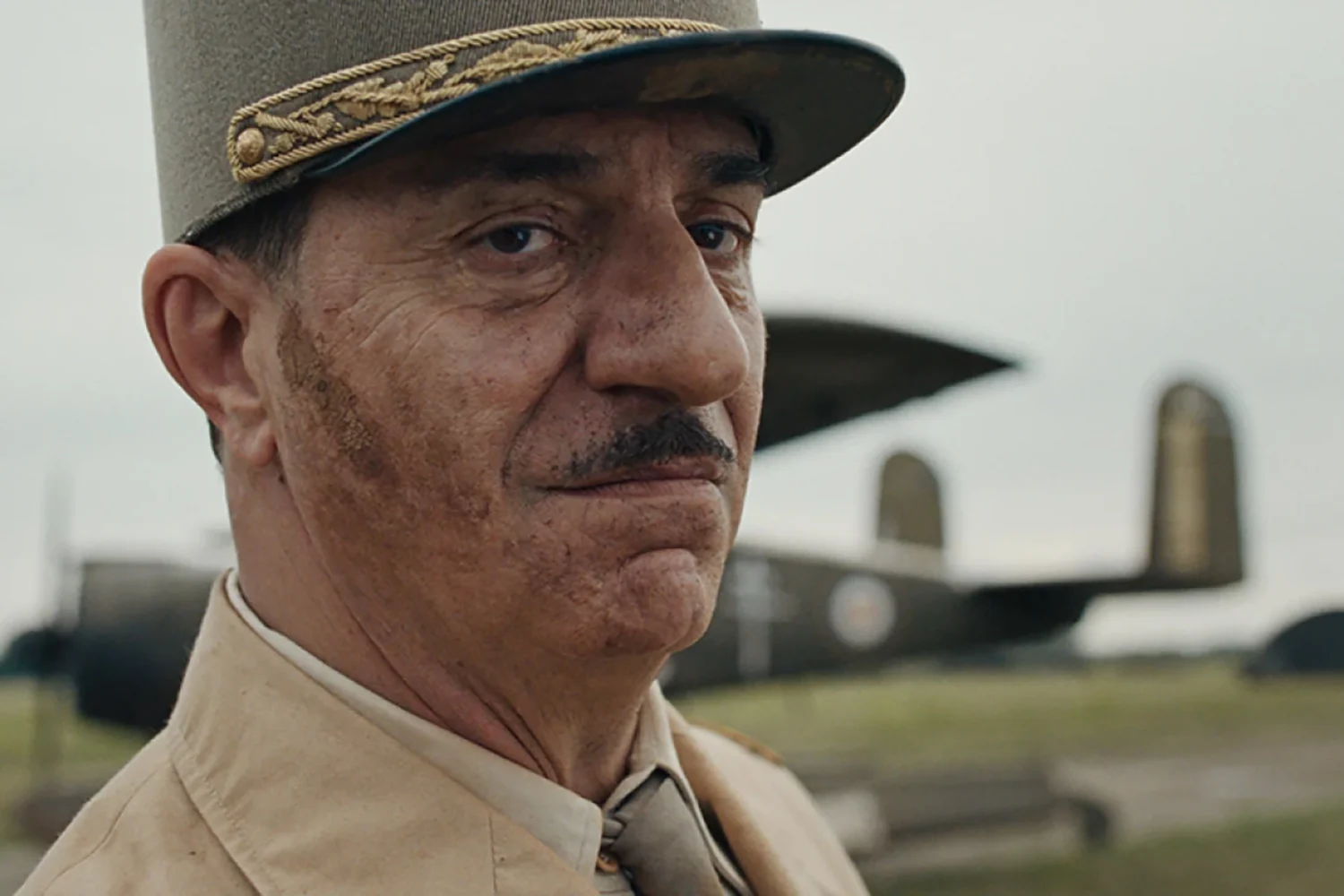
With year-end best-of lists about to arrive, one strong contender for film of the year might seem unlikely at first: a five-hour, two-part, largely French-language biopic of French general and statesman Charles de Gaulle that only recently reached U.S. screens. Directed by Antonin Baudry and starring a strikingly de Gaulle-like Simon Abkarian, this French blockbuster comes with an almost-American budget of 74 million euros, one of the largest in the history of francophone cinema. Perhaps unsurprisingly given its subject, it became the hit of the French summer, offering audiences a nostalgic vision of national greatness at a moment of paralysis and division.
More surprisingly, the de Gaulle diptych has won praise outside of France as well, helped by the fact that it works superbly as both action and entertainment. Epic in scale, beautifully shot, both wryly amusing and often touching, its twin installments pass far more quickly than their daunting runtime might suggest. There are clear contemporary echoes, too, in de Gaulle’s personal struggles and story of dogged European defiance. Indeed, it is not hard to see why viewers in France and elsewhere have warmed to this tale of an embattled European leader fighting to re-build sovereignty in the face of pressure from the United States as the moorings of a crumbling old order give way to something frightening and new.
Each of the film’s two parts is just over two and a half hours long. The first, De Gaulle: Résistance (158 minutes; released in France as L’Age de fer), opens with the humiliation of the French collapse in June 1940. Refusing to accept the armistice, de Gaulle flees to England in a tiny plane. From there, he presses British Prime Minister Winston Churchill for greater support and builds a shaky government-in-exile from scratch, operating from a tiny office in central London.
The second, De Gaulle: Liberté (159 minutes; J’écris ton nom in France), covers 1943 to the end of 1944, following both the actions of the Resistance and de Gaulle’s power struggles with rival claimants to French leadership, before moving on to D-Day and the liberation of Paris. The epic closes movingly on Armistice Day, when Churchill visits the freed capital as de Gaulle’s guest.
For audiences outside France, some of this will be familiar, from de Gaulle’s defiant broadcasts on the BBC to his haughty and stubborn personal affect. Undeniably imperious and quite unable to forget a slight, Abkarian’s de Gaulle is both a model of determination in the face adversity and, to the Allied leaders who bankrolled him, a quintessentially French pain in the ass.
A still from De Gaulle: Résistance.Pathe Films
Other episodes are less well known in the English-speaking world, however, even as they remain central to France’s own story of the war, from the British destruction of the French fleet at Mers-el-Kébir in July 1940 (to keep its warships out of German hands) to the epic battle at Bir Hakeim in mid-1942. Perhaps now more familiar to tourists as the name of a Paris metro station, Bir Hakeim saw 3,700 Free French soldiers and their African colonial troops hold an isolated desert fort in Libya against German Gen. Erwin Rommel’s Afrika Korps for more than two weeks. Fighting against overwhelming odds, their bravery allowed Britain’s Eighth Army to fall back to El Alamein and regroup, marking an eventual turning point in the wider war. Providing the first film with a dramatic 15-minute denouement, the battle proved that de Gaulle’s ragtag movement could fight as a real army, provided a much-needed fillip to Free French morale, and strengthened the general’s position as a legitimate and potentially successful French leader.
Although this is very much a big-budget war movie, much of its power lies, paradoxically, in its intimate portrayal of the quiet complexities of leadership. In the public mind, de Gaulle can often come across as a cartoonish figure, all stubborn resolve, frosty self-regard, and Gallic hauteur. Abkarian’s ramrod-stiff performance is magnetic and provides plenty of evidence of this. But it also offers something more human, portraying with affection de Gaulle’s strange mix of grandeur and loneliness. The first film dwells in particular on his isolation and frequent despair. Arriving in London as a defeated tank division commander and former undersecretary of war, de Gaulle has no army, no money, barely any staff, and little claim to legitimate leadership. His situation is often tragi-comic, as when he tries unsuccessfully to win over members of the French expatriate community at a drinks party, or when he attempts to address a British audience in a packed theater, only to walk off ashamed without saying a word. In one especially memorable scene, he weeps alone in the bath of his small, dingy flat. In many others he is disconsolate, close to losing hope, and tempted to give up.
This most Gallic of films is in fact based on an equally epic book by a British academic: A Certain Idea of France, Julian Jackson’s 900-page biography, published in 2018. Reviewing it in the New Yorker, Adam Gopnik dwelt on the crippling weakness de Gaulle faced in 1940, and how he ultimately managed to think his way out of it via a mixture of imagination, self-belief, and obstinacy. De Gaulle depended “more on theatrical élan than did pretty much any other public man of his century,” as Gopnik put it. “No one has ever played a weaker hand more compellingly. His life was one long brilliant bluff.”
It is this vulnerability, rather than the more familiar image of pigheaded strength, that likely appealed to French audiences, prompting a reassessment of his traditionally unbending image and the controversial Gaullist legacy it inspired. For all that, the film is also huge fun. Its action sequences are slickly executed and, unusually for a European production, come with plenty of exuberant, Hollywood-style explosions. But it works as entertainment above all because at its center is the double act of de Gaulle and Churchill, played by Simon Russell Beale, easily the best of the many actors who have attempted the role.

A still from De Gaulle: Liberté.Pathe Films
The two men are endlessly frustrated by one another and an obvious study in contrasts: one reserved, austere, and abstemious, the other impulsive, theatrical, and alcoholic. Yet each recognizes in the other a wartime leader fighting to save his nation against massive odds, creating a certain fondness and clear mutual regard. Among their many fine scenes is a comic row involving translation. De Gaulle speaks poor English; Churchill’s French is comical but serviceable. As they argue, both men hear their respective interpreters diplomatically softening their words. Each leader throws his man out of the room in turn, preferring to fight out their differences in broken language. The grudging but sincere warmth between the two both humanizes the complexities of wartime leadership and provides the film’s emotional heart.
Some critics have accused director Baudry of playing fast and loose with history, mixing invented characters with historical leaders, among other sins against accuracy. Jackson, who acted as a consultant on the production, has written warmly in its defense: “My pavlovian historical pedantry – ‘no that is wrong, it didn’t happen like that’, ‘you have these events in the wrong order’, etc – was quickly slapped down with the reminder that this was a film not a documentary.”
The film’s very French portrayal of the United States, with a Machiavellian President Franklin D. Roosevelt cast as a chief villain, is one obvious area of potential historical dispute. But it also provides the film with its drama. Curiously, Adolf Hitler is never seen and barely even mentioned, while few German soldiers even appear. Instead, the real antagonist is Roosevelt’s Washington, and the U.S. president’s mounting frustration with an upstart French exile who contributes little manpower to the war effort yet irritatingly demands to be treated as an equal and a great power. In this sense it has something in common with zombie movies, where the greatest danger often comes less from the outside menace and more from potential betrayal within the group of humans struggling to survive.

A still from De Gaulle: Liberté.Pathe Films
In Roosevelt’s eyes, France had forfeited any claim to great-power status, while de Gaulle himself was merely an arrogant annoyance and obstacle to his plans. This broader threat to French survival is embodied in a plan to create the Allied Military Government of Occupied Territories (AMGOT), which the film presents as a U.S. scheme to permanently dismantle and divide the country. In this vision, a liberated France would be run by U.S. and British administrators, much as occupied Germany later was. That AMGOT was never the fully formed plan for France the film suggests is almost beside the point. In one memorable scene, Churchill is shown a future map of Europe in which France has vanished, carved up into a “New Wallonia” and other invented entities. In an act of covert friendship, he leaks it to de Gaulle; a rare act of British solidarity with the French over the Americans.
As exaggerated as the film’s version of the AMGOT plan may be—and Jackson concedes it is somewhat overplayed—the question of how to deal with a powerful United States runs throughout the film, giving it its most obvious modern resonance. In part this reflects a traditional and enduring Franco-British divide, with France seeking self-sufficiency and sovereignty while Britain prefers proximity and access to Washington.
On the eve of D-Day in June 1944, for instance, de Gaulle’s demands over his forces’ role in the coming liberation of France prompt another giant bust-up with Churchill, and one especially memorable exchange, recounted in de Gaulle’s own highly readable memoirs. “”Every time we have to choose between Europe and the open seas, we shall always choose the open seas,”” he recalls Churchill declaring. “”Every time I have to choose between you and Roosevelt, I shall always choose Roosevelt.”” From Churchill’s point of view, this was entirely sensible; Britain had no obvious alternative to a superpower’s existential support, and it would have been foolish to side with an exile liberation army possessing no resources of its own. Nonetheless, it was a line de Gaulle would go on to quote throughout his life: an emblem of British perfidy and deference to Washington.
Late in the second film, in a scene set in November 1944, de Gaulle sounds out Churchill on a deeper Anglo-French alliance. Churchill declines because Britain must stay close to Washington. The portrayal feels both enduring but also clearly modern, depicting two exhausted European powers facing common adversity but still quite unable to choose to be full partners with one another.
More than anything, the film brings to mind the modern predicament of embattled and weakened middle powers, trying to find their way in a world dominated by far larger and more chaotic forces. During World War II, Britain and France both still thought of themselves as great powers—in de Gaulle’s case almost absurdly so, given his limited circumstances. Yet both clearly lived at the mercy of others, be they Hitler’s marauding armies or the caprice of an indispensable but overbearing U.S. ally.
-

Three men in dark suits and ties stand close together outdoors under a clear blue sky, looking toward the man on the left. - U.S. President Donald Trump, French President Emmanuel Macron, and British Prime Minister Keir Starmer attend the G-7 summit in Évian-les-Bains, France, on June 16. Ludovic Marin/AFP via Getty Images
-

A black-and-white photograph of four men sitting in a row of chairs outdoors on grass, two in military uniforms and two in suits, with a microphone on a stand in front of them. - Gen. Henri Giraud, U.S. President Franklin D. Roosevelt, Gen. Charles de Gaulle, and British Prime Minister Winston Churchill in Casablanca, Morocco, in January 1943. AFP via Getty Images
Today European nations face a version of the same bind, struggling to rebuild sovereignty in a world dominated by superpowers increasingly willing to coerce and threaten them. The message of the film is clearly a comfortable one for French audiences: France was right all along about untrustworthy Americans, and about the need for strength and independence rather than reliance on potentially unreliable U.S.-led institutions like NATO. Nonetheless, here de Gaulle offers modern Europeans clear lessons on how to counteract weakness, via a mixture of political imagination, risk-taking, and—above all—a willingness to stand up to U.S. power from time to time.
What most people understand as “Gaullist” policies are increasingly common far beyond France as our geopolitical order frays, not least intrusive industrial policies aimed at technological self-sufficiency. Ben Judah, a British author and former political advisor, has gone further, proposing a new agenda of “Anglo-Gaullism” inspired by the French leader’s mixture of interventionism and political élan. “[T]he genius of de Gaulle was to re-enchant through storytelling a nation that had utterly lost confidence in itself,” he writes. Europe could clearly use a little more of that Gaullist enchantment today.
It is almost a cliche to contrast the giants of World War II with the slighter figures of our own generation. Yet watching de Gaulle’s struggles, it is hard not to think of the supplication of modern leaders like Mark Rutte, NATO’s secretary-general, whose approach to U.S. President Donald Trump was memorably described by Susan Glasser of the New Yorker as “strategic self-abasement.” De Gaulle is often fairly criticized for a grandiose vision of French leadership that far outstripped France’s actual power, leading to unhelpful delusions of national grandeur fed by the vision of its grandest of leaders. Nonetheless, de Gaulle’s obdurate refusal to accept decline—and his determination that France should stand, as he put it, as a nation “in the front rank”—should serve as an inspiration to Europe’s leaders today. This, too, is the lesson of the two excellent films that bear his name: to hold a vision of national power and to will it obstinately into existence, even if only by learning how to play a bad hand well.
