


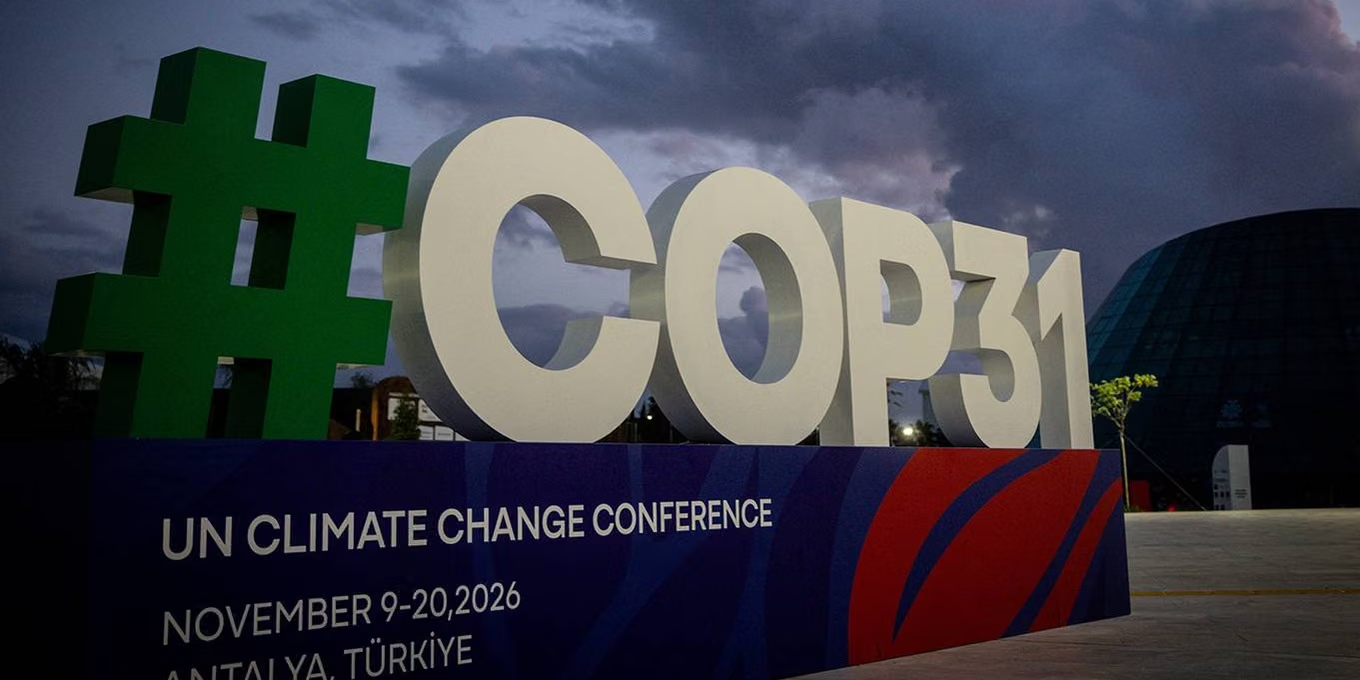
ANTALYA—This year’s United Nations climate talks in Antalya, Turkey, broke up on Sunday without an agreement. Nearly 200 countries spent two weeks arguing about whether the final agreement could even mention phasing out fossil fuels. Apparently, it could not. Like last year’s conference in Belém, Brazil, which also failed to adopt a fossil-fuel roadmap, COP31 further reveals the limits of consensus-driven diplomacy.
But these high-profile failures do not mean that the global response to climate change is stalled. On the contrary, the energy transition is moving faster than ever, even if it still is not fast enough.
Consider the latest headline figures. In the past ten years, solar photovoltaic costs have fallen by about 90%, onshore wind by about 70%, and batteries by over 90%. Global clean-energy investment now tops $2 trillion per year. Electric-vehicle sales keep rising. Transportation accounts for roughly 60% of global oil demand, most of it from cars and trucks, and EVs are simply the better technology. They are more efficient, cost less to operate, and are increasingly cheaper to buy. Once that becomes obvious to consumers everywhere, oil demand won’t just plateau. It will fall off a cliff, perhaps as soon as within the next decade or two.
Incumbents know this, even if their lobbyists won’t say it. ExxonMobil and Saudi Aramco have both pledged to reach net-zero emissions from their own operations by 2050. Though they have since gone quiet about these targets, cutting emissions to near-zero may happen anyway. Norway, after all, pursues a similar strategy, with Norwegians buying almost only EVs, and the grid operating fully on renewables. Shell’s influential forecasters see the world reaching near-zero emissions by 2100 even in their gloomiest scenario: the “Archipelago” of fragmented, nationalistic strategies that one finds today.
But even if the end of the fossil-fuel era is a foregone conclusion, timing is everything. A world that reaches net-zero around 2100 will suffer average global warming of around 2.2–2.8° Celsius above pre-industrial levels, making irreversible tipping points all but inevitable. Getting there decades sooner will save many lives and livelihoods, not to mention trillions of dollars in climate-related damage.
Speed matters for economic reasons, too. The energy shock from the Iran war has once again exposed how dependent many economies remain on globally traded, geopolitically volatile commodities. Call it “fossilflation”: the inflationary cost of tying prices, budgets, and national security to oil and gas markets that a handful of producers and conflicts can move at will. The fix for that macroeconomic exposure is the same as the fix for climate change: phase out fossil fuels.
So, why do official talks keep stalling? There are two structural reasons. First, the UN process focuses on outcomes—targets, tons, and dates—while largely ignoring the root cause: the extraction and supply of coal, oil, and gas. Second, the process requires a consensus among some 200 countries, which gives governments (and companies) with the most to lose an effective veto over the final language.
Fortunately, in April, a more promising alternative approach got its first real test. At the First Conference on Transitioning Away from Fossil Fuels in Santa Marta, Colombia (co-hosted by the Netherlands), 57 countries, representing roughly one-third of the global economy, showed up to discuss supply rather than only emissions. Such a coalition of the willing (akin to a “climate club” proposed by the late William D. Nordhaus) helps eliminate the consensus problem altogether. By definition, those in attendance are already doing more to accelerate the energy transition, and they know that their ranks can expand over time.
There is ample precedent for this approach. In 1997, Canada led more than 120 countries to sign the Ottawa Treaty banning anti-personnel landmines, thereby making up for the failure of the UN’s consensus-bound disarmament forum (where China, Russia, and the United States each wielded a veto). A decade later, the Norway-led Oslo Process followed the same playbook and produced the 2008 Convention on Cluster Munitions. Neither treaty started with universal buy-in, but both established global norms anyway, constraining even non-signatories.
Of course, removing the veto does not solve every problem. Markets will do much of the heavy lifting on cutting emissions, but they will not help poor countries adapt to the warming that is already locked in. That requires public money, which is where the lack of a global agreement hurts the most. By the UN Environment Programme’s latest count, wealthy countries provided only about $30 billion in public adaptation finance to developing countries in 2024, barely more than the previous year.
Even if public climate finance can be mobilized at scale, other hard questions will remain: Who will stop permitting new extraction first? How can coal-dependent developing economies begin to shut down their coal assets in favor of renewables? And who compensates the workers left behind? It is one thing to agree on the final goal, but quite another thing to figure out the sequencing and financing.
The countries with the least time to waste are pushing hardest. A bloc led by Pacific-island states, and accompanied by countries such as Colombia and Pakistan, is pressing for a legally binding Fossil Fuel Non-Proliferation Treaty, and the Santa Marta forum will reconvene in 2027 in Tuvalu (co-hosted with Ireland). A low-lying atoll country threatened by rising seas will host a summit on phasing out the fuels that threaten its very existence. The symbolism could not be starker.
Despite the failure in Antalya, the question is not whether phasing out fossil fuels is the right goal. Investors, consumers, and even the oil majors’ own planners have already answered that. The question, rather, is whether a coalition of the willing can use policy to push markets toward a faster, fairer, and smoother transition than the traditional COP process can deliver.
