

Close Menu
NCIJ Network NCIJ Network
    What's Hot

    NASA’s Hubble Views Ocean of Stars in Groundwork for Roman

    November 25, 2026

    New Paper Challenges Cruelty Exemptions for Food-Producing Animals

    November 25, 2026

    Guest opinion: Wisconsin must look beyond cannabis legalization to transform its carceral system

    November 25, 2026
    Facebook X (Twitter) Instagram
    Trending
    • NASA’s Hubble Views Ocean of Stars in Groundwork for Roman
    • New Paper Challenges Cruelty Exemptions for Food-Producing Animals
    • Guest opinion: Wisconsin must look beyond cannabis legalization to transform its carceral system
    • The Fossil-Fuel Endgame Doesn’t Require a COP Consensus by Gernot Wagner
    • Five Russian military jets hit in airfield strike, says Ukraine
    • A space telescope hunting for dark matter just discovered something unexpected
    • Divided and displaced: Brazil’s Kaingang people wait for an end to illegal leasing conflict
    • How We Uncovered That Ectopic Pregnancy Deaths Have Nearly Doubled — ProPublica
    • About
      • Our Team
      • Editorial Policy
      • Editorial Independence
      • International Support
    • Trust & Standards
      • AI Usage Policy
      • Conflict of Interest Policy
      • Corrections Policy
      • Ethics Policy
      • Fact-Checking Policy
      • Source Protection
    • Get Involved
      • Guide for Sources
      • Support Independent Journalism
    • Legal
      • Cookie Policy
      • Privacy Policy
      • Terms of Use
    Facebook X (Twitter) Instagram
    NCIJ Network NCIJ Network
    Wednesday, November 25
    • Home
    • World
    • Ai
    • Business
    • Politics
    • Health
    • Crypto
    • Science
    • Technology
    • Cybersecurity
    • Defense & Security
    • Economy
    • Energy
    • Europe
    • More
      • Fact Check
      • Investigations
      • Opinion & Analysis
      • Environment
    NCIJ Network NCIJ Network
    Home»Science

    NASA’s Hubble Views Ocean of Stars in Groundwork for Roman

    NCIJ NETWNCIJ NETWORKBy NCIJ NETWNCIJ NETWORKNovember 25, 2026 Science No Comments3 Mins Read
    Share
    Facebook Twitter LinkedIn Pinterest Email

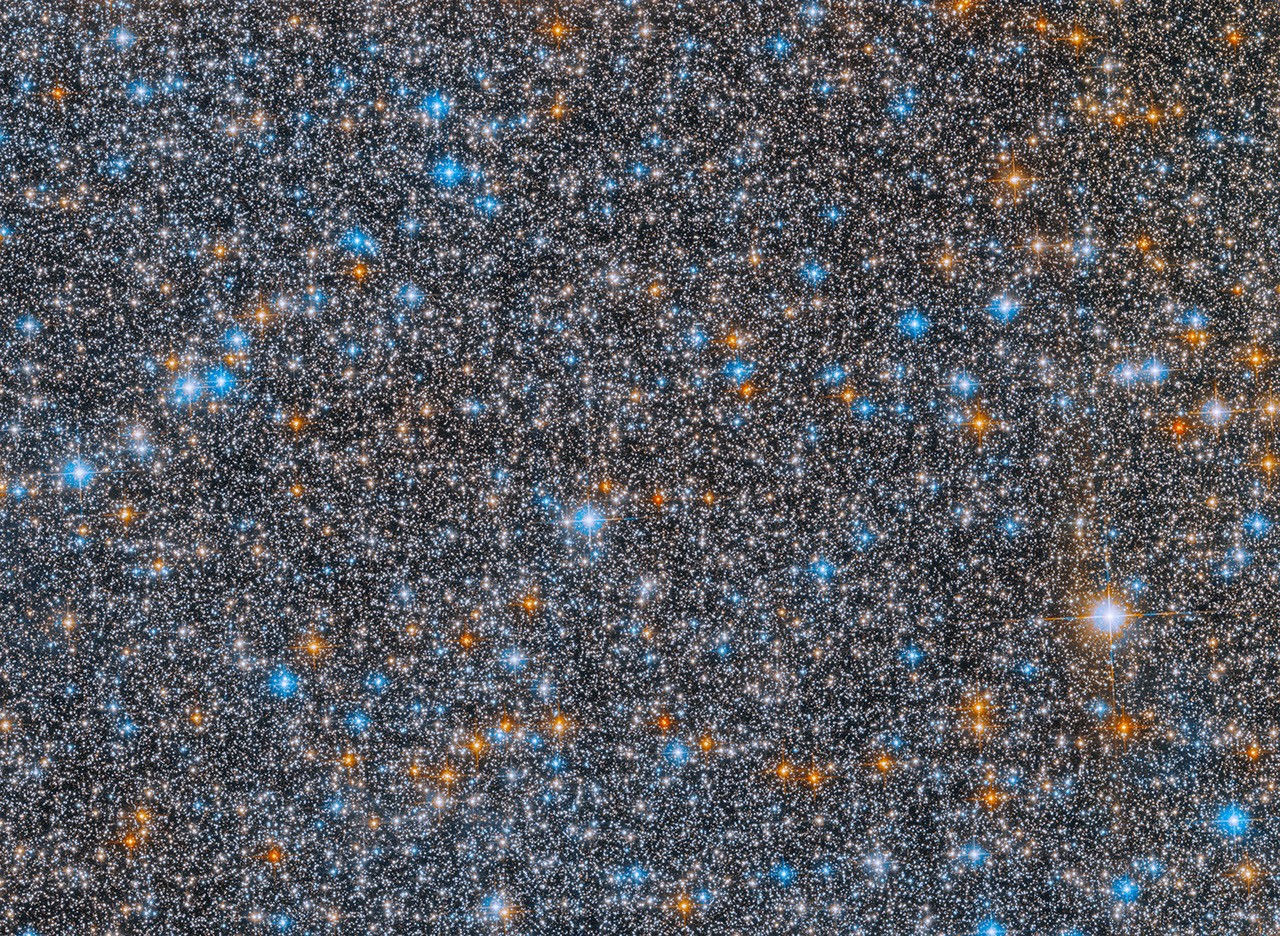
    An expanse of stars gleams in a rainbow of colors in these NASA Hubble Space Telescope images of the Milky Way. The images focus on an area of sky toward the galactic bulge, a densely packed, spherical region of stars that surrounds the center of a galaxy’s disk. These Hubble observations are part of a survey that will help researchers better interpret upcoming Nancy Grace Roman Space Telescope observations as they seek to characterize the stars and search for exoplanets in this busy region of our galaxy.

    Astronomers study the Milky Way’s galactic bulge because it holds nearly a quarter of the galaxy’s stellar mass, and its proximity allows them to examine the region in greater detail. Although we can see the glow from these crowded spheres of stars in other galaxies, they are too jam-packed and far away to resolve individual stars. By studying the Milky Way’s galactic bulge, researchers hope to find new planets and better understand how galaxies form, evolve, and interact over billions of years.

    Hubble views the universe primarily in ultraviolet, visible, and near-infrared light, while Roman collects data in near-infrared light and some visible light. Because researchers wish to compare Hubble’s observations to future Roman observations, Hubble looked at the region in wavelengths that overlap with Roman’s areas of sensitivity, the red end of the visible spectrum and near-infrared wavelengths.

    Hubble’s high resolution allows its instruments to collect data on the brightness, ages, composition, and motion of stars over time. With this knowledge, astronomers can search for potential exoplanets, determine the location of black holes or dark matter, and better understand our galaxy’s environment and evolution.

    A key component of Roman’s future observations is the search for exoplanets by capturing microlensing events, a type of gravitational lensing that occurs when light from a more distant object is magnified and distorted by the mass of a closer object along the line of sight. The way light from the distant star is distorted and magnified can reveal clues to the nature of the foreground star and any planets it may have. Hubble’s observations will help characterize stars in the region before they undergo a lensing event. Months or years in the future, when Roman captures a microlensing event, researchers can compare Hubble data to Roman data of the event, making it easer to interpret. These microlensing events are on a much smaller scale, that of stars and planets, than larger gravitational lenses that occur around galaxies and galaxy clusters.

    Over Hubble’s lifetime, it has observed our galaxy’s central bulge many times. These legacy surveys include the WFC3 Galactic Bulge Treasury Program that used Hubble’s Wide Field Camera 3 to study the brightness, precise positions, and motions of stars in this congested part of our galaxy. It also includes the Sagittarius Window Eclipsing Extrasolar Planet Search (SWEEPS) that used Hubble’s Advanced Camera for Surveys to look at 180,000 stars in the bulge of our galaxy. These new observations come from an observing program (#17776: S. Terry) designed to aid Roman in its search for exoplanets, black holes, neutron stars, and more. The data also adds to Hubble’s continuing legacy of high-precision observations of stars in the galactic bulge.

    Media Contact:

    Claire Andreoli
    NASA’s Goddard Space Flight Center, Greenbelt, MD
    claire.andreoli@nasa.gov

    GROUNDWORK Hubble NASAs ocean Roman stars views
    NCIJ NETWNCIJ NETWORK
    • Website

    Keep Reading

    A space telescope hunting for dark matter just discovered something unexpected

    Peppermint oil significantly lowers blood pressure in just 20 days

    Common sleep and anxiety drugs could be harming aging brains

    Earth’s next ice age may have already begun. Global warming stopped it

    Ancient rocks from the Moon’s far side rewrite the Solar System’s violent past

    Georgia’s Pecan Belt – NASA Science

    Add A Comment
    Leave A Reply Cancel Reply

    Editors Picks

    NASA’s Hubble Views Ocean of Stars in Groundwork for Roman

    November 25, 2026

    New Paper Challenges Cruelty Exemptions for Food-Producing Animals

    November 25, 2026

    Guest opinion: Wisconsin must look beyond cannabis legalization to transform its carceral system

    November 25, 2026

    The Fossil-Fuel Endgame Doesn’t Require a COP Consensus by Gernot Wagner

    November 25, 2026
    Latest Posts

    Iran-linked hackers blamed for cyber-attack that shut down UK power plant | Iran

    August 23, 2026

    Burning Questions Confront Wildland Firefighters in Maine and Across New England

    August 23, 2026

    Curiosity Blog, Sols 4982–4987: Back to Our Regularly Scheduled Programming

    August 23, 2026

    Subscribe to News

    Get the latest sports news from NewsSite about world, sports and politics.

    NCIJ Network is an independent digital news platform delivering trusted investigative journalism, European and global news, in-depth analysis, and fact-based reporting with accuracy, transparency, and integrity.

    Facebook X (Twitter) Instagram Pinterest YouTube

    NASA’s Hubble Views Ocean of Stars in Groundwork for Roman

    November 25, 2026

    New Paper Challenges Cruelty Exemptions for Food-Producing Animals

    November 25, 2026

    Guest opinion: Wisconsin must look beyond cannabis legalization to transform its carceral system

    November 25, 2026

    Subscribe to Updates

    Get the latest creative news from FooBar about art, design and business.

    Type above and press Enter to search. Press Esc to cancel.