


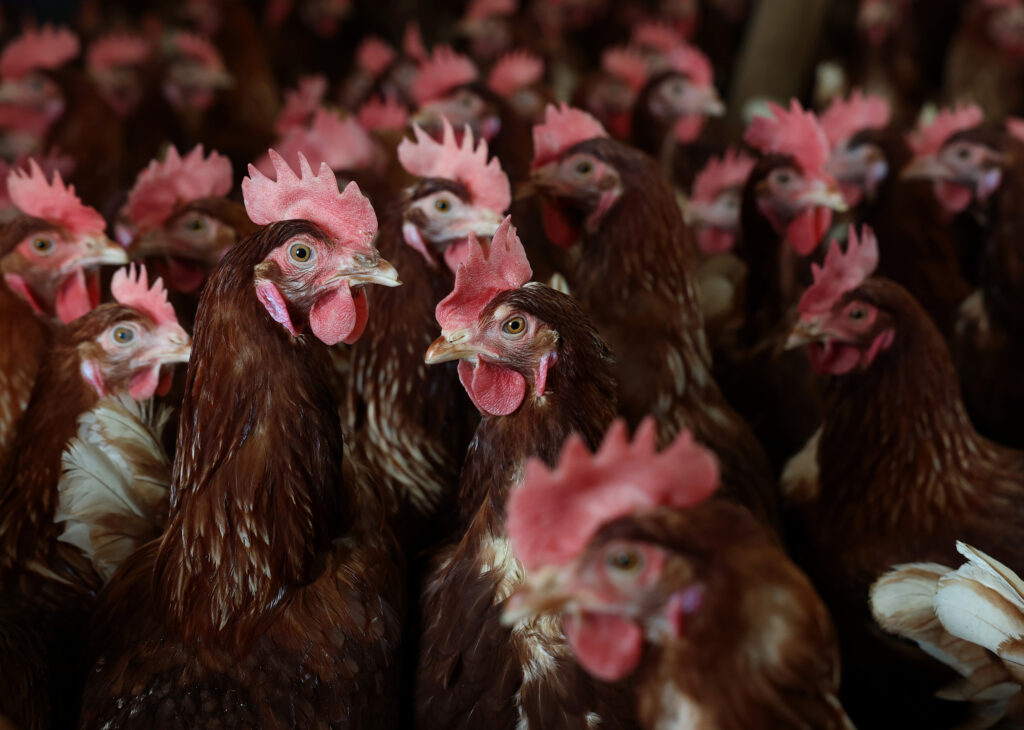
Clipping off chickens’ sensitive beaks without anesthesia. Cramming sows in crates so small they can’t turn around. Castrating or dehorning livestock without painkillers. Slamming piglets on the ground to kill them—a practice known in the industry as “thumping.”
These are all considered standard, common or accepted practice in U.S. animal agriculture and are exempt from state animal cruelty laws. Even in a country that overwhelmingly says it wants animals treated well—not just the 150 million or so kept as pets, but the 10 billion raised for food—this is the status quo.
The vast majority of the animals that are consumed or generate animal products in the United States are raised in intensive confinement, out of public view. Animal cruelty laws largely don’t apply to them mostly because of the immense power of the American farm lobby, which has convinced lawmakers that the industry itself can decide what is standard practice and therefore legal.
But a new paper argues that these exemptions for food-producing animals—which have been widely accepted as the norm for decades, even by animal advocacy groups—aren’t legally ironclad after all.
“The narrative has gone that these exemptions put farmed animals beyond the law—even if we wanted to, we could not prosecute for cruelty that’s happening on the farms,” said Delcianna Winders, a law professor and director of the Animal Law and Policy Institute at the Vermont Law and Graduate School. “What I’ve done is challenged that and said: What does the law actually say?”
In Winders’ new paper, which she discussed on a Harvard University panel Thursday and will be published next April in Ecology Law Quarterly, she found that, in fact, the state laws covering animal cruelty on farms aren’t as pervasive or sweeping as commonly believed. Winders examines the laws, state by state, interpreting the specifics of the exemptions.
“Not one of them—not a single one—says farm animals are not covered by the law,” Winders said.
This argument, in theory, could open up legal avenues for animal advocacy or other groups to pursue factory farm operators for industry-standard practices that are arguably or obviously cruel. Winders points out that these practices have allowed American factory farms to proliferate on a massive scale—causing water pollution, air pollution and more emissions of methane, the especially potent greenhouse gas, than major developed economies, including Spain.
“If we were not engaging in these practices that Americans deem unacceptable—we were not crowding animals so tightly, mutilating them—we would not be able to produce animals on the scale that we are,” Winders said. “If you were going to have animals in conditions that are considered acceptable, it would be a different system, and it would have to be smaller.”
That’s because humane care undercuts profits. Many of the common practices in factory farm settings, such as de-horning or de-beaking, are performed to address the aggression that animals show when tightly confined and stressed. But giving animals space makes feeding and medicating inefficient and costly, while also limiting the economies of scale that has enabled the industry to get so big.
Most people would be surprised, Winders says, to learn that no federal regulation or law covers the treatment of food-producing animals on the industrial farms where they spend the majority of their lives. States have enacted animal laws that criminalize unjustified or unnecessary cruelty to animals, but they were crafted more than a century ago before factory-scale farming became the norm. Starting in the late 1980s and 1990s, states began crafting laws that exempted on-farm practices from criminal prosecution. Today, 38 states have some form of these exemptions.
This story is funded by readers like you.
Our nonprofit newsroom provides award-winning climate coverage free of charge and advertising. We rely on donations from readers like you to keep going. Please donate now to support our work.
But even in the 12 that don’t, criminal prosecutions for on-farm cruelty happen rarely. That, Winders said, is because there are no regulations that require oversight under federal animal cruelty laws in factory farms, which means the only way to know what’s actually happening is with a search warrant based on probable cause, and to do that the law requires evidence. Even after clearing those obstacles, prosecutions are difficult, largely because of vagueness in the law that tends to get interpreted in a defendant’s favor.
There is, she says, a more fundamental problem. “The fact that we’re just using criminal law to regulate a massive industry—that’s not generally how you regulate industries. Normally, you have a regulatory regime with licenses or permits and inspections. None of that is happening, and so the result is cruelty only ever comes to light if there’s an undercover investigation.”
These are exceptionally rare.
In 1996, legal scholar and lawyer David Wolfson published a seminal law review article and later a book based on that article, explaining how states had carved out exemptions for livestock in state animal cruelty laws.
Wolfson, who was Winder’s co-panelist at Harvard Thursday, wrote that the agriculture industry lobbied state legislatures to craft animal cruelty laws so it couldn’t be prosecuted for any farming practice that the industry deems acceptable, regardless of how painful or cruel it may be.
In a subsequent book that Wolfson co-authored with animal law expert Mariann Sullivan, they wrote: “As a result, in most of the United States, prosecutors, judges, and juries no longer have the power to determine whether or not farmed animals are treated in an acceptable manner. The industry alone defines the criminality of its own conduct.”
At least one animal welfare legal group has challenged these exemptions, arguing that they’re unconstitutional because only legislatures can make laws.
Will Lowrey, a lawyer for Animal Partisan, a Richmond, Virginia-based legal advocacy group, said at a recent animal law conference that his organization has filed lawsuits challenging exemptions in two states.
“Someone is effectively deciding what these practices are and our argument is that that is the animal agriculture industry,” Lowrey said. “We have delegated lawmaking power to the animal agriculture industry.”
One of those cases, filed in Pennsylvania, was not decided on merits; another was just filed this week in Kansas.
Winders has spent years studying these exemptions, picking each of them apart and poking holes in what was previously seen as bulletproof. For example, she points out in her new paper that two states exempt entire categories of animals. South Carolina’s cruelty law “does not apply to fowl” and Oregon’s exempts all commercially grown poultry. And while these exemptions are “expansive and alarming,” she writes, they are not absolute. She notes that Oregon’s exemption doesn’t apply if there’s demonstrated “gross negligence” and South Carolina’s doesn’t apply to mammalian livestock.
Winders noted that statutes that say “accepted” practices are exempt aren’t clear on who or what actually accepts that practice. Extensive polling and surveys have shown that the American public does not find many of these practices acceptable at all.
“We have just presumed that the legislature intended … that this means accepted by industry,” Winders said. “Why wouldn’t we look to public opinion of what is acceptable or expected, and if that is the case, then none of the practices I described are considered acceptable by the public.”
About This Story
Perhaps you noticed: This story, like all the news we publish, is free to read. That’s because Inside Climate News is a 501c3 nonprofit organization. We do not charge a subscription fee, lock our news behind a paywall, or clutter our website with ads. We make our news on climate and the environment freely available to you and anyone who wants it.
That’s not all. We also share our news for free with scores of other media organizations around the country. Many of them can’t afford to do environmental journalism of their own. We’ve built bureaus from coast to coast to report local stories, collaborate with local newsrooms and co-publish articles so that this vital work is shared as widely as possible.
Two of us launched ICN in 2007. Six years later we earned a Pulitzer Prize for National Reporting, and now we run the oldest and largest dedicated climate newsroom in the nation. We tell the story in all its complexity. We hold polluters accountable. We expose environmental injustice. We debunk misinformation. We scrutinize solutions and inspire action.
Donations from readers like you fund every aspect of what we do. If you don’t already, will you support our ongoing work, our reporting on the biggest crisis facing our planet, and help us reach even more readers in more places?
Please take a moment to make a tax-deductible donation. Every one of them makes a difference.
Thank you,
