


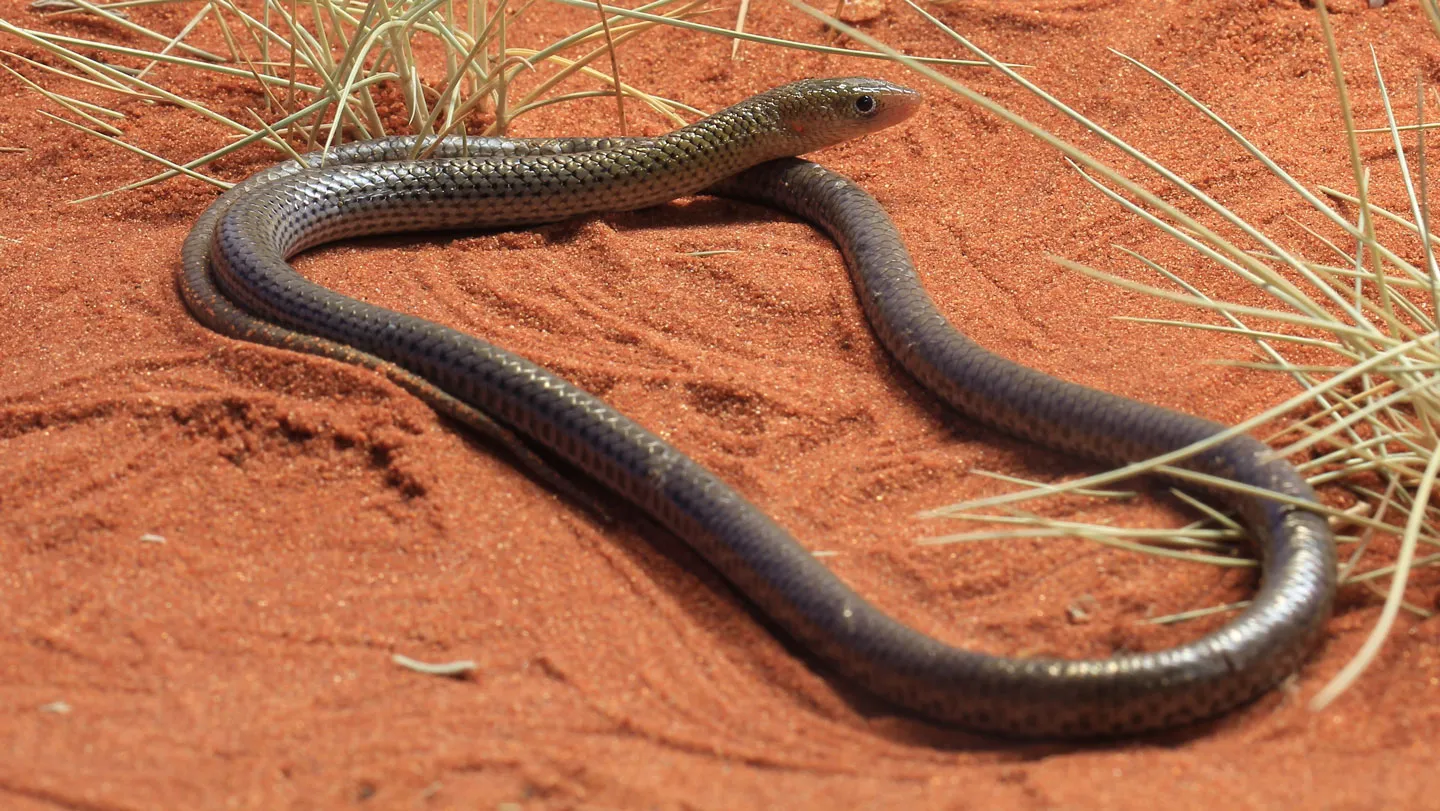
Australia’s limbless geckos look a lot like snakes. It turns out they’ve evolved like snakes too.
Snakes are technically a highly modified group of legless lizards. Dozens of other lizard lineages have independently lost their legs, too. But the legless pygopod geckos aren’t quite like their slithering nonsnake kin. Pygopods have dietary pickiness and physical diversity patterns that are more reminiscent of those found in snakes than in other legless lizards, researchers report in a preprint posted at bioRxiv.org on October 23.
The 50 recognized species of pygopod geckos are found throughout Australia and New Guinea. Pygopods range from a meter long to the size of half a cooked spaghetti noodle. They have odd tails, which in some species can be fantastically long, exceeding 400 percent of their less-than-1-centimeter-long bodies. Some use their tails like a spring to leap.
“They create a little sine wave and they shoot themselves up in the air, and they can do successive jumps,” says Ian Brennan, an evolutionary biologist at the Queensland Museum Kurilpa in Brisbane, Australia.
But not much else is known about them, Brennan says.
“They’re real oddballs,” he says, noting that geckos are typically thought of as skilled climbers on walls or glass surfaces. “[Pygopods are] a group that’s gone the exact opposite direction.”
As part of a large project tackling the genetics of Australia’s lizards and snakes, Brennan and his colleagues gathered data on pygopods’ genes, diet and physical features. They analyzed DNA from all 50 species of pygopod and generated an evolutionary tree. The team also put together data from the literature on the ratio of their body and tail lengths and compared this with a dataset of similar information on over 3,100 lizard and snake species.
As they evolved, snakes got longer by lengthening their bodies. Limbed lizards tend to get longer by lengthening their tails. The team found that pygopods have done both, an unusual strategy among legless lizards. This dual strategy resulted in some unexpected physical diversity in tail and body ratio.
Next, the team tackled diet, comparing between 1,738 lizard and snake species. Snakes as a group have a broad diet with lots of specialization, which might be partly why they’ve been so successful at diversifying into so many ecological roles in so many habitats, Brennan says. There are pythons that eat only large mammals and sea snakes that eat only fish eggs, for instance.
This pattern is rare in lizards. Most geckos eat insects such as beetles and cockroaches, Brennan says. This is especially true of the legless groups, which mostly gobble down whatever insects they happen to slither past.
But the team found that the wide variety in what pygopods as a group will eat is exceeded among reptiles only by monitor lizards and colubrid snakes, a hyperdiverse group of over 2,000 snake species. Within that broad dietary range, particular pygopods flirt with snakelike pickiness. Some pygopods chiefly hunt spiders and scorpions. Another group targets ants and termites. One predatory pygopod — the Lialis genus — gulps down other lizards snake-style.
Pygopods’ evolutionary history may provide hints about how this heightened diversity developed. The team’s findings suggest they split off from other geckos in Australia 50 million years ago — much more recently than when the first snakes evolved around 160 million years ago, but before any modern snake groups reached Australia. Brennan thinks pygopods filled the roles of small snakes on the continent for millions of years in isolation.
“Pygopods were probably on a trajectory to do something spectacular, like snakes,” says Brennan. “But then all of these [snake] groups showed up in Australia and filled into those niches.”
Sonal Singhal — an evolutionary biologist at California State University, Dominguez Hills in Carson — would like to see this study’s data combined with data on pygopods’ skull shape, their habitat use and how their bodies move.
“For example, Lialis can swallow prey whole because their jaws are so flexible and kinetic and their teeth hinge back and forth, allowing them to trap prey.”
For Brennan, a lesson from the findings is that lacking limbs need not be an evolutionary constraint. Both snakes and pygopods “have diversified to do really interesting things, either due to or in spite of being limbless,” he says.
