


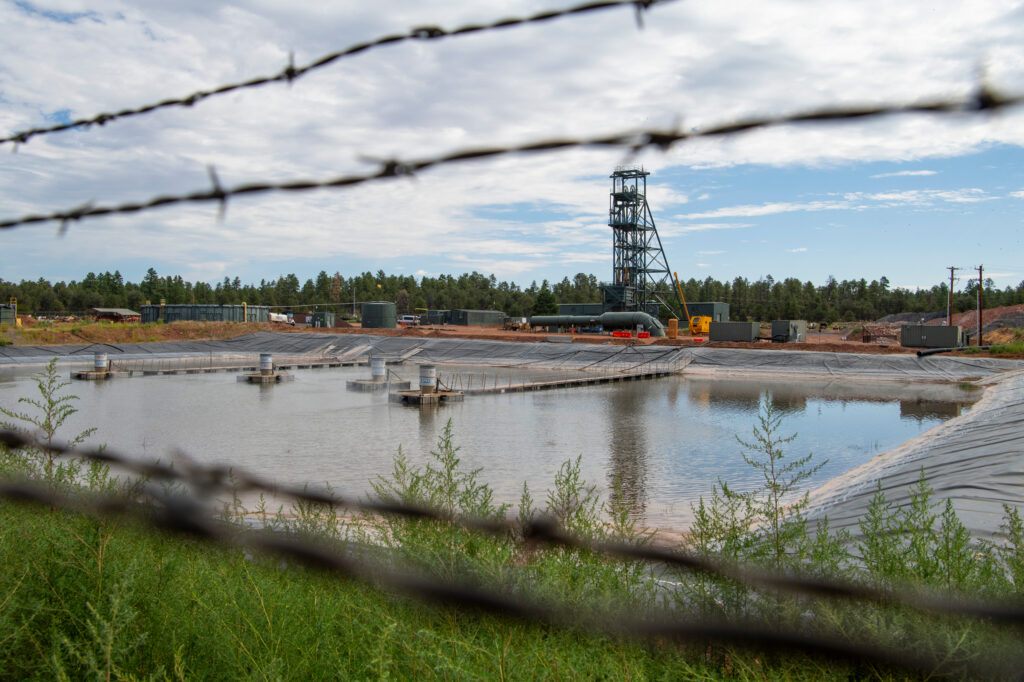
Three of four wells across the Grand Canyon region that have average arsenic levels above the Environmental Protection Agency’s standard for safe drinking water are at the site of a controversial uranium mine, a new analysis of groundwater sampling shows.
The analysis from the Grand Canyon Trust, a nonprofit advocating for protection of the canyon and the Colorado Plateau, relied on 32 years of groundwater sampling across 40 sites from the U.S. Geological Survey and the Arizona Department of Environmental Quality. The Pinyon Plain Mine, where the contaminated wells are located, lies within a national monument just nine miles away from the South Rim of the Grand Canyon.
The heightened arsenic levels at the mine site are not a coincidence, Misael Cabrera, senior vice president of environment, safety and sustainability for the mining company, Energy Fuels Resources Inc., said, as arsenic is found in highly mineralized areas, like at the Pinyon Plain Mine site.
“We don’t get to choose where we put a mine,” he said. “Nature puts the minerals in certain locations, and then if we want to harvest those minerals, we have to go to those locations.”
Cabrera was the director of the Arizona Department of Environmental Quality when the mine was being permitted.
It is the latest dispute in a months-long debate over the rising arsenic levels, what is increasing them and whether the contaminant is at risk of spreading throughout the region. Pinyon Plain mine—located within the Baaj Nwaavjo I’tah Kukveni—Ancestral Footprints of the Grand Canyon National Monument, is one of the country’s first new uranium mines driven by a resurgence of interest in nuclear energy.
The analysis comes after ADEQ permitted Energy Fuels to raise the levels of arsenic at one of the mine’s monitoring wells that require the company to issue an alert about the contamination. That decision prompted outcry from local communities and researchers.
“Our opposition is not based on fear or politics,” said Havasupai Tribal Chairwoman Melinda Yaiva at a press conference announcing the findings. “It is based on our responsibility as a sovereign tribal nation to protect our people, our homeland and the water that makes life in Supai (the tribe’s village in the Grand Canyon) possible. Today, the immediate issue is arsenic.”
For years, the mine’s opponents have expressed concern it would contaminate the region’s groundwater. Research from hydrologists found the shallow groundwater aquifer the mine drills into is connected to the deeper, regional aquifer. Reviews by the U.S. Geological Survey and the Environmental Protection Agency followed and found more research is needed to understand if the mine site poses a threat to the region’s water quality.
Cabrera said no data shows there is a risk for the mine’s water to spread.
“Despite all of the evidence that we have on record, despite all of the regulatory approvals, despite the multiple court cases, we are still being assumed to be guilty before proven innocent,” he said. “We really need to reflect on that as a country if we want to be able to produce our own energy without relying so heavily on foreign sources.”
He likened the current situation to looking at a traffic map of Arizona, where major cities like Phoenix would have the most congestion. “In the same vein, you are going to have higher levels of minerals” like arsenic at mine sites.
Laura Crossey, an emeritus professor of earth science at the University of New Mexico, who for decades has researched the hydrogeology of the Grand Canyon, has a traffic analogy as well. Dismissing data showing the aquifers are connected and that contamination can spread is “like studying the traffic pattern of Phoenix by only looking at the side streets and ignoring the interstates that move through, that are carrying much higher volumes, much higher speeds.”
This story is funded by readers like you.
Our nonprofit newsroom provides award-winning climate coverage free of charge and advertising. We rely on donations from readers like you to keep going. Please donate now to support our work.
One monitoring well at Energy Fuels’ Pinyon Plain Mine exceeded permitted alert levels for arsenic four times since 2025, before the company applied to amend its permit to allow for higher levels of arsenic. The groundwater in the mine’s sump is over 3,000 times the limit for arsenic in drinking water. At the mine’s monitoring wells, the water is nearly two, three and six times the safe drinking water levels of arsenic, respectively.
“This is a kind of a failure in the monitoring program and the regulatory process, because at the present time, we don’t really know why the arsenic is rising, because it hasn’t been thoroughly investigated,” said Brad Esser, a retired environmental radiochemistry researcher at Lawrence Livermore National Laboratory.
If the mine’s evaporation pond is leaking, it can be patched. If the groundwater pumping is changing the hydrologic flow, then limits can be placed on the pumping. But without a definitive study and answer to what’s causing the increasing levels of arsenic, a mitigation plan can’t be put in place, he said.
ADEQ and the company have claimed the arsenic issue is natural, and not due to mining. They attribute the rising arsenic levels to its groundwater pumping causing a “cone of depression” around the well that is drawing in water with more naturally occurring arsenic from further reaches of the aquifer.
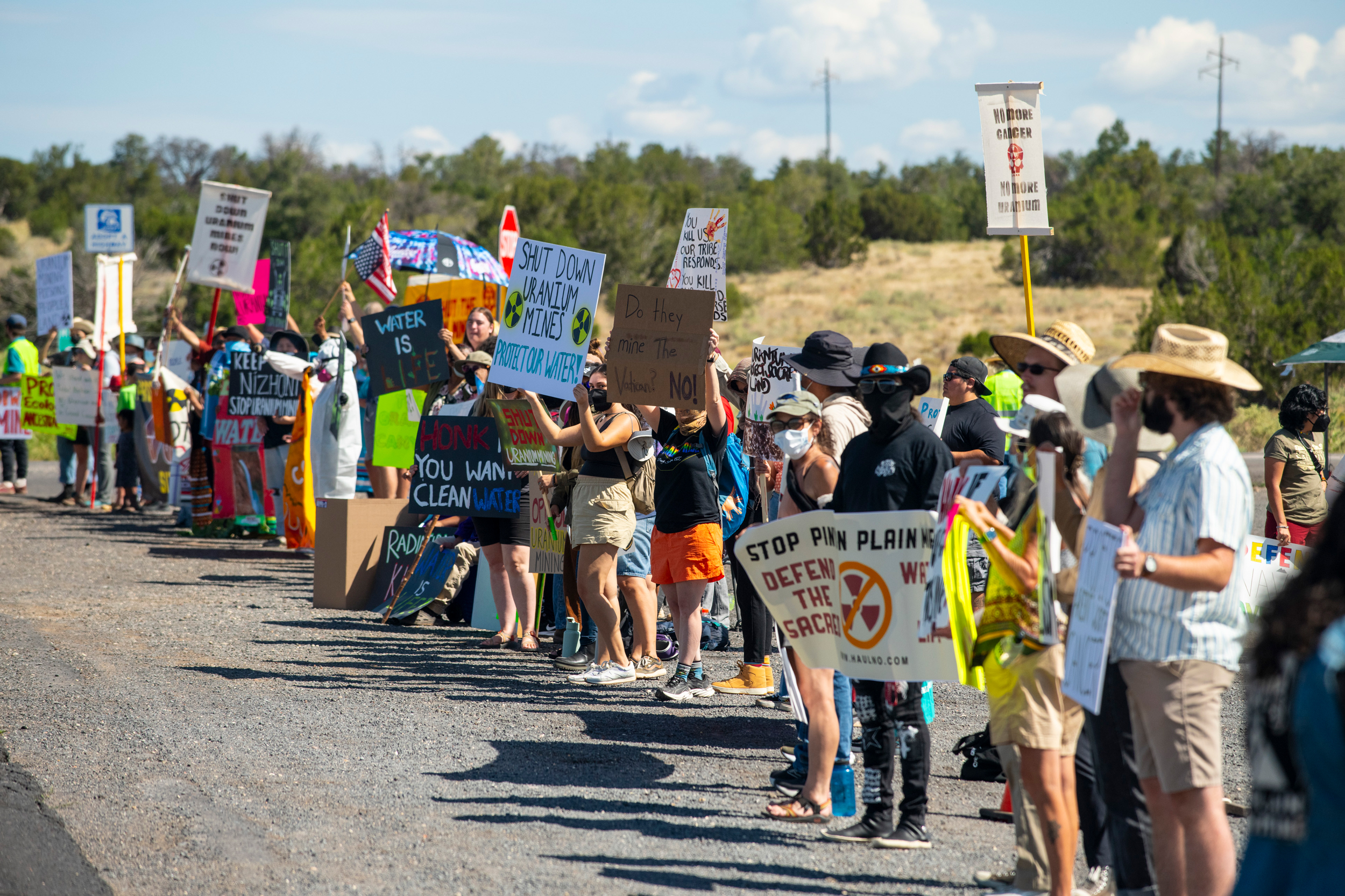
Critics have questioned that claim and said more data was needed to prove it before permitting higher arsenic alert levels. The analysis of regional arsenic levels in groundwater, they say, shows the company and ADEQ’s hypothesis is wrong.
“If arsenic concentrations in groundwater outside the mine are lower than inside, how can drawing low concentration outside increase the already high and increasing arsenic concentrations inside the property,” asked Dave Kreamer, emeritus professor of hydrology at the University of Nevada, Las Vegas. “You would think that adding cleaner water, groundwater from outside, shouldn’t it dilute the high concentrations inside? I’ve been asking this question of ADEQ monthly since June 1, and have not got an answer yet.”
Most at risk is the Havasupai Tribe, whose reservation is in the Grand Canyon. Its only source of water is Havasu Creek, which is directly fed by the regional Redwall-Mauv aquifer—the deeper regional groundwater supply.
The tribe has objected to ADEQ raising the allowable arsenic levels at the mine site, and appealed the decision. That appeal was dismissed by the agency’s appeals board, which concluded the tribe lacked standing. Yaiva said the tribe is considering what other options it has, including legal ones.
Something Havasupai children are taught at birth, Yaiva said, is that water is sacred. Havasu Creek, located on the tribe’s reservation and famed for its vibrant blue-green waters, is not just a beautiful place, she said. “It is the lifeblood of our homeland.”
“Our people drink this water,” she said. “We cook with it. We grow food with it. We care for our animals with it, and depend on it every day. It is also part of our ceremonies, our traditions, and our culture, and our identity as Havasupai people. Our relationship with this water goes back generations, long before the state of Arizona existed, long before the federal government approved the uranium mining near our homeland.”
About This Story
Perhaps you noticed: This story, like all the news we publish, is free to read. That’s because Inside Climate News is a 501c3 nonprofit organization. We do not charge a subscription fee, lock our news behind a paywall, or clutter our website with ads. We make our news on climate and the environment freely available to you and anyone who wants it.
That’s not all. We also share our news for free with scores of other media organizations around the country. Many of them can’t afford to do environmental journalism of their own. We’ve built bureaus from coast to coast to report local stories, collaborate with local newsrooms and co-publish articles so that this vital work is shared as widely as possible.
Two of us launched ICN in 2007. Six years later we earned a Pulitzer Prize for National Reporting, and now we run the oldest and largest dedicated climate newsroom in the nation. We tell the story in all its complexity. We hold polluters accountable. We expose environmental injustice. We debunk misinformation. We scrutinize solutions and inspire action.
Donations from readers like you fund every aspect of what we do. If you don’t already, will you support our ongoing work, our reporting on the biggest crisis facing our planet, and help us reach even more readers in more places?
Please take a moment to make a tax-deductible donation. Every one of them makes a difference.
Thank you,

Reporter, Phoenix
Wyatt Myskow covers drought, biodiversity and the renewable energy transition throughout the Western U.S. Based in Phoenix, he previously reported for The Arizona Republic and The Chronicle of Higher Education. Wyatt has lived in the Southwest since birth and graduated from Arizona State University with his bachelor’s degree in journalism.
