


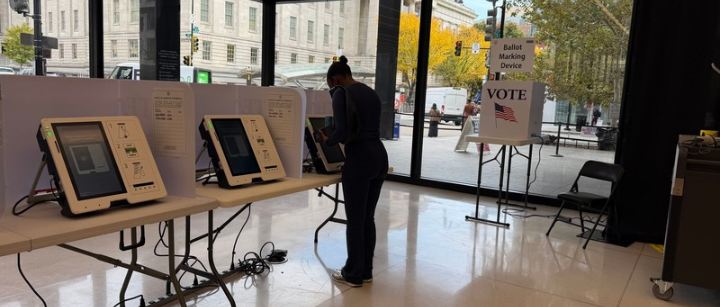
Q: Are voting machines changing Democratic votes to Republican votes? Several posts on Facebook are making that claim.
A: There is no evidence that touchscreen voting machines are deliberately switching voter selections. Rather, elections experts and state election officials have said that reported issues of machines initially not recording votes correctly are a result of familiar machine calibration issues or voter error. Also, nearly the entire country votes in a manner where voters review a paper ballot before having their votes officially cast.
FULL ANSWER
Several readers have asked us about social media claims that electronic voting machines have changed votes in multiple states. The claims started spreading last week.
Various social media posts have mentioned the issue in Texas, South Carolina and Tennessee, among other states, with some posts linking to news stories about voters complaining of this happening. All of the social media posts we reviewed cited incidents in which voters said their intended Democratic votes had been changed to Republican votes on the touchscreen, or didn’t specify how the votes had been changed.
On Oct. 21, WSMV-TV in Nashville reported that multiple early voters were experiencing problems with electronic voting machines incorrectly marking their intended choice.
The issue saw a surge in popularity after Stella Parton, sister of the late Dolly Parton, took to Facebook on Oct. 21 to complain that she “had to go back three times and correct my vote because it kept defaulting to Marsha Blackburn.” Blackburn, a Republican senator from Tennessee, is running for governor of the state against Democrat Jerri Green. The Cook Political Report rates the race as solid Republican.
While several social media posts we reviewed didn’t say machines were deliberately switching votes, that’s the impression some of our readers got, or the suggestion others on social media have made. However, elections experts and state election commissions have disputed that, saying the problem is likely a common touchscreen calibration issue or a result of human error.
David Becker, executive director and founder of the Center for Election Innovation and Research, portrayed the issue as a familiar one during a press briefing on Oct. 22: “2022, 2020, 2018, 2016, 2008. I mean, every election we get these smattering of vote-flipping claims,” he said.
Becker explained that for some jurisdictions – including some in Tennessee – ballots are still processed using a direct recording electronic machine, an older version of touchscreen, which “can sometimes have a little bit of calibration problems.”
However, he said, for more common modern touchscreens on ballot marking devices, “almost all of the claims of vote-flipping are understandable human error.”
We reached out to the Tennessee secretary of state’s office about these claims, but we haven’t received a response.
However, in a statement to WSMV-TV in Nashville, State Coordinator of Elections Mark Goins explained: “It’s not a vote-flipping situation. It’s normally like an unintended touch that they may not even realize.”
Goins said that there are multiple safeguards between the candidate being selected on the machine and the ballot being processed. Voters see a review screen of their selections before printing out their ballots. After the machine prints the filled-out ballot, it can be reviewed before it is deposited into the scanner and counted.
“The votes aren’t being counted on the screen. … They’re actually being counted on that paper ballot that’s going in the scanner,” Goins told WSMV-TV. “For you to vote for a candidate that’s not supposed to be voted for, every one of those checks and balances along the way are going to have to fail.”
Becker also voiced Goins’ reassurances about safeguards, explaining that if your printed ballot doesn’t match your intended selections, you can “spoil it and vote a regular ballot again.”
Justin Levitt, a law professor at Loyola Marymount University and an election law expert who served during the Biden administration as the White House’s senior policy adviser for democracy and voting rights, told us that he had “heard a few reports of a few instances in which touchscreen machines were apparently having difficulty registering individuals’ choices, and registering other choices instead,” citing a news report from Tennessee about voters raising such concerns.
Levitt explained that this issue isn’t unfamiliar, and “these stories always end up showing that the touchscreens aren’t quite precisely calibrated.” He suggested that if a voter encounters an issue, “the fix is easy: pay attention when the system asks you to verify that your choices are correct, and if you’re having difficulty, bring it to the pollworker or precinct inspector’s attention.”
Andrew Appel, a professor emeritus of computer science at Princeton University and an electronic voting security expert, echoed Levitt’s remarks. “This happens, in a few places, every couple of years,” he said. “It is typically a touchscreen calibration issue. It is unlikely to be malicious hacking, because a hacker who wanted to steal an election would use a method that voters couldn’t notice.”
Appel explained that a more plausible cheating attempt would be to hack the voting machine to display the chosen selection but print an incorrect ballot, since “93% of [voters] don’t look at the paper closely enough to notice an error if one would occur there.”
Election officials in South Carolina and Texas, two states that also have been mentioned in social media posts, told us that there was no “systematic issue with the touchscreens” or that they hadn’t received reports of supposed vote-switching.
The South Carolina Election Commission told us in a statement: “It is common to receive reports of unintended selections on touchscreens, particularly during statewide elections with high turnout. As with any touchscreen, unintended selections can occur for a variety of reasons. At this time, there is no indication of a systematic issue with the touchscreens. We encourage voters to make their selections carefully and review their choices throughout the voting process. … The voting process includes multiple safeguards to help ensure voter intent is accurately captured, including on-screen indicators of selections, opportunities to review and correct choices before printing, and a final review of the printed paper ballot before it is cast.”
Alicia Pierce, assistant secretary of state for communications in Texas, told us: “I am not aware of anyone reporting this experience to our office. As a note, as of this election Texas does not use direct recording electronic voting machines, with the rare exception if a machine is needed to accommodate a voter with disabilities. Instead, any machines must produce a human-readable paper ballot that a voter can review before casting. We encourage all voters to review their choices before finally casting their ballot.”
“It’s not mysterious, or nefarious,” Levitt said, “it’s just a question of a pressure-sensitive screen being over- or under-sensitive for particular users. And it can be readily addressed if voters just let the officials in charge of the polling place know about it.”
According to Verified Voting, a nonprofit that researches election technology, only 1.3% of registered voters — those who live in Louisiana — use electronic voting machines to record votes without ever seeing a paper ballot. A slightly larger percentage of voters, including those residing in certain counties in Tennessee, among other states, are given a Voter Verified Paper Audit Trail, where they can review a paper ballot before confirming their selections on the machine. VVPAT’s can also be used for recounts.
However, the vast majority of the nation votes directly with a paper ballot, or uses a voting machine to print out a ballot, which voters can then review before depositing into a scanner that actually counts the votes.
Editor’s note: FactCheck.org does not accept advertising. We rely on grants and individual donations from people like you. Please consider a donation. Credit card donations may be made through our “Donate” page. If you prefer to give by check, send to: FactCheck.org, Annenberg Public Policy Center, 202 S. 36th St., Philadelphia, PA 19104.
