


A known risk. Soybean processing plants have a documented history of explosions because of leaked Hexane, a flammable substance. ADM itself identified in 1997 a scenario similar to what preceded the explosion in September 2023.
Training questions. It’s unclear how much training ADM provided its plant workers. It allowed one employee to complete a complicated procedure from memory, and another employee told OSHA he was unaware of critical safety equipment.
Stonewalling. ADM prevented OSHA from interviewing an expert the company hired to investigate the cause of the fire, which is still publicly unknown. A former Department of Labor attorney said OSHA could have fought harder for answers.
The smell was stronger than normal.
Yoan Heredia had breathed in the flammable Hexane gas before. In the building he supervised on the sprawling Archer Daniels Midland campus in Decatur, Illinois, workers regularly encountered the gasoline-like odor. That was because the Fortune 500 company used Hexane to transform raw soybeans into a cooking staple, vegetable oil. Usually, its presence wasn’t cause for concern to the ADM employees.
But, roughly an hour into a night shift on Sept. 10, 2023, Heredia noticed something troubling — the smell was “so bad I felt lightheaded and slightly confused,” he later told federal investigators. On the radio, there was a call to “get out.”
“That’s all I remember,” he later said.
OSHA records document ADM supervisor Yoan Heredia’s account of smelling hexane gas shortly before the explosion that left him severely injured. Document obtained by Investigate Midwest through a public records request
An ambulance rushed him to a local hospital, where he was then flown to a trauma burn unit in Indianapolis, 175 miles away. When he regained consciousness two days later, he awoke to burns on his “whole face,” his sister-in-law told the local paper.
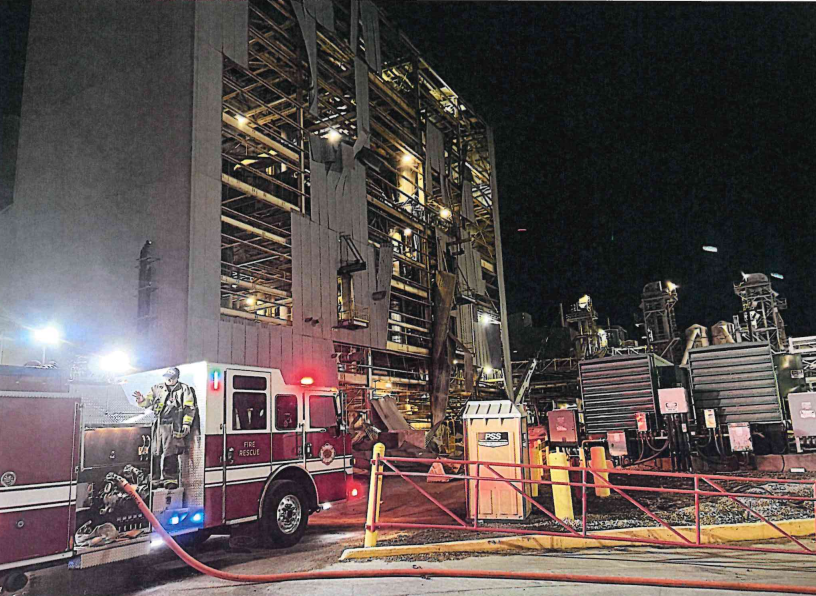
Heredia was one of eight people who suffered severe injuries from the explosion at ADM’s flagship plant that night. The blast tore open a building’s entire side, and it knocked the company’s soybean processing operation offline for at least several months.
After the incident, ADM posted regular updates on its website about its employees’ conditions. However, the company did not offer any details or information explaining the cause of the explosion, despite Decatur’s U.S. Congressional representative, Nikki Budzinski, saying publicly, “We need answers.”
Federal records obtained by Investigate Midwest offer the clearest picture yet of ADM’s lack of safety oversight at the Decatur plant, which government investigators say paved the way for the potentially deadly threat of leaked Hexane gas.
ADM’s safety training at the Decatur facility was poor, the Occupational Safety and Health Administration found: It provided incorrect guidance about a crucial piece of safety equipment; a longtime supervisor performed a complicated procedure that preceded the explosion by “memory”; and a newly hired supervisor was unaware of important safety tools. It all contributed to Hexane escaping containment.
An alarm detected the leaked gas roughly an hour before the explosion and workers noted Hexane’s presence, but no evacuation order appears to have been given in time, according to OSHA records.
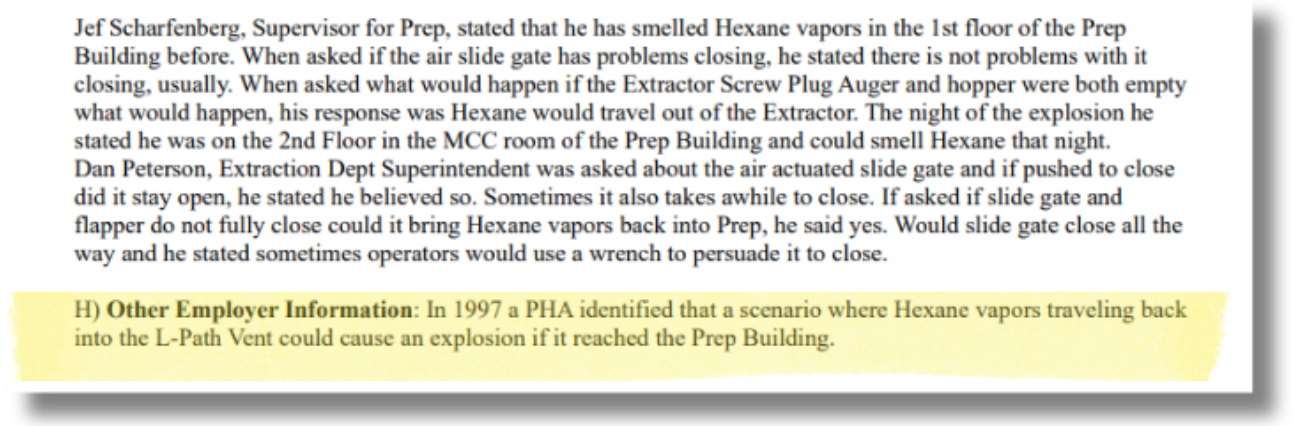
ADM has known for decades leaked Hexane posed a risk. In internal safety documents from 1997, the company identified it as a threat. There were also examples from other companies in the soybean processing industry that showed the consequences of mishandling safety protocols. In 1994, a blast at an Indianapolis plant injured 15 people. In 2003, two people died in an explosion at an Iowa facility.
Investigate Midwest asked John Newquist, a former longtime OSHA official, to review the federal records related to ADM’s Decatur facility and provide feedback based on his years of agency experience. The documents’ redactions limit a full understanding of OSHA’s findings. However, the available records were enough for Newquist to conclude the Decatur explosion was preventable.
“This wasn’t a freak accident,” he said. “The hazard was known, the safeguards meant to stop it were unreliable, and there were warning signs before the blast.”
Investigate Midwest first contacted ADM in mid-September. Its spokesperson, Jackie Anderson, has not returned more than a dozen emails since then, and several calls to her phone number on the company’s website have not been returned. The Decatur facility’s communications manager, Dane Lisser, did not return multiple emails nor calls to his office and cell phone numbers. Neither returned requests for comment through LinkedIn, as well.
Over the past several years, OSHA has cited ADM’s Decatur facility multiple times for lax safety standards. In 2019, for instance, the agency found ADM did not properly maintain equipment that hoovered up dangerous grain dust. During the processing of soybeans and corn, dust is flung into the air. If it meets a spark, it blows. The poor maintenance had allowed large amounts of grain dust to build up, causing an explosion.
Poor maintenance was also at the center of an April 2023 dust explosion at the same plant, OSHA found. ADM had installed a system that could snuff out nascent fires. It was supposed to be inspected annually, but no one had since 2016. When this fire started, the system failed to work.
Initially, dust was thought to be the main reason for the September 2023 explosion that injured Heredia. After the explosion, ADM employees told firefighters they thought dust was the culprit. OSHA investigators eventually focused on leaked Hexane gas, though.
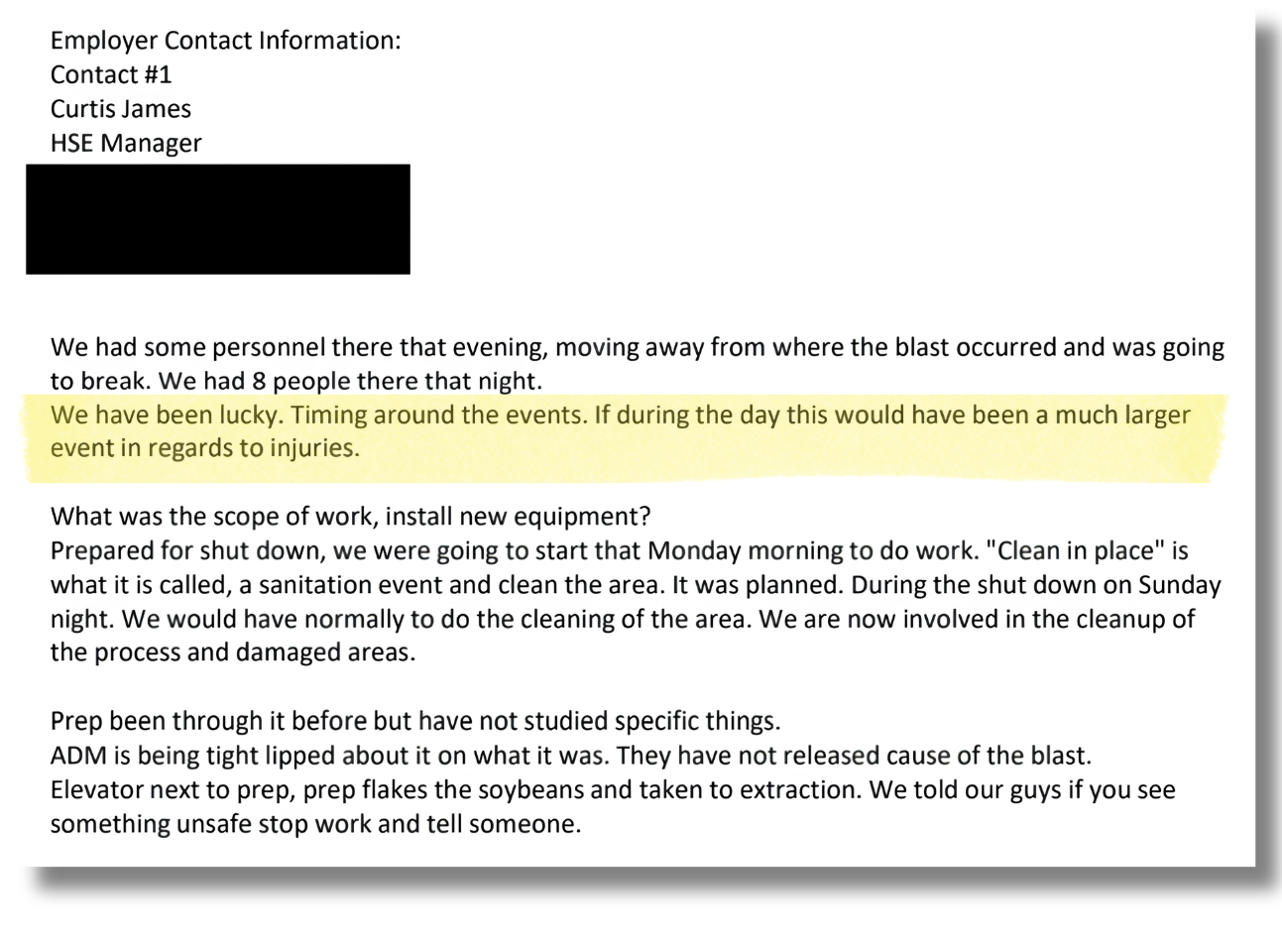
ADM is Decatur’s largest employer, and, during the day, about 4,000 people mill about the campus. Fewer people work the night shift, an ADM contractor told OSHA. “We have been lucky,” the contractor said. “If during the day [sic], this would have been a much larger event in regards to injuries.”
OSHA fined ADM $50,000 after conducting an investigation between September 2023 and March 2024. It cited four violations:
- Not maintaining accurate safety information for its employees;
- Not having “effective engineering and administrative controls” to prevent Hexane from leaking;
- Not adequately addressing “human factors” that can lead to blasts; and
- Not ensuring safety procedures were performed as written.
All the citations related to ADM’s “process safety management,” which, per OSHA requirements, is a standardized approach companies must create that prevents the release of hazardous materials. OSHA determined ADM’s management “had deficiencies … prevent(ing) the release of Hexane.” Safety management problems can “reasonably be predicted to result in permanently disabling injuries and/or death,” OSHA said.
OSHA closed the case this January, making the investigative file available. Investigate Midwest filed a Freedom of Information Act request in March seeking a copy.
ADM contested the fine, which was ultimately reduced to about $25,000. The second and third violations — related to ADM’s administrative controls — were dropped. The records provided to Investigate Midwest do not state why.
Dennis Cooper, a member of the Decatur City Council, worked part-time at ADM for about a decade. Cooper always felt safe in the facility and said he’s glad a major company has its North American headquarters in town.
But he also feels the fine OSHA imposed was too low.
“I feel the fine should have been higher with that type of incident, the negligence that they found, and with the company making the amount of money that ADM makes,” Cooper said. “That fine was just a slap on the hand. … We want people to know that if they go to work, most likely they will come home each night to their families.”
Safety gaps before blast
When Heredia arrived for work at 6 p.m. on Sept. 10, 2023, he and others stepped, unknowingly, into a risky environment, according to the OSHA records. With a wife and two young daughters, Heredia had started at ADM in April 2023. That night, he was supervising a scheduled maintenance shutdown, and nothing seemed amiss. “Everything was as usual,” he later told federal investigators.
Because he was new, Heredia leaned on a more experienced employee, he told OSHA. Jeff Scharfenberg had worked at the plant since 1991, and he’d been a supervisor for almost two decades. Heredia told OSHA Scharfenberg was “knowledgeable and leading the shutdown for us due to my inexperience as a supervisor.”
Scharfenberg told OSHA he oversaw the shutdown without consulting written procedures that night. He was “good with memory,” he said. OSHA investigators wrote in their report that this showed “operating procedures were not followed.”
The two men had different responsibilities that night. Scharfenberg oversaw the “Prep Building,” where machines cracked soybeans open. The beans then fell onto a conveyor belt. Through a tunnel, the beans were transported into a different building. Heredia oversaw this area, called “extraction.” Here, the cracked beans tumbled into a tank filled with liquid Hexane. The substance, an ingredient in paint thinners, extracts the beans’ oil.
The buildings operated in lockstep, and both were being shut down. But it was a tricky procedure. It’s when “these plants are most vulnerable,” said Newquist, the former OSHA official.
To prevent injuries and deaths in situations like this, ADM was required to develop what’s called a “process hazard analysis” — a careful review of everything that could go wrong during a shutdown and the necessary safeguards. ADM had not examined how to perform the shutdown in a “step-by-step fashion,” which OSHA and Newquist said was critical.
The company’s analysis also failed to address a common issue in the extraction area, OSHA found. Employees regularly left doors open during warmer months, and at least one person was written up over it. Open doors risked allowing Hexane gas to escape and enter the Prep Building, where it could contact a spark. OSHA requires companies to mitigate “human factors” like leaving doors ajar, but ADM did not do so, the agency found.
Other safety issues were at play, as well. The extraction area had sensor alarms that alerted workers to increased levels of Hexane in the air, but the Prep Building lacked them because, technically, Hexane was not used there — despite company safety documents from 1997 identifying a leak into the Prep Building as a real risk. It’s also unclear how much training the employees had on mitigating Hexane risks.
Both were rectified after the explosion. OSHA required ADM to install alarms in the Prep Building and to mandate all plant employees attend two safety training sessions.
Scharfenberg still works for ADM, his LinkedIn profile shows, and declined to comment. Heredia, who left the company in summer 2024, did not return requests for comment.
Photos from the Decatur Fire Department show firefighters responding to the September 2023 explosion at ADM’s flagship plant in Decatur, Illinois, and the extensive damage left behind. Eight workers were injured in the blast. photos obtained by Investigate Midwest through a public records request
Wrong guidance provided
Something immediately went wrong after the shutdown began at 6:13 p.m.
When the buildings were up and running, there was little chance of Hexane gas leaking. So many soybeans traveled through the tunnel between the two buildings and emptied into the extraction tank that there was no room for gas to escape. However, during a shutdown, there were no soybeans in the tunnel. That meant a natural plug could disappear.
Two backups were designed to seal the tunnel and prevent leaks: a flap valve and a sliding gate. Both had problems.
The flap valve opened to allow soybeans to flow into the tank, and it closed to stop gas from leaving the tank. But, employees told OSHA, it regularly stuck open because processed beans were “caked on.” It was cleaned only once a year, OSHA found.
For the gate, ADM’s written guidance for employees stated it closed automatically after pushing a button. However, that wasn’t accurate, OSHA found. One of the Prep Building’s managers, Dan Peterson, told OSHA it took “awhile” for the gate to shut. Sometimes, he said, operators would use a wrench to “persuade it to close.” Peterson wasn’t working that night.
As Scharfenberg supervised the Prep Building shutdown, he told OSHA, he “didn’t know the status” of the extraction area. He was “not aware of (the flap valve) sticking.” He did know the gate needed to be closed manually, but he told OSHA there was “no problem with it closing usually.” Heredia told OSHA he didn’t know if there was a flap valve or a gate.
As the shutdown started, the gate was not closed.
Dangerous gas spreads
Five minutes later, at 6:18 p.m., a sensor alarm near the extraction tank detected large amounts of Hexane in the air. The sensor read 8.8%, eight times what ADM, internally, considered dangerous.
Apparently, no one noticed the alarm, but workers began to smell a gasoline-like odor. For Scharfenberg, it did not seem to trigger alarm bells. “I smelled a little bit of Hexane but not to the point it did what it did,” he told OSHA.
Others found it worrisome. Two employees of Austin Industries, an ADM contractor, walked into the Prep Building, breathed in Hexane and walked out. They told an ADM supervisor, OSHA found. An Austin Industries manager later told OSHA: “We told our guys if you see something unsafe, stop work and tell someone.” Austin Industries did not return requests for comment.
The OSHA records do not identify who the contractors reported to or what happened after they did so. “Nothing in the (OSHA) record shows an effective response, such as an evacuation,” Newquist said.
About 50 minutes after the alarm, at 7:11 p.m., the explosion ripped apart the building, knocked at least one person, Heredia, unconscious, and burned multiple workers’ bodies. One man suffered “multiple skull fractures” and would spend weeks in a medically induced coma, according to a lawsuit the injured employee filed.
Whether the gas leaked into the Prep Building because of the faulty backups or because doors were propped open — or both — is unclear in the records. Regardless, gas was present, and it found a spark, the source of which is not established in the OSHA records.
OSHA did determine that, at the same time as the explosion, an employee turned off a circuit breaker that controlled a piece of equipment in the Prep Building. The OSHA records do not say explicitly whether it malfunctioned. Later, the Decatur Fire Department identified operating equipment as the source of the fire.
The fire department, though, did not fully investigate the cause of the fire “because of the extensive damage to the facility,” then-fire chief Jeff Abbott wrote in an internal summary. A Decatur city spokesman, Ryan Huffer, declined to comment when asked whether this was normal procedure. The city also said the department had no fire investigators at the time, and it has no related “investigative records.”
Potential dangers lingered
In the aftermath, black smoke surrounded Scharfenberg, and his shirt sleeve caught fire, he told OSHA. He found two injured workers and got them to safety. He then returned to find others and led them to safety, he said.
The plant had a system to douse fires, but it had been out of service the two weeks prior. Instead, the backup system activated. About 10 minutes after the blast, Decatur firefighters arrived and found several areas in flames, according to city records.
With fires blazing, ADM representatives issued a warning to first responders. “ADM reps were telling me that another possible dust explosion was our biggest hazard,” one firefighter reported.
Some of the damaged buildings were inaccessible. But to prevent another fireball, ADM personnel told firefighters to hose down airducts, motors and a dust collector, according to city records. It took a couple hours to control the fire, and firefighters didn’t leave until the next afternoon.
Concern lingered for days. In an internal email about a week afterward, an OSHA manager told his colleagues: “There is still ongoing discussion regarding imminent danger due to grain dust.” Employees who worked in other parts of the Decatur plant that continued to operate after the fire could be at-risk, given the April and September 2023 explosions, the manager said.
“The soy operations may not be active at the moment,” he wrote, “but there is concern about other operations now that we’ve experienced 2 major grain dust explosions within 6 months.”
Two weeks after the explosion, OSHA inspectors could still not access some areas, according to the case file. One building’s basement had a “huge scorch mark,” and it was “not deemed safe” to enter, an inspector noted.
It’s unclear how long soybean processing stopped functioning, but it stretched into early 2024 at least. In a March 2024 interview with OSHA, Scharfenberg said it was still not operational: “Hopefully we rebuild and get up and running again.”
ADM lacks transparency
ADM didn’t fully cooperate with OSHA’s investigation, especially on one major question, according to OSHA’s records.
While ADM facilitated OSHA’s interviews with employees, the company prevented the agency from speaking with a longtime fire investigator the company hired. About two months after the explosion, OSHA requested to interview Doug Rayburn, the owner of Rayburn Fire Scene Investigations, based in Orland Park, Illinois.
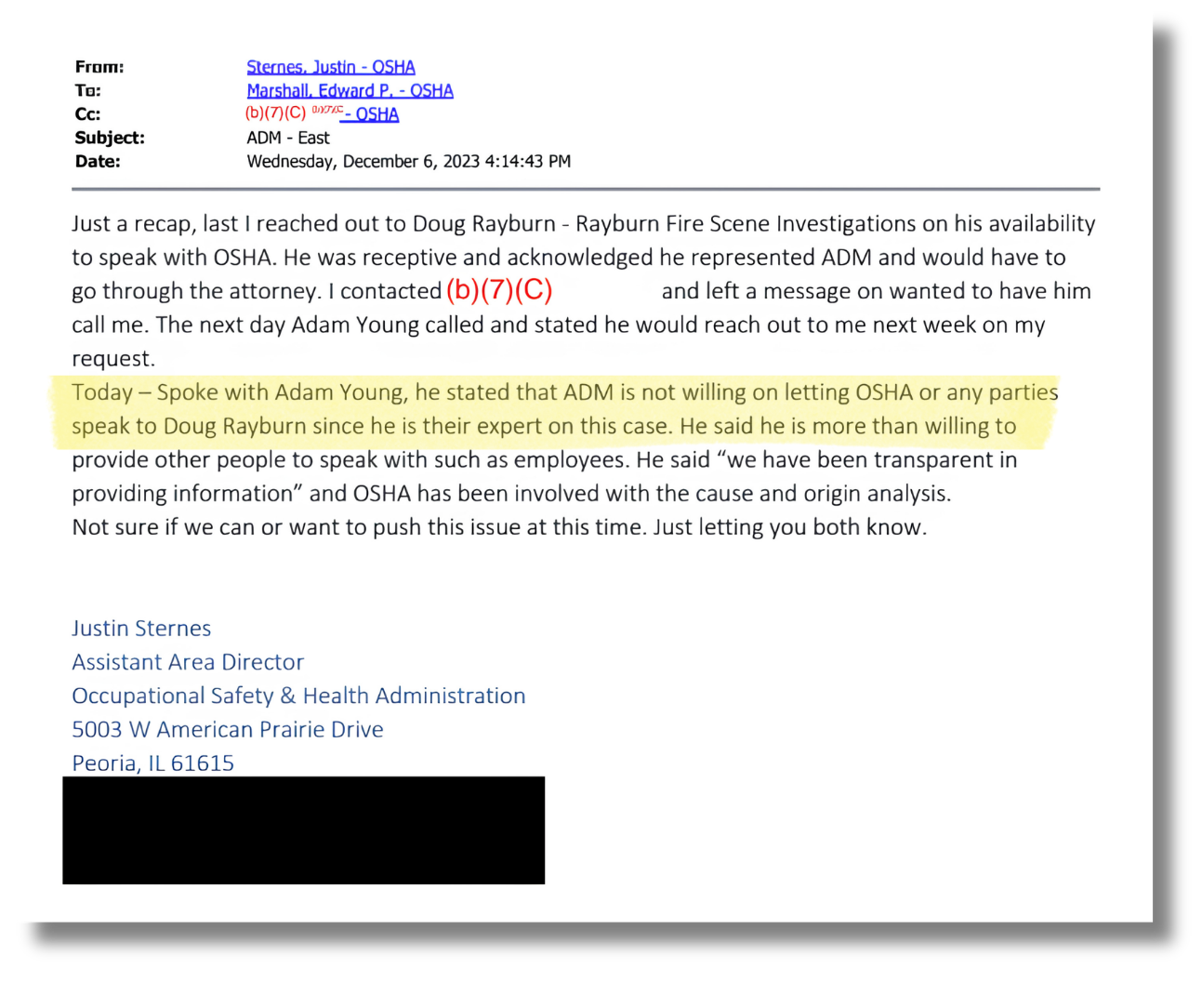
In an email to his boss, an OSHA investigator described his meeting with Adam Young, ADM’s attorney: “ADM is not willing” to let OSHA interview Rayburn because “he is their expert.” Young added, according to the email, “We have been transparent providing information.”
To the OSHA investigator, it seemed unclear whether the agency could compel ADM to share Rayburn’s findings. “Not sure if we can or want to push this issue at this time,” he told his boss. If his boss responded, it is not in OSHA’s records.
Ann Rosenthal worked as an attorney for the U.S. Department of Labor, including OSHA, for more than 35 years. During an investigation, she said, OSHA can subpoena anyone with relevant information.
“They could have done more (to obtain all the relevant information),” she said. “They could have fought harder. … OSHA did not do an adequate inspection by not trying harder to talk to the expert.”
But providing proper oversight might have required resources the agency did not have, she said. The agency had 736 inspectors as of summer 2025, a historically low figure, and the Trump administration’s proposed budget calls for even fewer. Few federal attorneys — coupled with DOGE forcing experienced staff out and a federal hiring freeze — means heavy caseloads, she explained.
Rosenthal noted OSHA could have pursued a “willful” violation, given the Decatur plant’s history of safety issues. During its investigation into the April 2023 explosion, OSHA noted the plant’s rash of incidents and levied a “willful” violation against ADM. The result was a much larger fine. However, companies can dispute OSHA fines, and ADM and the agency are still negotiating a settlement.
ADM did not return requests for comment about why it blocked OSHA from interviewing Rayburn. Young, ADM’s attorney, did not respond to a request for comment. Rayburn, the fire investigator, did not return requests for comment.
Investigate Midwest contacted OSHA multiple times about this incident, and each time the agency said it was working on a response. However, it did not provide a comment by publication.
Calls for transparency
Three years since the explosion, ADM has not released any information about its cause and has not shared any updates with Decatur leaders, according to Cooper and David Horn, another city council member.
Horn said Decatur is proud to have ADM in town, but he thinks the company could be more transparent about how it’s addressing safety concerns.
“It’s the lack of reassurance both to the city as a whole and to the elected officials,” Horn said. “There’s an opportunity to have a better open dialogue, and I feel that will be an opportunity for ADM to strengthen its reputation with the residents of the city.”
Investigate Midwest shared OSHA’s findings with every member of the Decatur City Council. Only Cooper and Horn agreed to interviews.
In the days after the 2023 explosion, U.S. Representative Nikki Budzinski, a Democrat who represents the Decatur area, called for a “thorough” investigation into the explosion. She told the Decatur Herald & Review, the town’s newspaper, that it needed to be “comprehensive so that we can really get the real answers so this never happens again.”
In a statement to Investigate Midwest, Budzinski said it’s essential that OSHA has the power to hold companies accountable for safety lapses.
“While OSHA’s findings and citations deliver the clarity we sought regarding safety breakdowns that occurred,” Budzinski said, “our neighbors and workers shouldn’t have to wait for essential safety information.”
This story started with a Freedom of Information Act request I filed in March 2026. I’d written about the September 2023 explosion at the ADM’s Decatur facility before, but there was actually very little information available about how exactly the explosion happened. When I received the records in early September of this year, I read through them and tried to interview the people involved and affected by the explosion. I also interviewed experts who have worked at OSHA for years.
Interviews/statements
Emailed analysis from John Newquist, former OSHA official, Sept. 21, 2026
Interview with David Horn, Decatur City Council, Sept. 22, 2026
Interview with Dennis Cooper, Decatur City Council, Sept. 24, 2026
Emailed statement from U.S. Rep. Nikki Budzinski’s office, Sept. 25, 2026
Interview with Ann Rosenthal, former DOL attorney, Sept. 30, 2026
Emailed statement from Ryan Huffer, City of Decatur spokesperson, Oct. 5, 2026
Public records
OSHA investigation into Archer Daniels Midland
OSHA investigation into Austin Industries
Decatur Fire Department narratives
Decatur Fire Department photos
Government releases
“US Department of Labor investigation finds ADM failed to inspect, test critical safety systems in explosion that injured 3 workers at Decatur facility,” OSHA press release, Oct. 18, 2023
“US Department of Labor’s Top Management and Performance Challenges,” DOL Office of Inspector General, January 2026
“Process Safety Management,” OSHA website, undated
“Hazard Recognition,” OSHA website, undated
“Hexane,” PubChem website, undated
OSHA Inspection Detail, Inspection: 1696750.015
Company releases
“ADM Statements Regarding East Plant Incident,” ADM website, last updated Sept. 25, 2023
“Major Employers,” Economic Development Corporation for Decatur and Macon County website, undated
News stories
“Explosion at Indy feed mill,” UPI, June 28, 1994
“5 workers remain hospitalized after explosion at ADM plant in Decatur,” Decatur Herald & Review, Sept. 11, 2023
“Budzinski on ADM blast: ‘We need answers,’” Decatur Herald & Review, Sept. 11, 2023
“ADM rethinking Decatur expansion as demand for plant-based protein falls,” Chicago Business Journal, Oct. 25, 2023
“‘I know I have a dust problem’: ADM repeatedly failed to prevent potentially deadly grain explosions,” Investigate Midwest, May 21, 2025
“Archer Daniels Midland,” Fortune, undated
