


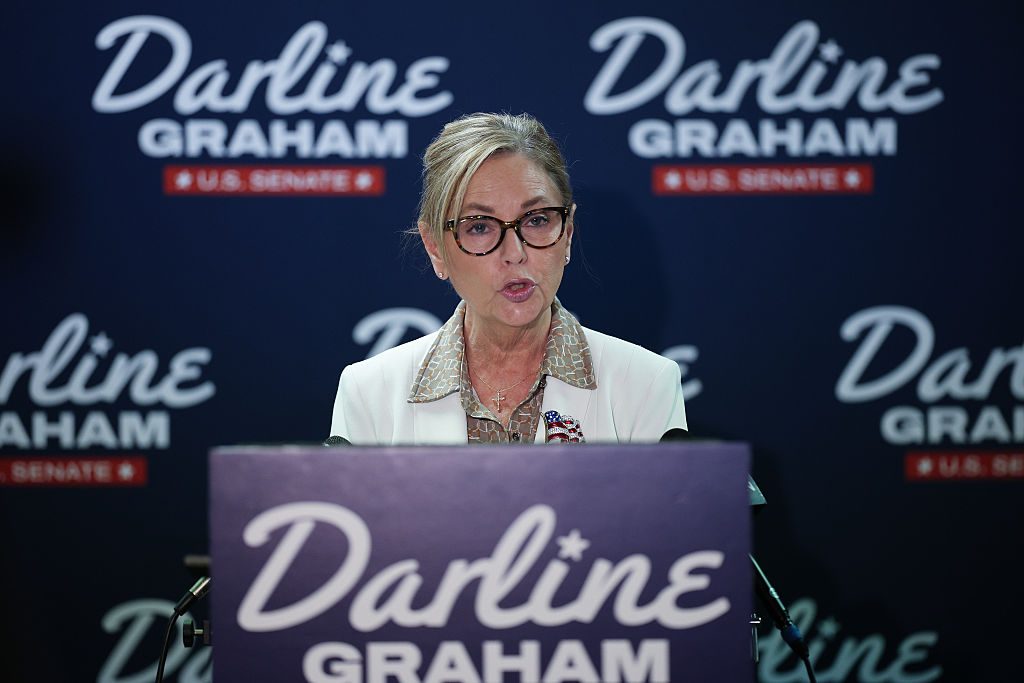
Sen. Darline Graham entered the homestretch at a severe financial disadvantage after entering the South Carolina race against Annie Andrews in the summer. (Photo by Win McNamee/Getty Images)
Late entries. Steep head starts in fundraising for their opponents. Very different results.
For the candidates who entered House and Senate races midstream, their initial quarterly campaign finance filings reveal a notable divide. One completely erased his established opponent’s multimillion-dollar head start. The other two have raised only a fraction of their opponents’ totals.
Maine Democratic Senate nominee Troy Jackson raised $26.6 million since July 7, according to an OpenSecrets analysis of Federal Election Commission disclosures as of Oct. 26 – surpassing Republican Sen. Susan Collins’ total of $21.9 million raised since January 2025.
But in two other races marked by late changes to the ballot, the fundraising picture looks drastically different: In South Carolina, Republican Sen. Darline Graham has raised about one-thirteenth of what her Democratic opponent, Annie Andrews, has. In North Carolina’s 11th District, the gap is even wider: Republican Jennifer Balkcom has raised about one-fifteenth of Democrat Jamie Ager’s total.
University of Maine political scientist Mark Brewer said the Maine race is “night and day compared to” South Carolina’s, calling it “an interesting contrast.”
For Graham and Balkcom, the short timelines have come with significant challenges. Specifically, it has been tough for Balkcom to introduce herself to voters, said Chris Cooper, a political science professor at Western Carolina University. Served by media outlets scattered across multiple states, the district in the state’s western mountains is “just a tough place to run a quick campaign,” he said.
But candidate fundraising tells only part of the story. Super PACs and other outside groups have spent $183.8 million so far across the three races, including the primaries and spending on candidates no longer running, according to an OpenSecrets analysis of the FEC’s outside spending disclosures as of Oct. 26. Roughly three-quarters of it was spent opposing a candidate.
OpenSecrets reached out to the campaigns of all three candidates. Jackson’s team pointed to a news release, and Graham’s and Balkcom’s did not respond. OpenSecrets’ figures reflect net amounts, which subtract refunds, offsets and loan repayments, and may differ slightly from the totals on the FEC’s website.
In Maine’s Senate race, individual donors power Jackson
Jackson, a former state Senate president, entered the battleground Senate race after populist nominee Graham Platner (D) dropped out in early July amid a sexual assault allegation. He won the nomination at the party’s special convention later that month, capping a whirlwind process that Brewer characterized as “unprecedented.”
“I don’t want to call it a circus, but [consider] how much of a wild ride the Platner campaign was, which was unlike anything I’d ever seen in Maine before,” Brewer said. “And then when it all came kind of falling apart, how are the Democrats going to react and put it together? And the fact that they were able to do that and pull it off in [a] short period of time without a whole lot of glitches was pretty impressive.”
(function(){function e(){window.addEventListener(`message`,function(e){if(e.data[`datawrapper-height`]!==void 0){var t=document.querySelectorAll(`iframe`);for(var n in e.data[`datawrapper-height`])for(var r=0,i;i=t[r];r++)if(i.contentWindow===e.source){var a=e.data[`datawrapper-height`][n]+`px`;i.style.height=a}}})}e()})();
In a span of 108 days – from his campaign committee’s July 7 registration date through Oct. 23 – Jackson raised an average of about $246,000 per day to push his total past the amount Collins raised since January 2025. Individual donors have powered his fundraising, with $24 million in contributions accounting for 89% of his total. Of that, small-dollar donors – those giving less than $200 – have contributed $9.9 million (37%) of the total. A spokesperson for the Jackson campaign directed OpenSecrets’ request for comment to a news release it issued around the Oct. 15 filing deadline. That release said nearly 95% of the approximately 350,000 contributions it received during the quarter were less than $100, a figure OpenSecrets could not immediately independently verify.
Individual donors are also Collins’ largest source, but they account for a much smaller share. Their $15.3 million in donations represents 68% of her total, with the remainder coming from political action committees ($1.6 million) and other sources ($5.6 million), such as transfers from joint fundraising committees and the Republican Party. Just 12% of her total – $2.6 million – came from small-dollar donors.
Collins had $2.7 million in cash on hand as of Oct. 26 to $1.6 million for Jackson, who reported spending $25 million. And the $1.6 million her campaign received from PACs is nearly four times what Jackson’s campaign has raised from them.
Still, one question hovers over the race: How much does fundraising actually matter against Collins?
She won her last Senate race in 2020 despite being outraised by more than $45 million, in large part because outside groups historically have spent big to back her. In this race, outside money favors her nearly 2 to 1. Independent groups have spent $69 million as of Oct. 26 either supporting Collins or opposing Jackson, compared with $41.4 million to oppose Collins or support Jackson.
“Yes, this [fundraising] number is still eye-popping for Jackson,” Brewer said. “But if you look at the total money haul on each side, bringing in this outside money, Collins still has a significant advantage.”
Andrews leads S.C. Senate’s cash contest, but outside money favors Graham
The sudden, unexpected death of Sen. Lindsey Graham (R-S.C.) on July 11 from a tear in his aorta started a chain of events that led his younger sister to the Republican nomination. Three days after his death, President Donald Trump endorsed Darline Graham to fill his seat and Republican Gov. Henry McMaster appointed her later that day. Darline Graham then finished first in an Aug. 11 special primary election and defeated Ralph Norman in a runoff two weeks later to claim the nomination.
(function(){function e(){window.addEventListener(`message`,function(e){if(e.data[`datawrapper-height`]!==void 0){var t=document.querySelectorAll(`iframe`);for(var n in e.data[`datawrapper-height`])for(var r=0,i;i=t[r];r++)if(i.contentWindow===e.source){var a=e.data[`datawrapper-height`][n]+`px`;i.style.height=a}}})}e()})();
Andrews has raised $24.1 million compared with $1.9 million for Graham. The money also came from different places: Individual donors provided more than 97% of Andrews’ total ($23.6 million), with small-dollar donors accounting for 52% of the money. For Graham, $1.3 million came directly from individuals and PACs donated $524,000. Andrews had $2.3 million in cash as of Oct. 26, while Graham had $634,000.
But Graham has some other advantages: name recognition, and the fundamentals of South Carolina politics. With the exception of 1976, Republican presidential candidates have won the state every year since 1964. Trump took it by 18 points in 2024. No Democrat has won a Senate race there since 1998.
Andrews is “a good fundraiser, and I think she is the type of candidate who is very appealing to Democrats nationwide,” Cooper said. “Whether that’s enough in a state that is this red, I don’t know.”
Outside groups have filled much of the gap. Through Oct. 26, they have spent $9.6 million supporting Graham – five times her own fundraising. Security Is Strength PAC – which spent $3.8 million to support Lindsey Graham – has spent nearly the same amount backing his sister along with $3.5 million to oppose Andrews. In all, outside groups opposing Andrews have spent $8.4 million, and $3.8 million of that came from the Senate Leadership Fund. Groups supporting Andrews or opposing Darline Graham have spent $6.6 million.
Late nominee Balkcom faces 15-to-1 fundraising gap in N.C.’s 11th
Cooper called North Carolina’s 11th District “arguably the most interesting congressional race in the country” – one marked by a monthslong investigation into sexual harassment allegations against Rep. Chuck Edwards (R). Though he has denied the allegations, Edwards withdrew from the race Aug. 5 and was censured by the House. Five days later, North Carolina Republicans picked Balkcom, a state representative, to replace him on the ballot.
(function(){function e(){window.addEventListener(`message`,function(e){if(e.data[`datawrapper-height`]!==void 0){var t=document.querySelectorAll(`iframe`);for(var n in e.data[`datawrapper-height`])for(var r=0,i;i=t[r];r++)if(i.contentWindow===e.source){var a=e.data[`datawrapper-height`][n]+`px`;i.style.height=a}}})}e()})();
Much like Graham, Balkcom has not overcome her opponent’s significant fundraising advantage: Ager has raised $5.8 million, nearly 15 times the $387,000 raised by Balkcom. Individual donors make up 86% of Ager’s total ($5 million) but just a third of Balkcom’s ($128,000). Most of her fundraising ($212,000) came from PACs compared with 6% ($365,000) for Ager.
Ager had $620,000 in cash on hand as of Oct. 26 to $295,000 for Balkcom. Ager’s bid to become just the second Democrat since 1991 to win the district was aided when the Democratic Congressional Campaign Committee prioritized the race by placing it on its “Red to Blue” list.
“This just acts as a Bat-Signal for donors nationwide to say, ‘Send your checks here,’” Cooper said. “And the donors did.”
So have outside groups. They spent $16.3 million on the race as of Oct. 26, including $866,000 aimed at Edwards before he withdrew. Much – $7.6 million – was spent to oppose Balkcom. Conversely, $5.4 million was spent opposing Ager, and $5 million of that came from No Going Back PAC, a Trump-aligned super PAC. However, The Washington Sun reported Oct. 21 that the group has canceled future ad reservations in that district.
“So I think we’re going to see some real shifts,” Cooper said. “But judging just from my mailbox, I can attest there is plenty of outside money coming into this district.”
