


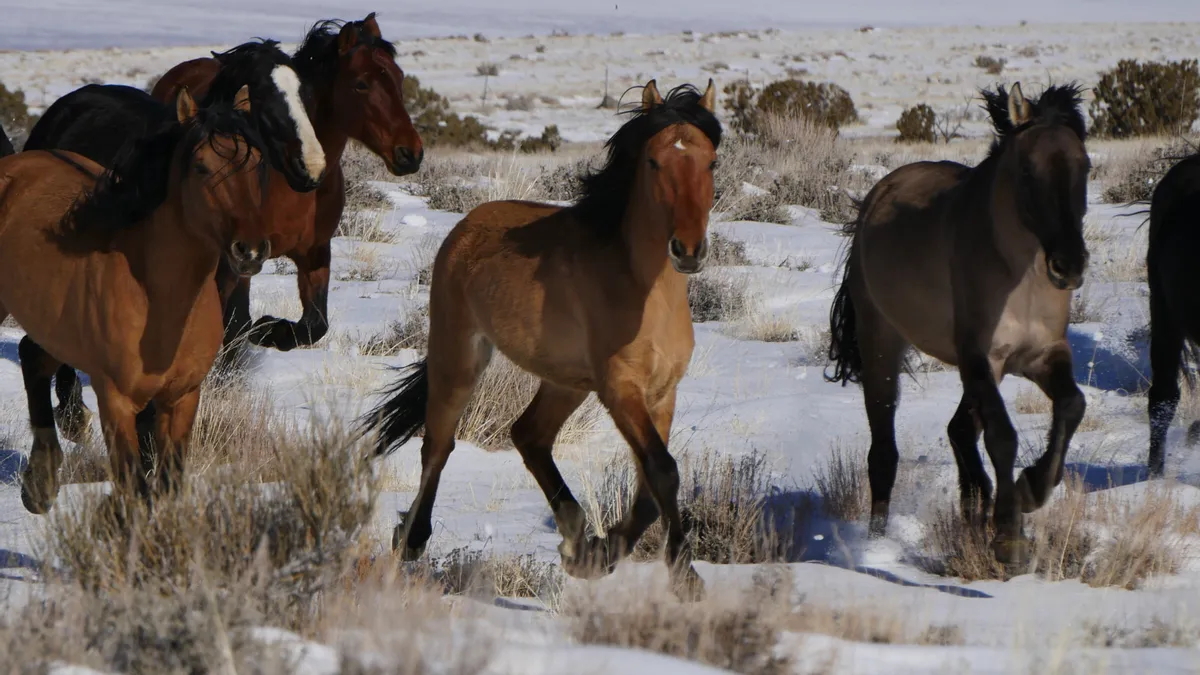
- The claim that the Trump administration uses a legal loophole to sell protected wild horses to slaughterhouses is still under investigation.
- The rumor stems from reporting by The New York Times in August 2026 and was backed by research by animal rights groups that suggested buyers of wild horses sold through the Bureau of Land Management’s Wild Horse and Burro Sale Program were transporting the animals overseas for slaughter.
- According to its website, it is BLM policy “not to sell or send any wild horses or burros to slaughter,” and buyers from the sale program sign a bill of sale saying they will not slaughter or sell for slaughter the animals they buy.
- The Times’ reporting brought to light a long-standing issue within the BLM about what to do with excess wild horses and burros. The bureau is bound by law to regulate populations but has historically avoided euthanizing healthy animals due to concerns about public perception.
- Though the Times provided very strong circumstantial evidence to suggest that some buyers did purchase horses from the BLM and sell them for slaughter, the article did not include primary evidence, such as ownership documents, pictures or videos, of the alleged transfers. Therefore, we leave this claim unrated.
- We contacted the Times journalist who wrote the article and an animal rights group that provided research to ask for additional evidence and await replies to our queries.
In August 2026, The New York Times published an investigation into the Bureau of Land Management’s sale of wild horses, titled “Under Trump, Protected Wild Horses Are Going to Slaughter.”
Synopses of the Times’ findings circulated widely online. For example, one Facebook page wrote (archived):
A heartbreaking investigation revealed that Trump’s Bureau of Land Management is systematically rounding up thousands of America’s wild horses, then quietly selling them off to buyers who are shipping them to slaughterhouses abroad. Before, the U.S. government rarely sold wild horses. But since Trump took office, government sales have more than doubled.
Versions of the claim also circulated on Threads (archived), Instagram (archived), X (archived), Bluesky (archived) and Reddit (archived). Snopes readers contacted us to learn more about it. One reader wrote, “Is Trump really rounding up horses to sell to slaughterhouses?”
The Times article reported how the U.S. government, faced with the ballooning costs of taking care of more than 50,000 wild horses it has rounded up to control herd sizes, sold thousands every year to buyers who purchased the animals for as little as $25 to sell at auction to other buyers that shipped them to slaughterhouses. This was allowed to happen, the Times reported, because selling a wild horse removes its statutory protection from “capture, branding, harassment, or death.”
Though the Times provided very strong circumstantial evidence to suggest that some buyers of wild horses sold through the BLM’s Wild Horse and Burro Sale Program were transporting the animals overseas for slaughter, the article didn’t include primary evidence, such as ownership documents, pictures or videos, of the alleged transfers.
Snopes contacted Skydog Ranch and Sanctuary, an animal rescue organization that said it tracked animals from BLM ownership to auctions attended by slaughterhouse buyers to ask for additional evidence of the process the Times article described. We also contacted Dave Phillips, who wrote the Times article, to ask what primary evidence he used for his reporting. We await replies to our queries.
In the meantime, we leave this claim unrated.
We contacted the BLM for its comments on the Times’ reporting and await a reply.
The Times article suggested the BLM had found a way to offload its large off-range holding population of wild horses and burros that was effectively sending the animals to slaughter without incriminating the bureau.
The Wild Horse and Burro Program allows the BLM to sell animals that are more than 10 years old or that it has unsuccessfully listed for adoption at least three times. However, the Times reported, “Livestock inspection records show mustangs sold by the government soon ended up on trucks bound for slaughter plants in Canada.”
The article focused on one reported buyer from Ohio, who the Times said had bought 500 horses from the BLM in a matter of years. Some of those horses, the article said, later showed up for sale at “an auction in Tennessee frequented by slaughter buyers.”
The article also alleged that a week after the Ohio buyer received a shipment of 97 formerly wild mares, an Ohio exporter of animals for slaughter shipped two trucks of horses across the Canadian border. The Times said that, according to one image its reporter had viewed, at least one of those horses had a BLM freeze mark.
The Ohio buyer reportedly spoke to the Times reporter for two hours but “refused to say specifically what had happened to the horses he purchased from the government, other than to insist that none had gone to slaughter.” He declined having worked with the Ohio exporter that shipped the two trucks across the Canadian border. The exporter would not comment to the Times on whether he had purchased horses from the buyer.
Without primary evidence — meaning sales documents tracking individual animals from the BLM to the Ohio buyer to the auction in Tennessee or from the BLM to the Ohio buyer to the Ohio exporter to a slaughterhouse — it was not possible for Snopes to independently verify the claims in the Times article.
Holding costs tie up BLM program budget
The Times article highlighted an issue that the BLM has grappled with for years: how to legally, effectively and tastefully control wild horse populations. According to the bureau’s data, wild horse and burro populations exceed the BLM’s Appropriate Management Level, meaning the number of animals that can thrive in balance with other public land resources and uses, in nearly all the states where the bureau tracks populations.
The BLM is required by The Wild Free-Roaming Horses and Burros Act of 1971 — the same act that protects wild horses and burros from “capture, branding, harassment, or death” — to uphold the AML for the populations it tracks (Sec. 1333b1). Under the Act, the BLM is allowed to euthanize excess animals “in the most humane and cost efficient manner possible” (Sec. 1333b2C). However, a 2008 report by the Government Accountability Office on the BLM’s management of “unadoptable” horses found that the bureau hesitated to do this because it was thought to be “unacceptable to the public” (Page 56).
The BLM estimates that wild horse and burro populations, if left unregulated, would double every four years. Therefore, the bureau rounds up and removes thousands of animals from the wild to control populations. Those animals end up in the BLM’s Wild Horse and Burro Program’s off-range corrals and pastures. By May 2026, the program reported that it held 58,025 formerly wild horses and burros and that its total capacity for off-range holding was 78,751 animals. According to the program’s figures it spent $101 million — 66% of its budget — on off-range holding costs in fiscal year 2024.
A long-standing problem
According to the 2008 GAO report, the BLM’s Wild Horse and Burro Program faced the same challenges then that the Times article highlighted 18 years later. The report said the cost of caring for off-range animals was already overwhelming the program in 2008, and that the program had “limited” options for “dealing with” animals it could not adopt out because it feared the public would not support humanely euthanizing healthy animals (Page 9).
The program had reportedly sold animals since 2005, though at that point also faced issues with animals ending up at slaughterhouses after the sale (Page 43). As a result, the bureau implemented a mandatory “statement of intent” at purchase, which required the buyer to say that they did not intend to sell the animals they bought for slaughter. BLM bills of sale for wild horses and burros still included such a clause in 2026.
The effectiveness of the clause was unclear because the BLM also said on its website about its sales program that it did not track animals after it sold them. The 2008 report noted that the introduction of a “statement of intent” was part of the reason the BLM sold fewer horses than before.
Aside from adoption, sale or euthanasia, the BLM has been pursuing fertility treatment as a way to control populations since 1992 (Page 69). However, the BLM itself and peer-reviewed research have found it comes with its own challenges around finding and accessing animals and keeping up with treatment. According to the BLM, it delivered 921 fertility treatments to wild horses and burros in fiscal year 2025. That same year, it removed 7,853 horses and burros from the wild.
The Times report said that although government experts did recommend wider use of fertility treatment to control populations the recommendation was hard for the BLM to act on because its funds were largely tied up in the removal, holding and care of excess animals.
In sum, while it was not possible to verify the exact elements of the Times’ reporting, the article brought to light a complicated issue for the BLM that predated both Trump administrations but nonetheless had lethal consequences for the horses and burros the U.S. government is bound to protect.
