


Welcome back to World Brief, where we’re looking at an Iranian-Omani proposal for the Strait of Hormuz, deadly flash flooding in Nepal and Tibet, and rising Israeli extremist violence against Palestinians in the West Bank.
Tehran’s Demands for Hormuz
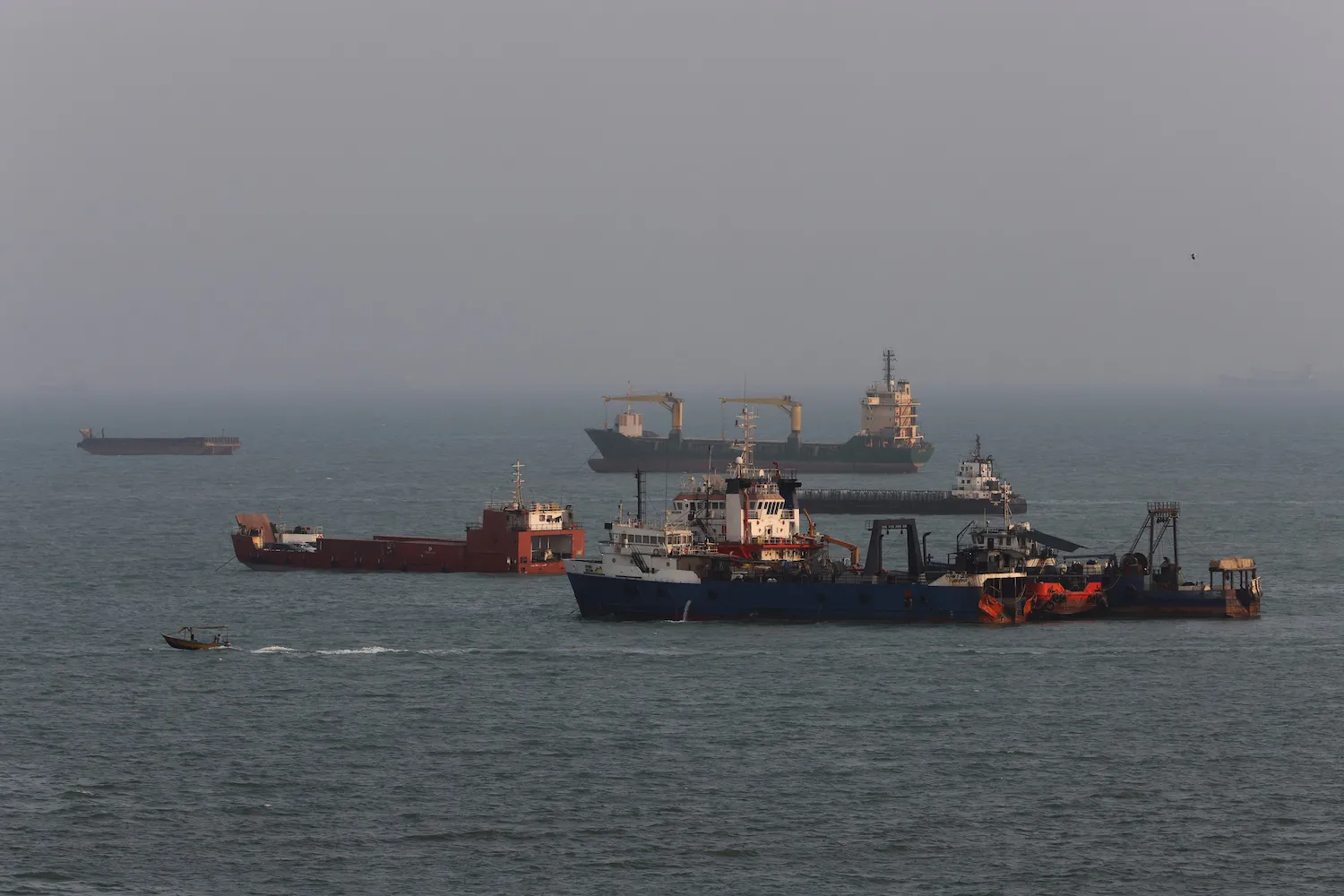
Iran and Oman reached a revenue-sharing agreement on the Strait of Hormuz on Wednesday, with Muscat saying it is “hopeful” that the deal will be formalized soon. Meanwhile, Tehran warned that the critical waterway will remain closed if the United States fails to accept the proposal’s terms. “The U.S. is obstructing this process, causing progress to be delayed,” said Hossein Mohebbi, a spokesperson for Iran’s Islamic Revolutionary Guard Corps.
Welcome back to World Brief, where we’re looking at an Iranian-Omani proposal for the Strait of Hormuz, deadly flash flooding in Nepal and Tibet, and rising Israeli extremist violence against Palestinians in the West Bank.
Tehran’s Demands for Hormuz
Iran and Oman reached a revenue-sharing agreement on the Strait of Hormuz on Wednesday, with Muscat saying it is “hopeful” that the deal will be formalized soon. Meanwhile, Tehran warned that the critical waterway will remain closed if the United States fails to accept the proposal’s terms. “The U.S. is obstructing this process, causing progress to be delayed,” said Hossein Mohebbi, a spokesperson for Iran’s Islamic Revolutionary Guard Corps.
The announcement goes further than the joint Iranian-Omani statement issued Tuesday that spoke of a “phased framework” for resuming shipping transits through the thoroughfare. Although the initial declaration had proposed a “joint temporary navigational corridor” and bilateral efforts to clear sea mines in the strait, it stopped short of unveiling any formal deal or mentioning the possibility of charging tolls—a key demand of Tehran’s.
Global oil prices dipped on Wednesday in response to the news. Both Brent crude and West Texas Intermediate dropped more than $2 per barrel from Tuesday’s highs of roughly $88 and $82, respectively.
But U.S. President Donald Trump does not appear eager to accept the Iran-Oman proposal. In an interview with conservative radio host Glenn Beck on Wednesday, Trump insisted that the strait was already open, undermining Tehran’s threat that it will keep the waterway blocked if Washington does not concede.
“We take a lot of ships through the strait now. We’re taking them in,” Trump said. “Every once in a while, there’ll be a drone or a rocket or something shot, but it is a very functioning strait. A lot of oil is pouring out.”
Only 14 vessels were in the Strait of Hormuz at time of writing on Wednesday, according to TankerMap, which tracks oil and natural gas tanker traffic. Before the war began, an average of roughly 130 ships passed through the waterway daily to transport roughly one-fifth of the world’s oil and natural gas supplies. Part of the reduction is due to fears about the continued presence of sea mines in the area, which “no one except Iran knows the location of,” Iranian Deputy Foreign Minister Kazem Gharibabadi maintained on Wednesday. He went on to dismiss Trump’s claims that all the mines have been cleared.
The Iran-Oman proposal comes just two days after the Trump administration unveiled Operation Economic Outcast, which threatens to impose so-called secondary sanctions on all countries that continue to do business with Tehran. At the time, U.S. Treasury Secretary Scott Bessent insisted that the White House is “giving everyone the opportunity to remedy bad behavior” before these sanctions take effect. However, Iran and its top trading partner, China, have already vowed to resist Trump’s economic warfare.
“When a bully declares that every bank, company, port, and government must choose between obeying Washington’s whims or facing American vengeance, this is no longer just about Iran,” Iranian Foreign Ministry spokesperson Esmail Baghaei wrote on X on Tuesday.
Today’s Most Read
What We’re Following
Rising death toll. Flash flooding in Nepal and the Chinese territory of Tibet killed at least 157 people on Wednesday and left hundreds of others missing, including more than 340 foreign tourists. The exact number of potential casualties and the total cost of damages remain unclear, but authorities expect the death toll to rise. Thousands of people live in villages downstream of the flooding, and officials have already documented the destruction of key bridges, schools, and hydropower facilities.
Scientists studying the disaster believe that a large chunk of ice broke off from a glacier and fell into Nepal’s Bhotekoshi River, triggering the flooding. “There was no rain in Nepal, so we were not expecting anything like this,” said Narendra Pariyar, the chief district officer of one of the country’s affected areas. The force of the ice avalanche was so strong that seismologists initially recorded it as an earthquake. It is too early to determine why the landslide occurred, but scientists have not ruled out global warming, which may have accelerated the glacier’s collapse.
Wednesday’s disaster is expected to test the government of newly elected Nepali Prime Minister Balendra Shah, whose victory in March was driven by a youth-led anti-government protest movement. “Please be patient,” Shah said in a statement on social media. “The government takes full responsibility for your rescue, treatment, food, and shelter. In times of such a disaster, we all need to stand together.”
Chinese President Xi Jinping ordered local authorities in Tibet to “make every effort” to rescue missing civilians, and he reiterated a need for better flood prevention measures.
West Bank violence. A far-right Israeli lawmaker severely damaged a monument in the occupied West Bank on Tuesday amid a rise in extremist violence against Palestinians. According to video footage shared on social media that was verified by the New York Times, 35-year-old Zvi Sukkot as well as several of his aides used a sledgehammer to smash a limestone statue in the Palestinian village of Madama.
The monument featured an outline of all territory between the Jordan River and Mediterranean Sea with the word “Palestine” written in Arabic in the middle, as well as names of Palestinians who have been killed in the conflict with Israel over the years.
Sukkot defended his actions, saying that the monument included the names of Palestinians who had attacked Israelis, including Yamen Faraj, a militant commander who was allegedly involved in a 2003 suicide bombing. The leader of Sukkot’s party, Finance Minister Bezalel Smotrich, similarly justified Sukkot’s behavior. Israel “should have long ago dismantled the terror monument,” Smotrich said, adding that dozens of other statues across the West Bank should also be destroyed.
However, in a rare show of disagreement, the office of Israeli Prime Minister Benjamin Netanyahu condemned the assault. “Taking the law into one’s own hands, particularly by public figures, is unacceptable,” the office said in a statement. The Israel Defense Forces (IDF) confirmed that Sukkot and his aides had been visiting the city of Madama as part of a guided tour of Palestinian communities and that the tour was conducted “under the security of IDF troops.” However, the military said that in attacking the monument, Sukkot and his aides had “acted deceptively and manipulatively, without authorization, departing entirely from the approved framework.”
Rami Nassar, the head of the Madama village council, accused the Israeli military of failing to immediately intervene, and no soldiers are seen trying to stop Sukkot and his aides in the video. “They provided a shield for this criminal act,” Nassar said. The IDF said that when troops saw what was happening, they notified their commanders, who then instructed the forces to halt the tour and take Sukkot and his aides out of the village.
Deadly nursery fire. A fire at a hospital nursery in Islamabad killed at least 14 newborn babies on Wednesday. According to local authorities, only one infant in the nursery at the Pakistan Institute of Medical Sciences’ facility was rescued. An initial investigation suggests that an exploding air conditioner in the maternity ward triggered the blaze, which remained confined to the nursery. No other injuries or outside damages were reported.
Pakistani Prime Minister Shehbaz Sharif ordered Health Secretary Aslam Ghauri, the country’s highest-ranking health civil servant, to be removed from office over the incident and convened a high-level meeting to discuss next steps. “A tragedy involving children is an irreparable loss,” Sharif said. Wednesday’s fire marked one of Pakistan’s deadliest calamities involving minors in recent years.
Opposition leaders condemned Sharif’s administration on Wednesday for failing to provide basic safety measures at public hospitals. According to the World Bank, Pakistan’s healthcare expenditure in relation to its GDP is among the lowest in South Asia. “Administrative failure and regulatory oversight lapses have turned these institutions into danger zones,” said Abdul Ghafoor Shoro, the secretary-general of Pakistan’s leading doctors’ association.
Odds and Ends
Turn up the music! The Air Guitar World Championships kicked off in Finland on Wednesday, with more than 50 musicians from 13 countries vying for the No. 1 spot. This year’s theme, “Rockin’ in the Free World,” marks the 30th anniversary of the international competition. According to the event’s website, its mission is to promote world peace, including the end of all wars and the reversal of climate change. “You can’t hold a gun while you play the air guitar,” the competition states.
