


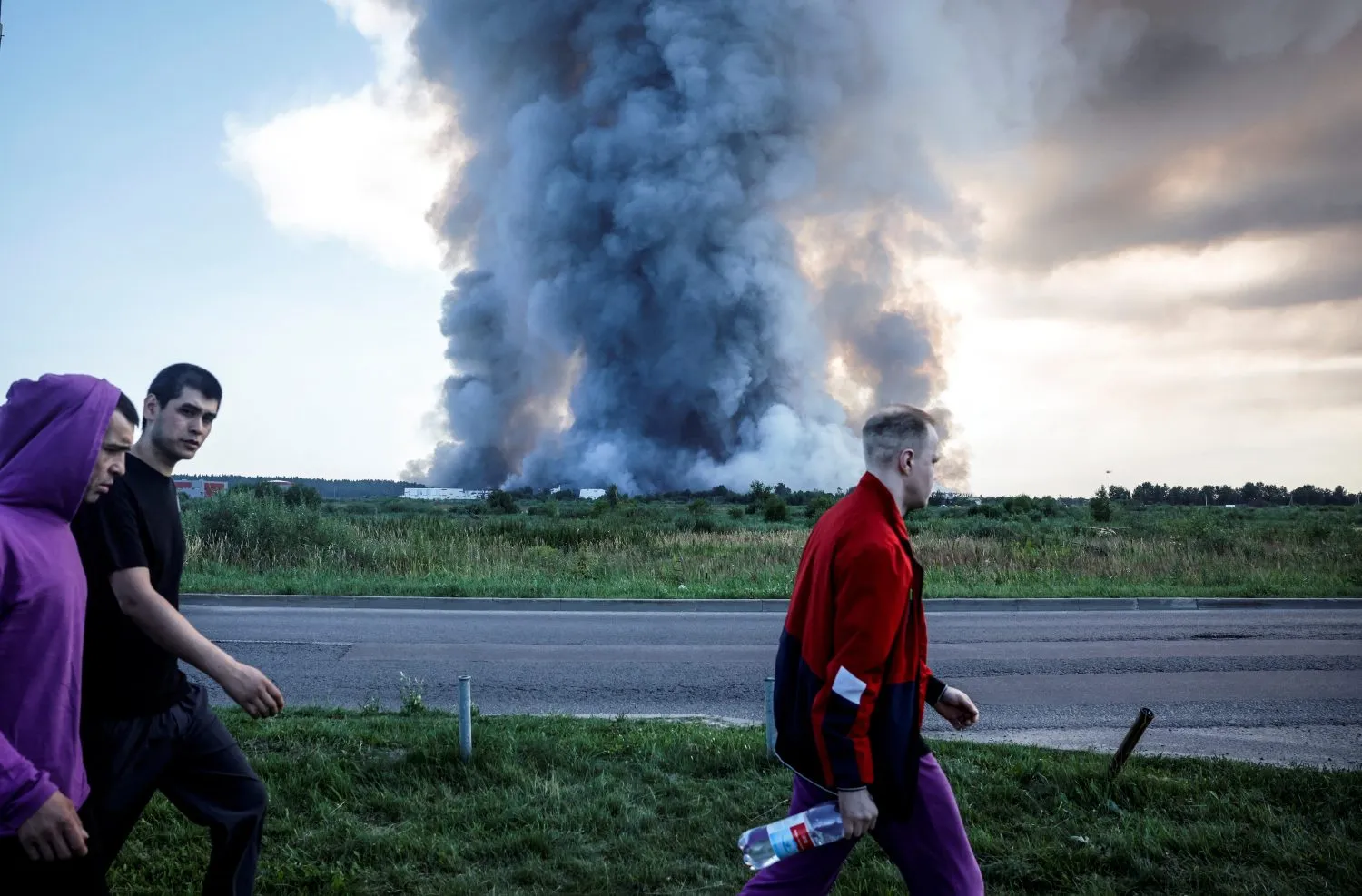
Ukraine’s campaign of deep strikes against oil refineries, military bases, and logistical targets has brought the war home to Russians. The past week has seen at least a dozen attacks on the warehouses of Wildberries, an e-commerce retailer often described as the Russian Amazon. The opening salvo on the company’s flagship logistics facility near Moscow generated a smoke plume so enormous that it could be seen from space, blackening the skies over much of the metropolitan region. Other strikes set fire to Wildberries logistics hubs in St. Petersburg, Tver, and Simferopol in occupied Crimea. The company’s warehouses in Krasnodar, Tambov, and Voronezh were hit as well, killing several workers.
This is not a strange target for the Ukrainian military, although it might look like one at first. Tens of millions of ordinary Russians use Wildberries just about daily to buy everything from laundry detergent and baby formula to sneakers, dresses, and cheap headphones. The Kremlin hasn’t missed an opportunity to accuse Kyiv of attacking civilian infrastructure and committing a war crime. That is obviously hypocritical, considering that Russia has spent years hitting Nova Poshta, Ukraine’s largest private delivery company, destroying the company’s terminals and killing at least a dozen employees, three of them as recently as July 19.
Ukraine’s campaign of deep strikes against oil refineries, military bases, and logistical targets has brought the war home to Russians. The past week has seen at least a dozen attacks on the warehouses of Wildberries, an e-commerce retailer often described as the Russian Amazon. The opening salvo on the company’s flagship logistics facility near Moscow generated a smoke plume so enormous that it could be seen from space, blackening the skies over much of the metropolitan region. Other strikes set fire to Wildberries logistics hubs in St. Petersburg, Tver, and Simferopol in occupied Crimea. The company’s warehouses in Krasnodar, Tambov, and Voronezh were hit as well, killing several workers.
This is not a strange target for the Ukrainian military, although it might look like one at first. Tens of millions of ordinary Russians use Wildberries just about daily to buy everything from laundry detergent and baby formula to sneakers, dresses, and cheap headphones. The Kremlin hasn’t missed an opportunity to accuse Kyiv of attacking civilian infrastructure and committing a war crime. That is obviously hypocritical, considering that Russia has spent years hitting Nova Poshta, Ukraine’s largest private delivery company, destroying the company’s terminals and killing at least a dozen employees, three of them as recently as July 19.
Look closer, however, and Wildberries makes an astonishingly obvious target. The retailer has developed into a vast supply channel for Russia’s war. With official military logistics beset by shortages, delays, incompetence, and corruption, Russian units at the front are dependent on private deliveries and donations of supplies and equipment, often crowdfunded; countless fighters also order on their own account. Until it was hastily scrubbed from the site over the weekend, Wildberries featured a dedicated catalog category “Everything for the SVO,” using the Russian acronym for “special military operation.” The catalog included more than 200,000 listings, including not just war-themed coffee mugs but also thousands of battlefield items, such as body armor, tactical helmets, and custom drone components such as drop rigs and tail fins tailored to Russian projectile grenades. (The items are still listed but now under other categories.)
Many listings come with a “tested in the SVO” badge and official Russian certification stamps, meaning that this trade is actively encouraged by the platform. As of last week, top results in the SVO category included a Br2 military helmet, an armor vest with combat-fire-tested ballistic plates, and a combat medical kit; one-day delivery was available for an extra fee. Verified buyers gave these top items near-perfect star ratings, with buyers writing that they were ordering “for the guys in the SVO.” Ukrainian President Volodymyr Zelensky said on X last week that the strikes were destroying “logistics hubs involved in supplying the Russian army with drone components, navigation equipment, and other gear.”
Under international humanitarian law, a civilian object becomes a legitimate target when its function offers a “definite military advantage.” Wildberries easily passes that test—unlike Russia’s attacks on Ukrainian apartment blocks, shopping centers, and maternity clinics. Russian military bloggers have been explicit about Wildberries’ indispensability to front-line soldiers, posting screenshots of some of the most in-demand items, such as first-person-view drones and their spare parts. It seems that the company anticipated becoming a target: Shortly before the first strikes on its warehouses, Wildberries changed its terms and conditions to add drone and missile attacks to its force majeure clause, absolving a platform of liability for destroyed stock.
There isn’t a single figure to indicate how much the Russian army depends on private deliveries and crowdfunding, but there are clues. My own research over the last few days found close to 1,000 Wildberries listings that met a strict definition of military equipment with no plausible civilian use, such as body armor plates, combat helmets, drone munitions components, drone detectors, and electronic warfare jamming systems. Another 4,500 listings fit into a broader dual-use category: Items such as night-vision devices, tourniquets, power banks, and cold-weather gear have ordinary civilian purposes, but the demand on the platform is visibly combat-driven. Hundreds of Telegram channels are fundraising for the army: A review of 30 such channels turned up more than 18,000 posts linking directly to product pages on Wildberries and its competitor Ozon over the past two years. Some of the procurement requests were so specific that they included an individual military unit’s call sign.
The Russian government acknowledges this state of affairs but spins it as grassroots ingenuity rather than a problem with defense procurement. In December 2024, Russian Defense Minister Andrei Belousov said more than 65 volunteer-built drone and electronic warfare systems had been delivered to the armed forces since that April, alongside more than 100,000 individual products purchased from small civilian manufacturers and design shops. Russian President Vladimir Putin has praised civilian tinkerers putting together military equipment outside the Defense Ministry’s official procurement chain. These efforts depend on precisely the kind of consumer logistics infrastructure Wildberries provides: searchable product listings, standardized fulfillment, one-day delivery, and a customer review system that functions, inadvertently, as a real-time field-testing report from soldiers.
That is what makes the warehouse strikes militarily coherent. Russia’s official logistics system, as retired U.S. Army Lt. Gen. Ben Hodges and other Western observers have noted since the war’s beginning, has never reliably supplied its own soldiers with basics such as thermal imagers, generators, or quality tourniquets, a gap that volunteers and crowdfunders have spent four years filling. Break the platform that aggregates and delivers that informal supply, and the damage doesn’t stay contained to the company, its warehouse workers, and the small-business sellers losing their stock.
Besides their effect on the military supply chain, the attacks on Wildberries have also brought the war home to Russians in a way that is even more profound than the oil refinery attacks that have led to fuel shortages across the country. Tens of millions of ordinary Russians depend on Wildberries for deliveries; millions of them earn part or all of their living as sellers on the platform. Russian social media channels are full of videos of sellers venting their anger and grief over their incinerated stocks and lost livelihoods. Many of them seem genuinely shocked, incapable of connecting their fate to their country’s war against its neighbor—an invasion that many of them had been cheering on. Like the fuel shortages, the disruption of Wildberries brings the war’s effects deep into the Russian middle class.
Unlike with Ukraine’s refinery attacks, Putin has been unable to protect his key clientele: the populations of Moscow and St. Petersburg, which he has tried to insulate from the war. Gasoline can be rerouted from remote regions to keep Russia’s two main cities supplied; recent maps of fuel availability and a report by Reuters suggest that this is indeed taking place, with the provinces bearing the brunt of the shortages. Warehouse fires do not spare sellers based on where they live, and a broken logistics system hits everyone. Infrastructure that maintains swift delivery across 11 time zones cannot simply be reshuffled. It is getting ever more difficult for Putin to maintain the illusion of normalcy.
Beyond the military supply chain effect, the damage is real: By July 22, after only the first few attacks, Ukraine had already knocked out an estimated 8 percent of Wildberries’ total logistics capacity; physical damage to the warehouses alone was estimated at around $400 million. Sellers’ losses from destroyed inventory could reach another $2 billion, little of which the sellers can recover. The company’s sheer size will have other ripple effects across the Russian economy, including damage to the banks holding its substantial debt.
The Russian state’s response to the attacks was also predictable. The state media simply ignored them. On July 24, police in Krasnodar detained a 19-year-old woman simply for posting video of the aftermath of the strike on the city’s Wildberries facility. At the same time, the Kremlin is reportedly considering government support for the company, likely involving already-stressed state-controlled banks.
Ukrainian drone force commander Robert “Magyar” Brovdi has been candid about the strategy. The Wildberries strikes, he said, were partly intended as psychological operations aimed at disrupting what he called the “illusion of a comfortable peacetime” that Russians have been permitted to maintain even as their army wages a brutal war next door. Putin built his domestic bargain with ordinary Russians on the promise that the war would not touch them directly. Wildberries, however, is an app on every Russian’s phone, making the war impossible to ignore. That, more than any single warehouse or any single lost shipment of body armor, is what Ukraine understood when it chose this particular target. After four years of Kremlin messaging about a war that changes nothing for Russians, the war has come home.
