


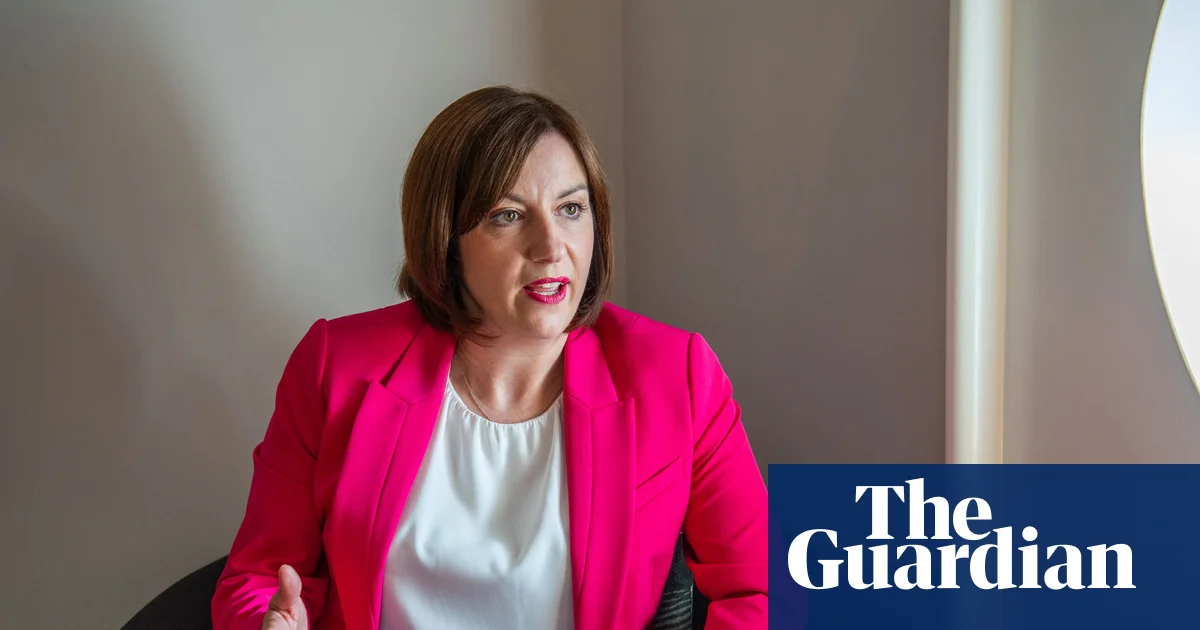
If Bridget Phillipson is angry at losing a job – one that, in the brief honeymoon period at the start of Keir Starmer’s Labour government, she called the “honour of my life” – she is doing a good job of hiding it. “It hurts to lose a job you love,” she says. “Being education secretary was amazing … and I’m really proud of what we achieved in that time.”
Phillipson was removed during the clearout of Starmer’s cabinet when Andy Burnham took office last week, and was replaced by Lucy Powell, an ally of the new prime minister. But unlike some spurned colleagues, Phillipson didn’t walk away from government, instead accepting the brief of women and equalities minister – now a cabinet standalone position – which she had previously held alongside education.
Her visit to a Rape Crisis centre in Cambridge this week highlighted why retaining the women and equalities brief may prove a canny move. On Monday, Burnham appointed Phillipson as the new chair of the Labour party – an apparent olive branch to Starmer allies, and a not entirely subtle attempt to restore some sense of unity to the party.
The role of Labour party chair is a nebulous one. Part election planner, administrator and party cheerleader, the chair’s importance rests heavily on the backing of the PM. On Monday, Burnham said Phillipson would play a “vital role” in getting Labour “match fit for the next election”.
With the subtlety of a sledgehammer, Labour’s communications stressed that the appointment showed Burnham’s commitment to building “one united team”. Phillipson echoed that it was by “uniting together” that Labour would “bring hope back to communities and strengthen British society against those working to divide us”.
Unity will involve working harmoniously with Powell, who defeated her in October’s deputy leadership contest and has now replaced her as education secretary. “That contest was almost a year ago. It’s in the past, and Lucy’s a great colleague,” Phillipson says. “We’ve worked together for many years, and she has my full support in the role.”
Phillipson hopes she can act as a vital bridge between bruised Starmer loyalists – many of whom are making no secret of their anger behind the scenes – and Burnham’s team.
“I know how people will feel, those who’ve lost out – I know it hurts. It hurts to lose a job that you have loved and put heart and soul into,” she says. “But I know that however people feel at the moment, they want to win the next election as much as I do, and they know how high the stakes are.”
Despite being a gentler character than some of her predecessors in the chair role, including Angela Rayner and Tom Watson, Phillipson insists she won’t pull her punches. She points to her record in developing the government’s fraught issue of reforming special educational needs provision in schools and pushing Starmer and Rachel Reeves to eventually lift the two-child benefit cap.
“I’m my own person, and I’ve always believed that there are different ways of being effective,” she says.
The fight against Reform UK, which slipped into second place behind Labour in a voter intention poll for the first time in more than a year this week, is a message she returns to repeatedly.
after newsletter promotion
“We’ve got the fight of our lives on our hands to win at the next general election, our country is at a perilous moment,” she says. “We’ve got to modernise and unite our party and our movement, and take the fight to Reform. That is a huge responsibility.”
She accuses Nigel Farage and his party of “shamefully” weaponising women’s pain with their focus on Pakistani grooming gangs and sexual violence committed by foreigners, and vows to keep the issue on the agenda as women and equalities minister. “We should go after whoever commits violence against women and girls, whatever their background, whatever their ethnicity,” she says.
Phillipson insists that Labour’s manifesto commitment to halve violence against women and girls in a decade still stands, despite Burnham making no reference to it so far. Making her role a standalone cabinet position “demonstrates his commitment to equality and advancing women’s rights in our country”, she says, adding that ministers will be tracking VAWG crimes reported in the crime survey for England and Wales to hold themselves to account.
A week and a half into Burnham’s government, after a blitz of new policies, social media videos and a bounce in the polls, Phillipson says the new PM has brought “a real sense of hope, optimism and energy”. But she adds that he is building on the “good work” of the last two years under Starmer. “I am very sad at how things ended for Keir because he has achieved something that very few Labour leaders ever do, which is going from opposition into government and winning a landslide victory,” she says.
But she makes it clear that her loyalties lie with the new man in No 10. “I supported Keir from opposition to government because I believe it is right that you support the leader of your party and you support your prime minister,” she says. “It is therefore now right that Andy commands that loyalty from all of us.”
