


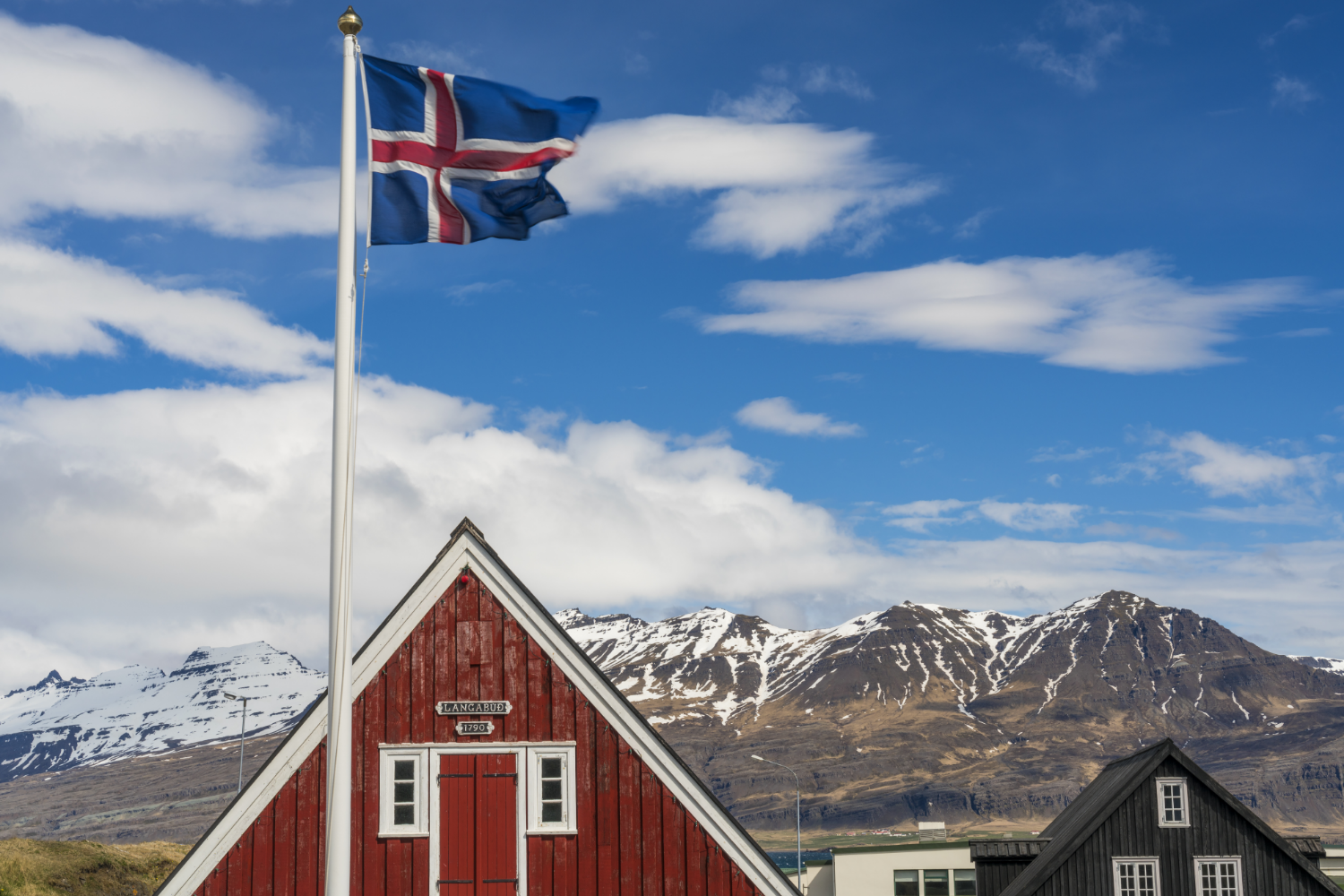
“It has been said,” British Prime Minister Winston Churchill once remarked, “whoever possesses Iceland holds a pistol firmly pointed at England, America, and Canada.”
Churchill was often preoccupied with the defense of Iceland during World War II, recognizing the tiny island in the middle of the North Atlantic to be of outsized importance in the global power struggle. In 1940, he sent troops into neutral Iceland in hopes of staving off a German counterinvasion. By the following summer, Britain’s army was stretched thin, and Churchill transferred Iceland’s defense to the United States—an obligation that remains to this day.
Iceland’s strategic position at the crossroads of North America and Europe has again attracted attention from those to its east and west. Any Russian vessel leaving the Kola Peninsula must transit through the stretch of ocean between Greenland, Iceland, and Britain to reach the Atlantic. This chokepoint has long been a surveillance priority for NATO, of which Iceland is a founding member.
Winston Churchill visits Reykjavik, Iceland, on Aug. 16, 1941.Getty Images/Mirrorpix
At the same time, if an attack were ever to come from the United States, Iceland would provide a crucial hub to defend mainland Europe. And yet, the island—with no military might of its own—has so far managed to evade those that would aim to control its barrel, so to speak.
On Aug. 29, however, Icelanders will head to the polls for a national referendum on whether the country should restart negotiations to join the European Union as its 28th member. Though the Nordic country has been a member of the European Economic Area since its inception in the 1990s, Icelanders have long resisted any move that could erode the island’s sovereignty. With pollsters predicting a near dead heat in the vote, that could soon change.

Signs reading “Natural resources for sale? No thanks” cover bus stops in Reykjavik, Iceland, ahead of the country’s upcoming referendum, seen on Aug. 25, 2026.Getty Images/Jonathan Nackstrand
The EU question has lingered over the country like a brewing storm for more than a decade. Iceland last mulled ascension into the halls of Brussels in 2009, when it was teetering on the brink of financial ruin. By 2013, however, the economic crisis had subsided—thanks, in no small part, to a tourism boom sprung from the country’s volcanic and glacial wonders. Taking heed of shifting public sentiment, the government put accession talks on indefinite hold.
Iceland now has one of the strongest economies in Europe per capita, though the rapid upswing of the 2010s has slowed. Yet the issue of whether Iceland should forgo its insular position has again been brought to the table—hijacking Icelanders’ otherwise peaceful retreat to distant summer houses, far removed from the politics of Reykjavik.
This time around, Iceland’s interest in the EU has seemingly emerged as a reaction to matters of security and defense, not finances. The country’s foreign minister, Thorgerdur Katrin Gunnarsdottir, has invoked U.S. President Donald Trump’s threats to seize Greenland as a warning sign for Iceland—and the EU’s support for Denmark and the autonomous territory as a strong argument for middle-power multilateralism. If Trump’s rationale for pursuing Greenland rests on its strategic position for U.S. national security, then the same can be said for Iceland.
Strength through numbers is an enticing proposition amid growing outside interest in the European Arctic. In this new political reality, it’s only logical that small, vulnerable countries would seek cover from predatory powers in the broad embrace of Europe, as Foreign Policy’s Caroline de Gruyter recently observed.
Further complicating matters for Iceland is the fact that it still relies on the United States for its defense, as agreed in a 1951 treaty. Not to mention that during a speech at the World Economic Forum in January, Trump appeared to conflate Greenland with Iceland—four times. “By accident, we are told,” said Hallgrimur Oddsson, an Icelander based in Brussels.
Oddsson established the think tank Evropustraumar in November 2025 to focus on Iceland-EU relations ahead of a possible referendum. Though he acknowledges that Arctic security is a compelling narrative for politicians, he sees the referendum as a top-down push by the coalition government that came to power in 2024. “It just so happens that you have the two parties that are pro-EU. … It’s always been high on their agenda,” Oddson said.
“People are aware of the geopolitical tensions,” he added. But, he said, that takes up less space than outsiders might think in Icelanders’ conversations on whether joining the EU would be a good idea.
Aligning with the EU would come with more than just security implications. Iceland would join as a net financial contributor, meaning that the country would give more money to EU funds than it would receive. Accession could also change the country’s stand-apart cultural identity.
Before any of these details are hammered out, however, Icelanders must choose whether they’re even open to the possibility. When EU talks were paused in 2013, the agreement was that they could only be resumed via a national referendum. Even if Icelanders vote yes this month, they will eventually face a second vote to actually accept the negotiated terms of entry.
“This is a self-inflicted wound, inherited from previous governments, to have to do this referendum twice,” said Kristinn Hrobjartsson, the director of the Icelandic security think tank Varda.
The Nordic nation does have good reasons for adding its star to the flag beyond security and defense. Although it is wealthy, Iceland has a volatile economy that relies heavily on fisheries and tourism. The krona—unlike the euro—is vulnerable to sudden shocks and high inflation. (A May report for the Icelandic Finance Ministry found that the cost of maintaining the krona significantly outweighs the benefits.) Cost of living can be eye-watering, with grocery prices around 55 percent higher than those in the EU. Moreover, Iceland lacks a seat at the table when laws are decided for the European Economic Area.
The country’s hinterlands, however, are showing signs of discontent. In the small fishing town of Siglufjordur, perched along the country’s north coast, locals have raised anti-EU flags in protest. Iceland’s bountiful fisheries, which account for around 10 percent of direct GDP, proved to be the coup de grâce in the last round of talks. Under the EU’s Common Fisheries Policy, Iceland would be required to share control over the fish stocks that it has historically managed independently, subject to fishing quotas and access regulations determined from afar.
“We would lose control over our fisheries, even if we were allowed by the grace of Brussels to continue to harvest fish in our waters,” said Hannes Holmsteinn Gissurarson, a professor emeritus of politics at the University of Iceland. Iceland’s foreign minister has demanded “sovereign control over all fisheries” in any membership deal, suggesting that the EU’s fisheries policy could be adapted to Iceland’s circumstances. But Gissurarson is skeptical of any such statement; the management of marine resources falls under the exclusive competence of the EU, meaning that only Brussels can prescribe laws.
Many of those who oppose EU negotiations are less concerned about a possible military takeover than the slow erosion of Icelandic identity.
“Icelanders are not afraid of the Americans,” said Haraldur Olafsson, the chair of the Icelandic Euroskeptic group Heimssyn, which has campaigned against EU membership for nearly 25 years. “Iceland has always been a nation of peace. It has never gone to war—and probably never will if it doesn’t join the European Union.”

Icelandic Prime Minister Kristrun Mjoll Frostadottir shakes hands with European Commission President Ursula von der Leyen at the European Commission in Brussels on Jan. 14.Getty Images/Simon Wohlfahrt
Iceland would be an attractive get for the European Union, which has not had a new financial contributor country sign on since Sweden, Finland, and Austria joined more than three decades ago. And Iceland embodies many of the social and political ideals championed by the EU, such as gender equality, strong labor rights and social protections, and freedom of expression.
“The European Union must rethink its own future admission of like-minded democracies as a geopolitical necessity,” Valérie Hayer, a French member of the European Parliament, wrote in the Guardian in June.
Hayer is leader of Renew Europe, a parliamentary group focused on reforming and advancing the EU. She argues that the bloc must amend its rigid membership rules to avoid the fisheries stalemate in any future accession talks, highlighting Iceland’s role in boosting Europe’s defensive capabilities. “Getting Iceland on board would kick off the geopolitical rise of an EU that understands the realities of the 21st century,” she wrote.
To many observers, the Iceland referendum is a gateway vote to landing an even larger fish: Norway.
As one of the wealthiest countries in the world, with vast oil reserves and an advanced social democracy to boot, Norway is the white whale of EU expansionism. Having both Iceland and Norway on board would greatly strengthen the EU’s northern flank and Arctic presence. But Norwegians have twice voted against EU membership, with the last vote held in 1994. Now, it seems that a larger share of Norwegians may be open to the idea, with one recent poll showing that support for EU membership rose from 27 percent in 2023 to 41 percent in 2025.
“There is obviously a reality where accession talks starting for one country triggers the other to join as well,” Oddson said. “When 10 countries joined the bloc in 2004, not all of them started the accession talks at the same time.”
If Iceland were to move toward the EU, Norway would be the only Nordic country left standing alone. Witnessing their neighbors go all-in might spur Norwegians to question why what works for Sweden, Denmark, Finland, and Iceland would not also serve Norway’s interests. “An Icelandic ‘yes’ on Aug. 29 will be a shock to the Norwegian debate—a positive shock,” said Georg Riekeles, the associate director at the European Policy Center in Brussels. “Iceland matters psychologically. It could really be that push that will set the machinery going also in Norway.”
But how likely is it that Icelanders will agree to reenter negotiations? Public opinion polls show a razor-thin margin, with 52 percent leaning “yes,” according to one June poll. And after reaching a high of 67 percent “yes” in mid-August, bets on Polymarket have also dropped to around 52 percent days ahead of the vote. Reykjavik residents with a university education—and those under the age of 30, or between 40 and 49—are more likely to vote in favor, according to Gallup.
“If I go by my vibe meter, in March or April, I thought this was going to be a ‘no.’ And then by May or June, I think it’s going to be a slight ‘yes,’” said Hrobjartsson, the director of Varda.
Some already see the long shadow of the Brexit fallout mirrored in the discussions happening throughout the country. “I still think we would have been better without this idea, because it really splits families apart,” Olafsson said. “It’s like a poison in society.”
Yet if merely agreeing to reopen a conversation about EU membership can barely scrape through a referendum, this suggests that even if Iceland moves forward now, the success of a future vote to join the bloc outright is far from guaranteed.
