


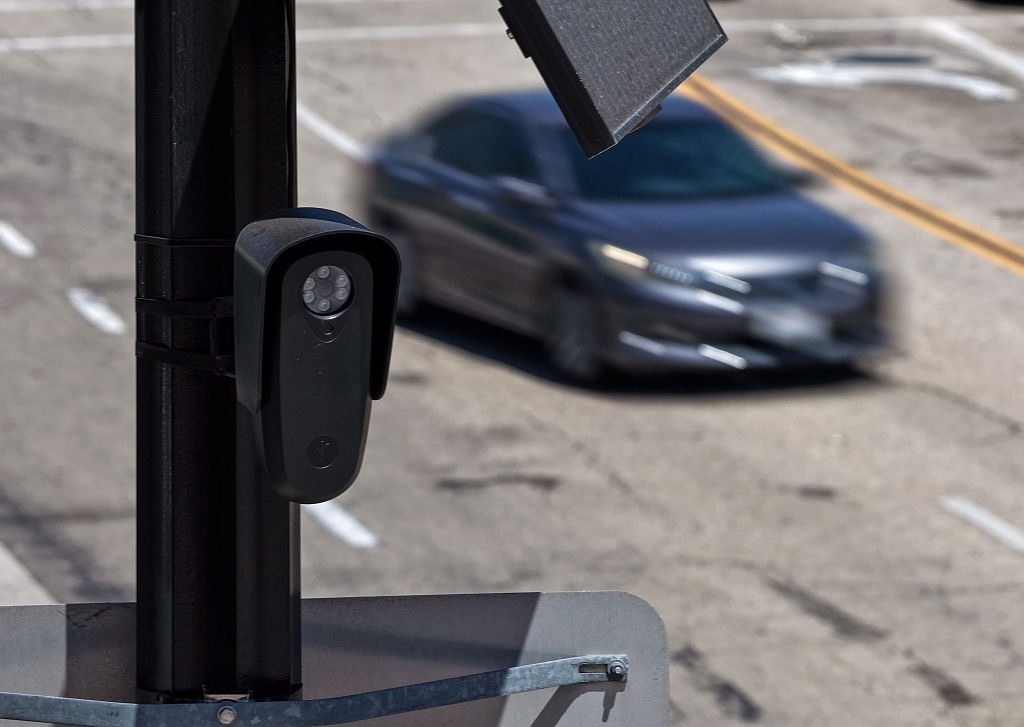
Flock Safety’s automated license plate reader cameras have been deployed across 49 states. The company has spent more than $2 million on lobbying in 2025 and 2026. (Justin Sullivan/Getty Images)
Flock Safety has poured more than $2 million into federal and state lobbying since 2025 as the fast‑growing surveillance company faces mounting scrutiny from lawmakers in both parties and privacy advocates over its ever-expanding network of license‑plate‑tracking cameras.
The company spent nearly $1.3 million between January 2025 and July 2026 on federal lobbying and at least another $1 million in statehouses across the U.S., according to OpenSecrets’ federal lobbying data and an analysis of lobbying disclosures across all 50 states. Flock has hired lobbyists in dozens of states – often former government employees passing through the political “revolving door” – including in places where weak disclosure laws mean spending totals are not publicly reported.
Flock has drawn increasing criticism over the vast, largely unregulated network of automated cameras it operates nationwide. The cameras record license plate numbers and other characteristics of all vehicles passing by, allowing thousands of law enforcement agencies in 49 states (all except Alaska) to search and share Flock’s data across jurisdictions. This enables police to track vehicles in real time and build investigative dossiers from billions of scans collected each month.
While police agencies praise the system as a tool for locating missing people and tracking suspects, privacy advocates warn the technology enables mass surveillance without a warrant. And amid a nationwide wave of protests and vandalism targeting the company’s cameras, more than 120 agencies or jurisdictions have canceled, suspended or rejected a contract – or deactivated their cameras – since January 2025, according to a tracker maintained by DeFlock, a group that opposes their use.
Many of those terminations followed concerns raised about improper data access, including instances in which officers conducted personal searches – raising a central question: What, exactly, does Flock want from this lobbying push? OpenSecrets reached out to the company for comment but did not receive a response.
Torin Monahan, a professor at the University of North Carolina and co-editor of the peer-reviewed journal Surveillance & Society, identified several likely items on Flock’s lobbying agenda. He said the company is likely focused on securing long-term contracts with municipalities and counties as well as avoiding potential restrictions that could require police to obtain a warrant before using the system or limit the cross-jurisdiction data sharing that underpins Flock’s network.
“Some of the things they’re lobbying for are things that they’re worried about,” Monahan told OpenSecrets. “I would imagine those are areas where they would like to head those restrictions off at the pass, if they could.”
He also suggested that Flock “wants to become the monopoly for this particular service” of license plate readers because the network gains power as the user count grows.
Flock says it has deals with more than 5,000 law enforcement agencies across 6,000 communities. The company leases its cameras to governments, private neighborhoods and other groups, typically charging an annual fee of $2,500 to $3,000 per camera.
“So if you have more adoption throughout the country, then it probably will … barring any political blowback, persuade other clients that this is the right company that they should contract with for these services,” Monahan said.
Flock’s federal lobbying spending nears $1.4M
Flock is coming off its highest-spending quarter since it began lobbying the federal government in 2024. Between April 1 and June 30, 2026, the company reported $220,000 in federal lobbying spending after spending $210,000 in each of the five preceding quarters.
In total, it has spent nearly $1.4 million on federal lobbying, including $840,000 in 2025 and $430,000 so far in 2026.
While the company has not reported lobbying on specific bills, its 2026 filings show activity focused on both chambers of Congress and the White House, including the Office of Administration. Its lobbyists have been working on broad issue areas including homeland security, law enforcement, crime and criminal justice – an agenda that aligns with the company’s efforts to expand its camera network.
Several of Flock’s competitors also are active on K Street, though those legacy firms operate far larger product portfolios.
Axon Enterprise, a weapons and tech company formerly known as Taser, has spent nearly $5.3 million on federal lobbying since 2024 on a range of issues topped by homeland security, law enforcement, crime and criminal justice. Motorola Solutions – the parent of surveillance vendor Vigilant Solutions – has spent about $5 million in the same time frame, with its most frequently cited issues including the federal budget and appropriations, telecommunications, defense and intelligence. But the lobbying activity by those companies is not broken out by subsidiary or product line, making it unclear how much of their spending is tied specifically to automated license plate reader systems.
Much of Flock’s lobbying work has been handled by veterans of the revolving door – former public servants now advocating on its behalf. Five of the seven lobbyists hired by Flock this year fall into that category.
Among them: Bryan Lanza of Mercury Public Affairs, who served as communications director for President Donald Trump’s first transition team; Jennifer Lawkin Lukawski of BGR Group, the first executive director of the Republican Study Committee in the House of Representatives; and BGR Group President Erskine Wells, a former deputy chief of staff for Sen. Roger Wicker (R‑Miss.).
Flock lobbying in statehouses with mixed disclosure requirements
An OpenSecrets review of all 50 state lobbying disclosure databases showed Flock with active lobbyists in 34 states in 2025 and/or 2026. Those filings documented at least $1 million in state-level lobbying during that span – but that figure almost certainly understates the company’s true spending because many states do not require lobbyists or their clients to report compensation.
(function(){function e(){window.addEventListener(`message`,function(e){if(e.data[`datawrapper-height`]!==void 0){var t=document.querySelectorAll(`iframe`);for(var n in e.data[`datawrapper-height`])for(var r=0,i;i=t[r];r++)if(i.contentWindow===e.source){var a=e.data[`datawrapper-height`][n]+`px`;i.style.height=a}}})}e()})();
In 18 of those states, Flock’s lobbyists were active but no spending totals were available. State disclosure laws vary widely, from detailed quarterly reports to systems that exclude retainer fees entirely, and those gaps in reporting requirements create blind spots in understanding the company’s full financial footprint.
In Arizona, for example, Flock retained Molera Alvarez – a prominent Phoenix lobbying firm co-founded by a former state superintendent of schools and staffed with several former state and municipal government employees – to represent its interests in 2025. Yet the state’s lobbying database shows no reportable expenditures. Arizona law excludes lobbyist compensation and retainer fees from disclosure. The secretary of state’s summary of principal expenditures from the previous year also lists $0.
Similarly, in Alabama, the company hired former Secretary of State Beth Chapman in 2025 to lobby state officials. But Flock’s quarterly disclosure forms list $0 in reportable spending, consistent with state ethics rules that do not require companies to disclose private retainer fees.
Flock’s largest known expenditure came in California, where since January 2025 it spent $30,000 in each quarter for a total of $180,000. The company focused its efforts on bills adding guardrails around vendor contracts for license plate reader systems – including measures requiring data that fails to produce a hit to be purged within 30 days, mandating audits, requiring case numbers for queries and blocking cross-agency sharing without authorization.
Of those six bills, only one passed both chambers. That bill would have established data protection requirements for license-plate-reader systems, but Gov. Gavin Newsom (D) vetoed it in September 2025. The others died in committee or stalled in the appropriations process.
“I view the lobbying money … in the same category of trying to influence in advance what the particular outcomes might be,” Monahan said.
Flock also spent $169,000 since January 2025 on lobbying in Massachusetts on issues related to police, fire and law enforcement organizations, and $102,000 in Wisconsin lobbying on state Senate and Assembly bills to establish grants for law enforcement agencies to purchase license-plate-reader systems. In Tennessee, where lobbying disclosures include ranges instead of specific spending amounts, Flock paid its lobbying team between $25,000 and $50,000 in both 2025 and 2026 while recording less than $10,000 in expenses in both years.
By comparison, Flock’s contracts with municipalities and universities routinely climb into the hundreds of thousands of dollars. Monahan noted that some universities pay $750,000 to lease Flock’s systems and city and county deployments can top $1 million.
“It seems like a drop in the bucket compared to the size of their contracts,” Monahan said.
In a sign of its expanding lobbying footprint, Flock registered a lobbyist in Wyoming on June 29.
Minimal spending on campaigns by Flock leaders
Compared to Flock’s lobbying spending, the political activity by its leadership is scant.
Corporations are prohibited from donating directly to candidates or political action committees. Flock Safety does not operate a political action committee for its employees to contribute to, and there is no record of any independent expenditure committee – or, a super PAC – funded by the company or its executives. Nor is there any record of the company or its leaders donating to Trump’s inaugural fund, a legal loophole that allows corporations to give unlimited sums.
OpenSecrets data shows CEO Garrett Langley donated $1,000 in 2024 to Health Jobs Justice, the leadership PAC for Sen. Jon Ossoff (D‑Ga.). Beyond that single contribution, there is no visible federal political giving from Flock’s top executives.
Beyond lobbying: The data question
But Flock’s ambitions extend beyond shaping policy. Monahan said the company is diversifying its portfolio beyond license-plate readers and adding drones, gunfire location systems and citywide “safety dashboards” that aggregate public data.
Taken together, it’s a sign that “the law enforcement space is getting pretty crowded” and that mounting scrutiny may be pushing the company to expand, Monahan said.
But that expansion raises questions that go beyond lobbying dollars, because Monahan said the data Flock collects isn’t used just for law enforcement purposes. It also trains the company’s proprietary AI models.
“What we don’t know, as the public, is where all those data are going. How might compromising data be included in these models? What controls might we have about the applications that these AI systems are being put toward?” he said.
Those are questions, Monahan said, that Flock’s lobbying disclosures don’t answer – and that neither regulators nor the municipalities signing contracts with the company have yet to seriously ask.
