


The U.S. Army paid General Dynamics $533 million for an artillery factory that failed to produce a single usable shell.
Instead of efficient, state-of-the-art production lines, half a billion dollars in taxpayer funding paid for machines that kept failing in bizarre ways, former workers told ProPublica’s Jesse Coburn. Giant robot arms would catch fire. The Texas factory’s signature device often cracked the steel meant for the shells. And workers regularly had to take a sledgehammer to certain machines to try to make them function properly. But the machines still botched nearly every shell.
The boondoggle, which included a real-life dumpster fire, was described as an “absolute disaster,” by one former official who worked in an Army office overseeing the project. The official, like others interviewed for the story, spoke on the condition of anonymity.
In a detailed statement, the Army told ProPublica it exercises “rigorous oversight” and that, “where vendors fail to meet contract specifications” — as at the General Dynamics artillery factory — ”we are evaluating contract performance, seeking recoupment of funds, and pivoting resources.”
General Dynamics declined an interview request, but the company has said it “met or exceeded requirements,” according to a Department of Defense inspector general report. In a statement, a company spokesperson told ProPublica its reporting “fundamentally mischaracterizes the circumstances,” but did not respond to a request to specify our reporting’s alleged errors.
To chronicle what went wrong, Coburn interviewed 36 people who’ve worked for the Army, the Pentagon, General Dynamics and the White House, and he reviewed internal company documents as well as photos and video from inside the factory. Here are the lapses in planning and execution Coburn’s reporting uncovered — and some of the consequences of those mistakes.
The Red Flags
The Army awarded the project to General Dynamics in a rushed process despite significant unknowns.
When Russia invaded Ukraine in 2022, the Biden administration rushed to boost production of artillery shells to support Ukraine’s war effort. General Dynamics was the only company producing the 155 mm metal shell bodies in the U.S. at that time, mainly in a century-old facility in Pennsylvania.
The company could have simply replicated the facility’s traditional manufacturing method, which dated back to the time of the Korean War, to ramp up production. But General Dynamics proposed using a state-of-the-art production line from Repkon, a Turkish company virtually unknown in American defense.
Repkon said other countries were already using its machinery to build an older, simpler model of the artillery shells. But it wasn’t clear the Turkish equipment could work with the particular steel used to make the Army’s newer model of 155 mm shells. And Repkon said the Army and General Dynamics could not inspect full artillery production lines in action, citing customer privacy.
Repkon did not respond to requests for comment.
The Department of Defense did not competitively bid the project.
The Army could’ve insisted that General Dynamics more fully demonstrate that Repkon’s machines could perform the desired work. But that would’ve taken time, and — as a former Army official told Coburn — “there was incredible pressure to go fast.”
In November 2022, the Army gave General Dynamics the first in a series of contract awards for the artillery factory. Then, Congress granted the Department of Defense the power to award money for Ukraine-related causes without some of the usual contracting safeguards meant to ensure taxpayer money doesn’t go to waste. That meant the Army could give General Dynamics no-bid awards and the company could start work on the project before finalizing the contract terms with the government.
The U.S. ended up ordering three Repkon production lines — instead of just one — without knowing for certain whether they could make shells that met the Army’s specifications. (The Army said it selected General Dynamics because of the company’s unique artillery production experience).
The Army did not thoroughly vet the proposal before approving it.
Both the Army and General Dynamics sent staffers to Turkey to inspect the Repkon machines. But they never inspected a full production line in action, and they didn’t send enough experts who could identify potential defects in Repkon’s equipment, four former General Dynamics and Army officials told ProPublica.
The Army also didn’t require General Dynamics to demonstrate it could use Repkon’s equipment to complete the entire production process and make shells that met the service’s specifications. (The Army said that “formal testing could not occur prior to full machinery installation.”)
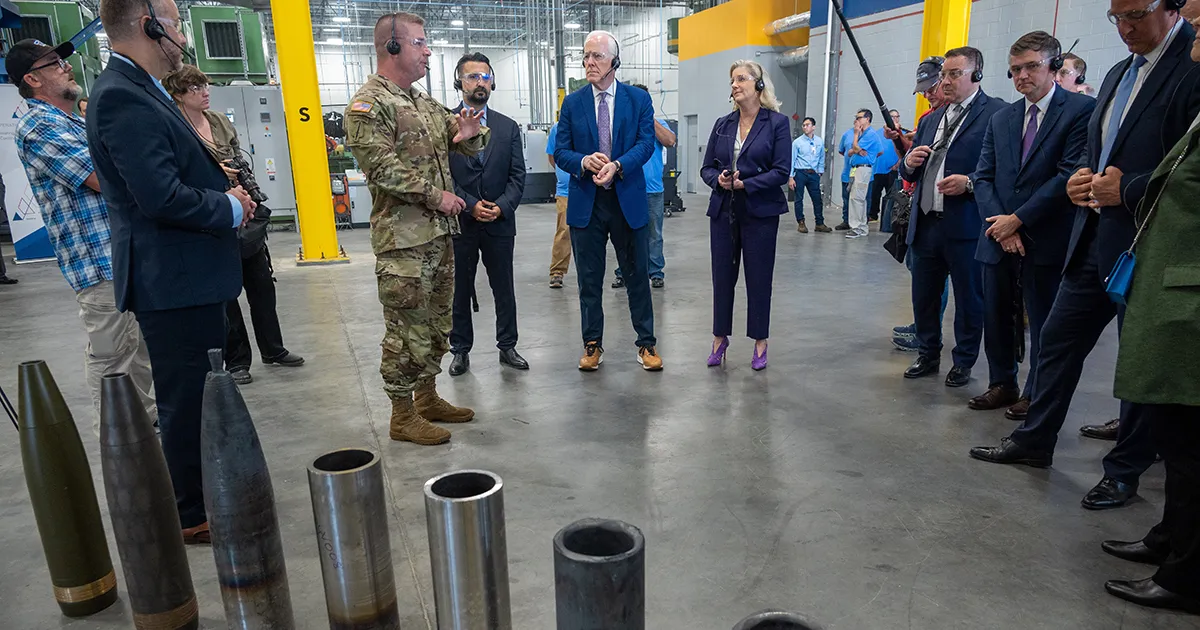
In 2024, leaders from the Army and General Dynamics gathered in Texas to celebrate the factory’s opening. But the machines were barely functioning.
Here’s how the rushed planning from the Army and General Dynamics played out in the factory.
The Consequences
In Texas, robotic arms caught fire and smashed into equipment.
Twelve former factory workers told Coburn that problems quickly piled up inside the factory. Machines meant to begin giving the shells perfectly smooth noses would, instead, mangle them into swirls that looked like soft-serve ice cream.
The robotic arms had a tendency to swing out of control, smashing into things around the factory. Workers talked about the arms going “rogue.” Sometimes, a machine in the factory would be seen moving on its own, controlled remotely by someone in Turkey, spooking workers in the Texas factory.
Workers said smoke hung in the air inside the factory, and it’d reach desert-like temperatures when the furnaces or forging presses were on. Making matters worse, walls cracked, water flooded in when it rained and employees said the foundation of the buildings appeared to be shifting or sinking beneath them.
As progress at the artillery plant continued to stall, paranoia grew and rumors swirled among the American workers that the Turkish employees from Repkon might be purposefully sabotaging the machinery.
“It was astonishing how little progress we would make, month after month, year after year,” one former worker told ProPublica. “People started speculating, ‘I wonder if they’re spying on us.’” (The Army said it has no evidence of sabotage or spying.)
General Dynamics failed to meet a number of milestones at the facility, including failing to perform scheduled first article tests, which would’ve demonstrated the factory could produce shells that met the Army’s requirements.
The Army hasn’t required General Dynamics to pay the money back.
General Dynamics, one of the world’s largest defense contractors, and Repkon haven’t been held publicly accountable for the taxpayer-funded failure. The Army also hasn’t made General Dynamics pay back the money. (The service said it will recover funding from the project by getting unspecified discounts from General Dynamics on production orders.)
In August 2025, the Army halted work on two of the three production lines at the factory. But the Army didn’t unilaterally terminate the contract awards. In December 2025, the government paid the company $26.3 million in “progress payments” for two production lines — although the lines had never made a usable shell.
The Army says it won’t spend any more money on the artillery plant. But since the Army partially halted work at the factory last summer, the same unit of General Dynamics responsible for the struggling facility has won contract awards worth $2.5 billion, according to the Army. (The service said this was for “distinct production lines and critical national defense requirements” unrelated to the Texas factory.)
Having experienced the failure of a little-proven technology in its factory, General Dynamics has announced it will team up with yet another unheard-of partner promising technological innovation. The new solution? Artificial intelligence.
