

Close Menu
NCIJ Network NCIJ Network
    What's Hot

    Morning Minute: Tether Finally Gets An Audit

    August 16, 2026

    In South America, Chinese EVs Are Racing Ahead

    August 16, 2026

    Block export of ‘national treasure’ UK fossils, says MP | Fossils

    August 16, 2026
    Facebook X (Twitter) Instagram
    Trending
    • Morning Minute: Tether Finally Gets An Audit
    • In South America, Chinese EVs Are Racing Ahead
    • Block export of ‘national treasure’ UK fossils, says MP | Fossils
    • Angela Rayner moves to protect pubs from being turned into houses or offices | Planning policy
    • Can we stop with the public ‘blasterbating’, actually?
    • Inside the Experimental Traps Scientists Set for Ghostly Neutrinos
    • Trump-linked World Liberty Financial wins OCC bank approval as $112 million DeFi position sits near liquidation
    • Empowering Guatemalan Villagers Plagued by Plastic
    • About
      • Our Team
      • Editorial Policy
      • Editorial Independence
      • International Support
    • Trust & Standards
      • AI Usage Policy
      • Conflict of Interest Policy
      • Corrections Policy
      • Ethics Policy
      • Fact-Checking Policy
      • Source Protection
    • Get Involved
      • Guide for Sources
      • Support Independent Journalism
    • Legal
      • Cookie Policy
      • Privacy Policy
      • Terms of Use
    Facebook X (Twitter) Instagram
    NCIJ Network NCIJ Network
    Sunday, August 16
    • Home
    • World
    • Ai
    • Business
    • Politics
    • Health
    • Crypto
    • Science
    • Technology
    • Cybersecurity
    • Defense & Security
    • Economy
    • Energy
    • Europe
    • More
      • Fact Check
      • Investigations
      • Opinion & Analysis
      • Environment
    NCIJ Network NCIJ Network
    Home»Technology

    Inside the Experimental Traps Scientists Set for Ghostly Neutrinos

    NCIJ NETWNCIJ NETWORKBy NCIJ NETWNCIJ NETWORKAugust 16, 2026 Technology No Comments4 Mins Read
    Share
    Facebook Twitter LinkedIn Pinterest Email

    Seventy years ago, the physicists Clyde Cowan and Frederick Reines took a custom-built 10-ton detector, surrounded it with thick lead walls and wet sandbags, and placed it near a powerful nuclear reactor at the Savannah River Plant in South Carolina. They called the experiment Project Poltergeist, designed as it was to catch a ghost.

    More than a quarter of a century before, physicists had been puzzling over why energy appeared to be lost during a radioactive process called beta decay. Something was missing, and there was no known physics to explain it. Then in 1930, the Austrian physicist Wolfgang Pauli proposed a radical solution: A virtually undetectable particle was silently carrying the missing energy away. “I have done a terrible thing,” Pauli told a friend. “I have postulated a particle that cannot be detected.” It would come to be known as the neutrino. Having almost no mass and no charge, these particles can pass through Earth and everything on it, including our bodies, virtually unimpeded.

    The massive device that Cowan and Reines deployed in early 1956 was meant to find what Pauli thought was impossible. That June, the pair of physicists from the Los Alamos National Laboratory sent Pauli a telegram: “We are happy to inform you that we have definitely detected neutrinos.”

    Attention then shifted to a broader question. If nuclear reactions produce neutrinos, could we use them to peer at the nuclear fireworks inside stars, including the sun? This presented a huge challenge: How can you possibly catch particles shooting from distant stars if these particles can pass through almost anything undetected? The suspicion was that detecting a particle that rarely collides with matter requires a vast amount of matter for it to collide with. Moreover, the matter would have to be shielded from the noise of other forms of radiation. So the answer scientists came up with was to build some of the biggest, deepest, and most exotic experimental traps in scientific history … and then wait.

    In the 1960s, Raymond Davis Jr. and colleagues at Brookhaven National Laboratory placed a tank 1.5 kilometers underground in the Homestake mine in South Dakota and filled it with nearly 400,000 liters of a chlorine-based cleaning fluid called perchloroethylene. On the rare occasion that a passing neutrino struck a chlorine nucleus, it would be transformed into a radioactive form of argon that could be detected and counted. The experiment, which would run for 25 years, found just one-third the number of neutrinos coming from the sun that had been predicted in theoretical models. This became known as the solar neutrino problem.

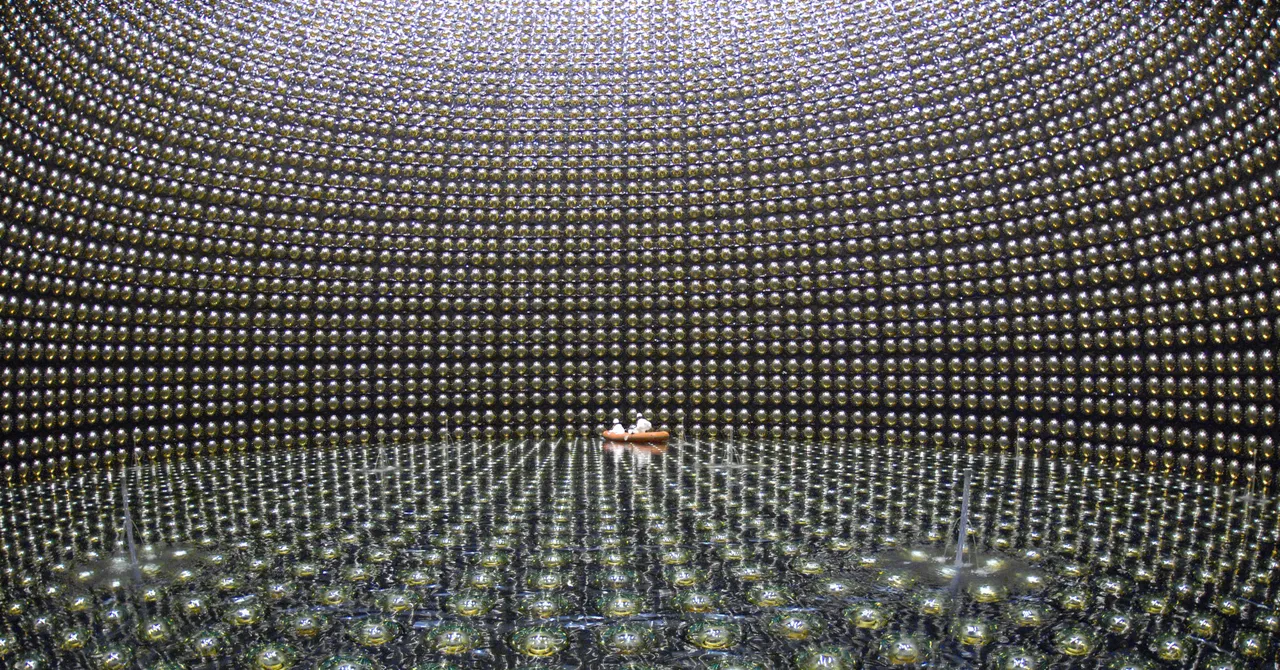
    Decades passed before it was solved—by yet more massive experiments. Deep in the Kamioka mine in Japan, Masatoshi Koshiba built a different kind of detector called Kamiokande, which used 3 million liters of ultrapure water. In this setup, neutrinos occasionally interact with atomic nuclei in the water. The interaction creates an electron that moves so fast, it generates a flash of what’s called Cherenkov light. This light gets picked up by detectors.

    Kamiokande and Koshiba confirmed Davis’ shortfall, and a second, even larger detector, Super-Kamiokande, as well as Canada’s Sudbury Neutrino Observatory, explained the discrepancy. Neutrinos come in three different “flavors” (electron, muon, and tau) and can oscillate, or switch, between them. To do so, neutrinos must have mass, which the laws of physics failed (and still fail) to predict.

    Newer neutrino detectors continue the tradition of grand ambitions and surprising results. The IceCube Neutrino Observatory below the Amundsen-Scott South Pole Station uses Antarctic ice instead of water. It has developed a map of the Milky Way made up only of neutrinos and traced these high-energy cosmic particles back to active galaxies powered by supermassive black holes. On the floor of the Mediterranean Sea, the Cubic Kilometer Neutrino Telescope (KM3NET) has detected the highest-energy cosmic neutrino on record. Its source remains unknown.

    experimental ghostly Neutrinos Scientists set traps
    NCIJ NETWNCIJ NETWORK
    • Website

    Keep Reading

    Xteink’s tiny e-readers are getting access to free books through Libby

    Amazon Can Use Your Twitch Content to Train Its AI—Unless You Opt Out

    Every fusion startup that has raised over $100M

    Anthropic shares more details about how Claude’s new watermarks will work

    Android can now tap to share for contact info, photos, and more – which phones get it first

    Puerto Rico Is Rationing Water. It Could’ve Avoided It by Harvesting Rainwater

    Add A Comment
    Leave A Reply Cancel Reply

    Editors Picks

    Morning Minute: Tether Finally Gets An Audit

    August 16, 2026

    In South America, Chinese EVs Are Racing Ahead

    August 16, 2026

    Block export of ‘national treasure’ UK fossils, says MP | Fossils

    August 16, 2026

    Angela Rayner moves to protect pubs from being turned into houses or offices | Planning policy

    August 16, 2026
    Latest Posts

    Why two public companies quietly liquidated 511 Bitcoin in 24 hours to escape $31.7 million in debt

    July 26, 2026

    TechCrunch Mobility: Uber bets on its former CEO

    July 26, 2026

    Ed Miliband indicates development and climate will be at heart of UK foreign policy | World Bank

    July 26, 2026

    Subscribe to News

    Get the latest sports news from NewsSite about world, sports and politics.

    NCIJ Network is an independent digital news platform delivering trusted investigative journalism, European and global news, in-depth analysis, and fact-based reporting with accuracy, transparency, and integrity.

    Facebook X (Twitter) Instagram Pinterest YouTube

    Morning Minute: Tether Finally Gets An Audit

    August 16, 2026

    In South America, Chinese EVs Are Racing Ahead

    August 16, 2026

    Block export of ‘national treasure’ UK fossils, says MP | Fossils

    August 16, 2026

    Subscribe to Updates

    Get the latest creative news from FooBar about art, design and business.

    Type above and press Enter to search. Press Esc to cancel.