


- The Indonesian government has integrated data from its Ministry of Culture, the Ancestral Domain Registration Agency and AMAN, the country’s largest Indigenous peoples’ alliance, to build a new dataset covering 3,857 Indigenous communities.
- The database will document and register customary territories and capture cultural aspects as well, including Indigenous languages, local foods and traditional knowledge.
- It is hoped that the database will provide greater visibility of Indigenous territories and enable them to be incorporated into permitting, development planning and spatial planning, but it does not grant legal recognition to Indigenous communities or customary territories.
JAKARTA — Indigenous peoples in Indonesia have long faced a basic problem: Data on their communities, cultures and customary territories are scattered across government agencies and civil society organizations, making them less visible in spatial planning and permitting.
The Indonesian government is trying to address that gap by integrating data from the Ministry of Culture, the Ancestral Domain Registration Agency (BRWA) and the country’s largest Indigenous peoples’ alliance, AMAN, in a dataset covering 3,857 Indigenous communities.
The government says the integrated data will strengthen policymaking and protection of Indigenous peoples. BRWA says the bigger significance could be spatial: Customary territory maps, which can show the ancestral lands, traditional territories, languages and more of Indigenous peoples, could eventually become part of the government’s geospatial data and potentially be visible in spatial planning and permitting.
BRWA was established in 2010 by Indigenous and civil society organizations, including AMAN, to document and register customary territories amid the government’s slow progress in recognizing Indigenous peoples and their lands.
The new integrated dataset was launched on Aug. 19 in Jakarta. Before the launch, data on Indigenous peoples had been scattered across various ministries, institutions and civil society organizations, according to Restu Gunawan, the Ministry of Culture’s director general of cultural and traditional protection.
The differences matter, he said during the launch: Even a difference of one community in the datasets could translate into thousands of hectares of difference when it comes to customary territories.
Didik Darmanto, director of religion, culture, youth and sports at the Ministry of National Development Planning, or Bappenas, cited the Kulawi Indigenous community in Central Sulawesi as an example.
Bappenas has data on the community, which is spread across several villages, while another dataset from the Ministry of Forestry also refers to Indigenous legal communities. Bappenas therefore needs to establish whether the different datasets refer to the same Indigenous community, Didik said during the launch.
One problem is that the different government datasets do not yet have a common “primary key” that would allow officials to establish whether records from different agencies refer to the same entity, he said.
Culture Minister Fadli Zon said the integration would make it easier for the government to coordinate policies and interventions aimed at protecting Indigenous peoples, their cultures and customary territories.
“Our weakness is indeed data,” he said during the launch event. “Data may look easy, but it turns out that we still cannot get it in order. If the data are not in order, policy interventions will also be inadequate. This is what is now being integrated.”
The database is intended to capture cultural aspects as well, including Indigenous languages, manuscripts, rites, local foods, traditional knowledge, folk games, oral traditions and other cultural expressions.
Fadli said the Ministry of Culture was ready to become the data custodian for Indigenous peoples, although BRWA says the formal process for determining the custodian still involves the country’s Geospatial Information Agency, or BIG.
Customary maps
The 3,857 community records are already the result of synchronizing the three sources, according to BRWA head Kasmita Widodo. But integrating customary territory maps into Indonesia’s broader official geospatial architecture requires another process involving BIG, he said.
The government’s national data governance system, One Data Indonesia, is intended to make data across government more accurate, up to date, integrated and shareable. Bappenas manages the central One Data Indonesia secretariat.
“By integrating customary territory maps into One Data Indonesia, the spatial information about these territories becomes part of the hundreds of IGT [thematic geospatial information] maps held by the government,” Kasmita told Mongabay.
During the launch, AMAN handed over 2,284 customary territory maps covering 36.6 million hectares. The maps are spread across 32 provinces and 209 districts and cities.
BRWA’s latest figures show that of the 2,284 customary territories it has registered, 418 have received recognition from local governments, covering about 7.54 million hectares (18.3 million acres).
The maps have a spatial dimension and could eventually become part of the government’s official thematic geospatial information, Kasmita said.
That would make Indigenous peoples and their territories more visible in government planning and permitting, he said.
At present, Kasmita said, a customary territory map does not necessarily appear as a layer in the government’s online permitting system if that territory has not been registered or integrated.
Therefore, a company seeking a permit could potentially not encounter a customary territory layer even if Indigenous peoples claim that territory.
With the integration of the data and the submission of the customary territory maps, Kasmita said he hopes Indigenous territories can eventually be incorporated into permitting, development planning and spatial planning.
“[Customary territories] have to become one of the important layers” in district and provincial spatial plans, he said.
But the maps will not automatically become part of Indonesia’s broader geospatial system simply because they have been synchronized, Kasmita added. BIG will need to go through a process to determine who is custodian of the data, based on proposals from the relevant ministries and institutions.

Recognition still lags
The integration could make Indigenous peoples more visible in government data, but it does not itself grant legal recognition to their communities or customary territories.
Furthermore, only 332,661 hectares (822,000 acres) had so far been recognized as customary forest, Kasmita said.
The problem is compounded by Indonesia’s sectoral system, in which different agencies have authority over different types of land.
Kasmita said that customary territories can fall inside state-designated forest areas, where the Forestry Ministry has authority; or in non-forest areas classified as APL or Other-Use Areas, which fall under the Ministry of Agrarian Affairs and Spatial Planning/National Land Agency.
He said BRWA had previously pushed the Ministry of Home Affairs to become data custodian because the ministry works with local governments on matters such as regional regulations and regent decrees concerning Indigenous peoples. The ministry has not taken on that role, he said.
The deeper problem is that Indonesia still lacks an effective system for recognizing Indigenous peoples and resolving competing claims over their territories, Indigenous advocates say.
Erasmus Cahyadi, deputy secretary general for advocacy, politics and law at AMAN and chairman of the substantive team of the coalition overseeing the Indigenous Peoples Bill, said the newly launched data answered questions that had remained unresolved for more than two decades.
Indonesia’s 1945 Constitution recognizes the existence of Indigenous peoples, he said, but Indonesia still lacks a system for determining who they are and where they live.
The new data provide visibility into Indigenous peoples’ existence, their identities and the extent of their territories, he added.
But recognition remains difficult.
“For more than a decade, we have become accustomed to complicated procedures for recognizing Indigenous peoples,” Erasmus said. “In this complicated process, the burden of proof lies with Indigenous peoples, while the authority to grant recognition lies with the government.”
He said recognition procedures often avoid rather than resolve underlying conflicts, particularly where customary territories overlap with forest areas or other land uses.
That recognition gap is one reason Indigenous advocates have continued to push for a comprehensive Indigenous Peoples Law, which has been under discussion for 16 years. Government officials, including Fadli and the chairman of the House of Representatives’ Legislative Body, Bob Hasan, have said they hope the bill can be enacted in 2026 or 2027.
For Indigenous peoples, however, the law needs to do more than establish another recognition procedure. It must also address the underlying legal and tenure problems on the ground, Erasmus said.
Without that, the Indigenous Peoples Law would not be of much use, he said.
Rukka Sombolinggi, secretary general of AMAN, said Indigenous peoples’ rights remain largely confined to constitutional recognition, without a comprehensive law translating those rights into a system for living alongside the state.
“So to this day, customary territories have not been recognized, Indigenous peoples have not been protected, and their authority to govern and manage themselves has not been protected,” she said during the launch event.
She cited roughly 11 million hectares (27 million acres) of customary territory that she said had been seized in the name of development during the 10 years of former President Joko Widodo’s administration from 2014 to 2024.
When Indigenous peoples resist the loss of their territories, they can face division, criminalization and, in some cases, violence, she said.
The data initiative could help change that by making Indigenous communities and their territories more visible to government, Rukka added.
That visibility also matters for environmental protection, she said. Indigenous knowledge has an important role in protecting ecosystems and helping communities restore damaged nature.
“The easiest way out of the crisis is to protect the guardians of the Earth, who protect the best remaining places, from the mountains to the sea,” Rukka said.
Research has similarly linked secure Indigenous and community land rights with better environmental outcomes.
Indigenous Peoples and local communities hold or manage large portions of the world’s land, while Indigenous territories contain a substantial share of the planet’s remaining biodiversity.
For Rukka, however, better data are only a first step.
“Hopefully, today will open a new door toward a better life, with Indigenous peoples becoming part of Indonesia and Indonesia being present among Indigenous peoples,” she said. “May Indigenous peoples experience complete freedom.”
Citation:
Nikolakis, W., Gay, V., Merkel, G., Sunderland, T., & Morrison, J. (2026). The relationship between Indigenous Peoples’ lands and conservation: A systematic literature review. People and Nature, 8(6), 1676-1691. doi:10.1002/pan3.70310
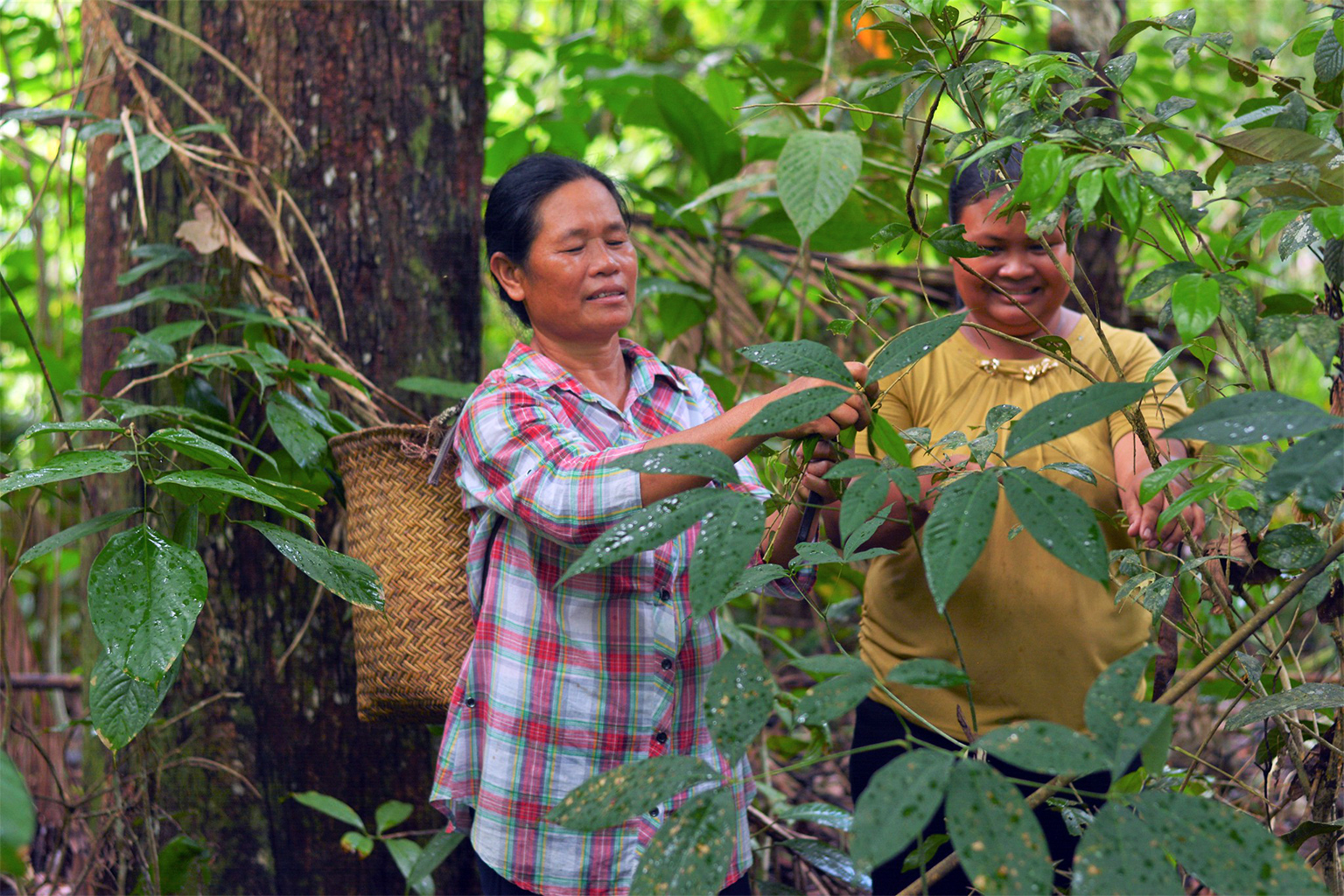
Banner image: A group of Dayak women weavers look for leaves for natural dyes in the forest. Image by TFCA Kalimantan/USAID via Flickr.
FEEDBACK: Use this form to send a message to the author of this post. If you want to post a public comment, you can do that at the bottom of the page.
Cite this article
Hans Nicholas Jong (2026). Indonesia integrates Indigenous data in bid to put customary lands on map. Mongabay Conservation news. DOI: https://doi.org/10.66709/news-327062

