


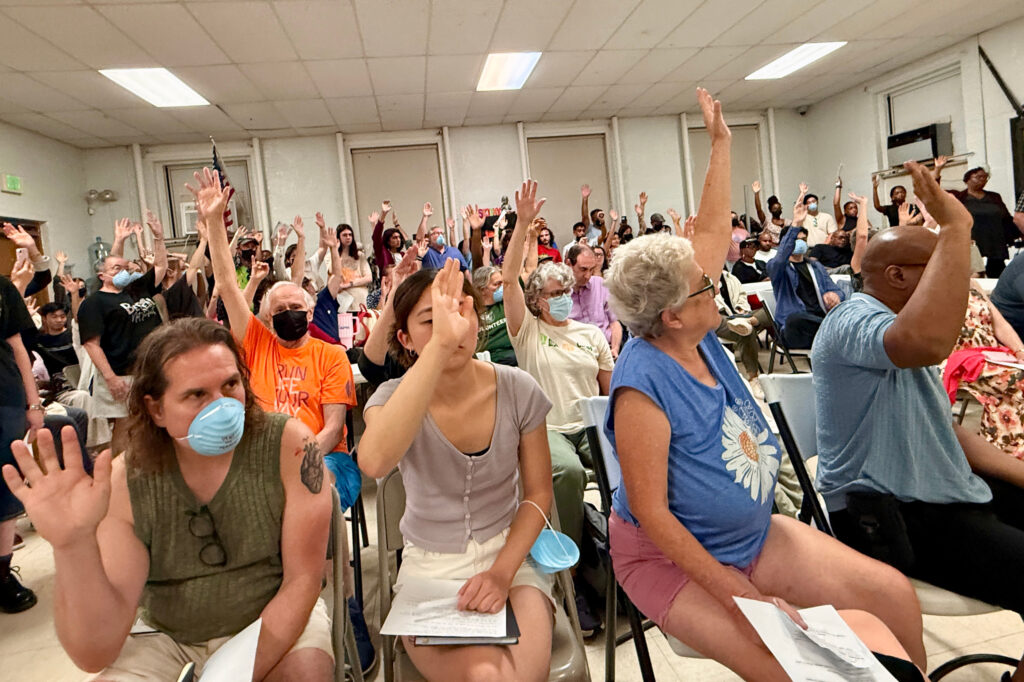
Around 100 Baltimore residents packed a community hall in the Curtis Bay neighborhood on the evening of Oct. 1. One after another, they implored the Maryland Department of the Environment not to renew the air permit for the city’s largest trash incinerator.
The speakers—young residents and retirees, longtime neighbors, doctors, students and environmental advocates—described the daily ordeal of living with asthma and other respiratory illnesses amid the industrial pollution that surrounds Curtis Bay.
It was a day of conflicting emotions for residents.
Within just over a week, separate government regulators moved in sharply different directions over two high-volume incinerators operating in heavily industrialized portions of South Baltimore.
On Oct. 1, Maryland regulators announced that a medical-waste incinerator that has illegally spewed pollution would stop burning waste under a settlement with the state, while Baltimore County approved a contract that could provide a potentially decade-long lifeline to the WIN Waste trash incinerator, one of Baltimore’s largest sources of air pollution.
South Baltimore is a historically overburdened community surrounded by dozens of industrial facilities. Residents have long raised concerns about the cumulative impacts of environmental pollution on their health and daily lives.
Community groups such as the South Baltimore Community Land Trust partnered with environmental coalitions across Baltimore, as well as academics at the Johns Hopkins Bloomberg School of Public Health, to advocate for the closure of the medical-waste incinerator after repeated violations. In 2023, the facility was fined $1.75 million for repeat violations, “one of the largest penalties in an environmental criminal case,” according to the state attorney general’s office.
The WIN Waste facility is a well-known landmark to many passing through the city; its Baltimore-branded smokestack towers above Interstate 95. A recent study estimated that its emissions impose nearly $54 million a year in health damages, with much of the burden falling on surrounding communities.
“We are paying with our lungs. We are paying with our blood,” said Lindi Shepard, a former teacher and education researcher, who came to testify at the public meeting.
Abby Cook, a lifelong Baltimore resident who has worked as an environmental professional, told regulators she wants to have a child someday but fears raising one in the city.
“I’m afraid to raise a child in Baltimore City because it isn’t safe … not because of crime, but because of the air,” Cook said.
“We are paying with our lungs. We are paying with our blood.”
— Lindi Shepard, former teacher and education researcher
That same evening, as Baltimore residents were trying to convince state regulators how challenging it was to live with industrial pollution every day, some of the Maryland officials with power over the state’s environmental policies were somewhere else.
Roughly four miles away, senior officials from Maryland’s environmental agencies were gathered with political leaders and environmental groups at an event honoring environmental champions. Among them were MDE Secretary Serena McIlwain, Maryland Comptroller Brooke Lierman, Maryland Energy Administration Director Kelly Speakes-Backman and several lawmakers. Gov. Wes Moore was the chief guest at the event.
The juxtaposition came at a consequential moment, particularly for the Curtis Bay community, which has fought for years to convince policymakers to find ways to reduce waste incineration and saw some progress with the closure of the medical waste facility.
Just when MDE announced that the medical-waste incinerator would stop operating under a settlement with state regulators, Baltimore County approved a contract that could continue sending roughly 215,000 tons of garbage each year to WIN Waste, also called BRESCO, for as long as 10 more years.
Among the main concerns residents raised about the WIN Waste incinerator is the large volume of ash it generates, which is subsequently disposed of at the Quarantine Road Landfill in South Baltimore. Studies of municipal incinerator ash have identified contaminants including dioxins, lead and arsenic, but community researchers say they have been unable to independently test ash from WIN Waste to determine its composition and contaminant levels.

Now, MDE has to decide whether to renew the air permit that would allow the facility to continue operating. WIN Waste’s air pollution permit is due for renewal this year, but in a press release, SCBLT said MDE has already granted WIN Waste a tentative determination to renew.
For South Baltimore residents, it was a tough situation to reconcile. Inside the recreation center, the testimony grew increasingly confrontational.
Alex Smith, who said his workforce-development organization has received support from WIN Waste, urged residents to move in “a more positive direction.”
A Howard University researcher who said her lab had studied the community for four years responded. “People are tired of being resilient,” she said. “It’s not about being positive.”
Then came Nicole Fabricant, who said she has worked with young people in South Baltimore for more than 17 years. She dismissed industry-funded community projects cited by WIN Waste supporters as inadequate compensation for the pollution residents say they endure.
“These are the trinkets,” Fabricant said. “These are not jobs. This is not employment, and this is not a sustainable future for Baltimore.”
This story is funded by readers like you.
Our nonprofit newsroom provides award-winning climate coverage free of charge and advertising. We rely on donations from readers like you to keep going. Please donate now to support our work.
When WIN Waste representatives stepped forward to the microphone, they presented a very different picture.
Company officials said a $45 million pollution-control upgrade had substantially reduced emissions, that years of testing had shown its ash does not meet regulatory definitions of hazardous waste and that the plant provides both electricity and a local alternative to hauling Baltimore’s garbage to distant landfills.
When one WIN Waste representative noted that she also lived nearby, in Hollins Market, someone in the audience shouted back: “Come on, live in South Baltimore.”
The hearing reached its peak when Shashawnda Campbell of the South Baltimore Community Land Trust took the microphone after speakers yielded portions of their time to her.
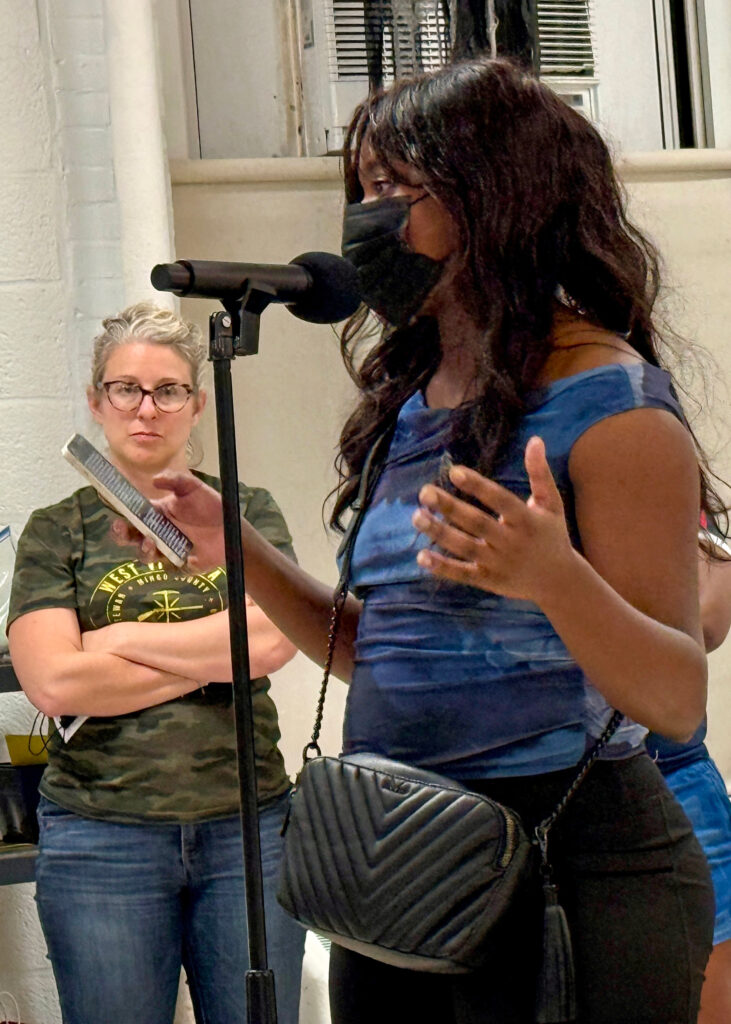
“What is the purpose of a public hearing if the community asks questions and does not receive actions?” Campbell asked.
She said residents had gone through “hearing after hearing, commitment after commitment, research after research, science after science” while continuing to demand answers about the facility’s pollution and its ash.
“We are tired, but we are still here,” Campbell said.
She asked everyone calling for MDE to deny the permit to raise their hands. Hands shot up across the room.
“Shut it down! Shut it down! Shut it down!” came the chants.
Greg Sawtell of SBCLT said MDE initially agreed to provide researchers with ash samples from both incinerators for independent testing, and even scheduled a handoff with the science team. But the agency abruptly cancelled the transfer and has yet to provide the samples or a clear explanation more than a year later, he added.
“It’s not just the community being blocked,” Sawtell said, adding that Maryland Senate President Bill Ferguson has also pressed MDE to identify the legal obstacle preventing the testing and, if one exists, what lawmakers would need to change to make it happen.
Sawtell said the medical waste incinerator’s shutdown showed that sustained monitoring and pressure could eventually produce regulatory action, he said, even if it came after years of harm.
Baltimore County, he said, by contrast “basically sleepwalked into another long-term arrangement” with WIN Waste, potentially locking itself into sending more than 200,000 tons of waste there annually while still claiming to pursue recycling, composting and waste reduction.
In written response, Nick Rodricks, chief of the county’s Solid Waste Management Bureau said the new WIN Waste contract is meant to preserve reliable disposal capacity while the county expands recycling, composting and other waste-diversion programs.
“These efforts are not mutually exclusive and our long-term goal remains to reduce the amount of waste requiring disposal,” Rodricks said.
He added that the agreement anticipates about 215,000 tons of county waste being sent to WIN Waste annually, but, unlike the previous contract, the new contract contains no “put-or-pay” provision that would financially penalize the county for sending less. He said the county continues to evaluate other disposal options and environmental considerations as it works to increase diversion.
In emailed comments, a WIN Waste spokesperson disputed residents’ descriptions of the facility’s pollution burden, saying its emissions represent a small share of pollutants already present in Baltimore’s air and again pointed to a $45 million emissions-control upgrade. The company reiterated that its ash is routinely sampled and analyzed under an MDE-approved program and has consistently tested as non-hazardous under applicable regulatory standards, with results submitted to the state as public records. WIN Waste did not clarify whether its Baltimore County contract contains minimum-tonnage or guaranteed-payment provisions that could discourage the county from reducing the amount of waste it sends for incineration.
MDE did not respond to questions about the differing trajectories of the two incinerators or Sawtell’s account that the agency prevented community researchers from obtaining ash samples for independent testing.
The public comment period on a draft air permit that would let Baltimore’s trash incinerator keep operating closes today, Oct. 8, as residents press the Maryland Department of the Environment to deny it.
About This Story
Perhaps you noticed: This story, like all the news we publish, is free to read. That’s because Inside Climate News is a 501c3 nonprofit organization. We do not charge a subscription fee, lock our news behind a paywall, or clutter our website with ads. We make our news on climate and the environment freely available to you and anyone who wants it.
That’s not all. We also share our news for free with scores of other media organizations around the country. Many of them can’t afford to do environmental journalism of their own. We’ve built bureaus from coast to coast to report local stories, collaborate with local newsrooms and co-publish articles so that this vital work is shared as widely as possible.
Two of us launched ICN in 2007. Six years later we earned a Pulitzer Prize for National Reporting, and now we run the oldest and largest dedicated climate newsroom in the nation. We tell the story in all its complexity. We hold polluters accountable. We expose environmental injustice. We debunk misinformation. We scrutinize solutions and inspire action.
Donations from readers like you fund every aspect of what we do. If you don’t already, will you support our ongoing work, our reporting on the biggest crisis facing our planet, and help us reach even more readers in more places?
Please take a moment to make a tax-deductible donation. Every one of them makes a difference.
Thank you,

Reporter, Washington, D.C.
Aman Azhar is a Washington, D.C.-based journalist who covers environmental justice for Inside Climate News with focus on Baltimore-Maryland area. He has previously worked as a broadcast journalist and multimedia producer for the BBC World Service, VOA News and other international news organizations, reporting from London, Islamabad, the United Arab Emirates and New York. He holds a graduate degree in Anthropology of Media from University of London’s School of Oriental and African Studies (SOAS) and an MA in Political Science from the University of the Punjab, and is the recipient of the Chevening scholarship from the UK government and an academic scholarship for graduate studies from the Australian government.
