


Bhutan is a Himalayan kingdom sandwiched between China and India. Forty percent of its 800,000 citizens work in the agriculture sector. The mountainous country is famous for its breathtaking landscapes and its unique policy of “Gross National Happiness,” instituted in 1972 by Jigme Singye Wangchuck, the fourth king of Bhutan.
My guests on the Newscast this week say this philosophy is the backbone of the nation’s food system, and its plan for full food self-sufficiency by 2029.
“Our food system isn’t just about producing food. It’s about sustaining our landscapes, our communities, and our culture,” says renowned chef and restaurateur Bleu Tshering Dorji. She owns two restaurants in the nation’s capital, Thimpu. She explains the unique challenges farmers she works with face due to climate change and steep mountain terrain.
“We are a mountainous landlocked country, and only a small percentage of our land is, I think, actually suitable for agriculture. We don’t have the luxury of just expanding farmland. We have to make better use of the land that we sort of already have,” she says.
“Labor is becoming extremely scarce as young people sort of move away from agriculture, and farmers still have to deal with issues like wildlife conflict, unpredictable weather, and also getting their produce to the market,” Bleu says.
She adds the outflow of young people from rural areas, where most of the population currently lives, presents its own set of challenges.
“We need our young Bhutanese people to be able to see farming as not a last resort, but as a profession that you could be proud of, that could be innovative and profitable.”
Sonam Wangchuk is an executive specialist at the Ministry of Agriculture and Livestock for the government of Bhutan. He also joins the conversation to explain how the government plans to address these challenges through the 13th five-year plan, “Transforming the Agrifood Sector for Economic Growth and Sustainable Development.” The plan calls for spending the equivalent of about $180 million through 2029. Much of these funds appear to be directly supporting smallholder farmers, the majority of whom in Bhutan are women.
“We have been working to strengthen the capacity of the smallholder farmers, especially through training on climate-smart agriculture, improve production technologies, farm mechanization, post-harvest management, value addition and agribusiness and business development for women and youth,” Wangchuk says.
“The skills are imparted to improve access to finance, technology and markets and creating an environment of entrepreneurship and to support the farmer groups and cooperatives.”
Some government measures have received criticism, such as the implementation of a 3,400-kilometer (2,100-mile) fence to deter human-wildlife conflict.
A previous study from 2023 on agricultural practices in the nation suggested that, “Bhutan should emphasise women-centred initiatives by enhancing access to assets, raising awareness of climate change mitigation strategies, and developing training programs to promote CSA,” or climate-smart agriculture.
This appears to be what the plan aims to do. However, not all challenges are easily solved with funding. Previous Mongabay fellow Choki Wangmo highlighted some of these challenges through the story of Pen Zam, a medicinal mushroom gatherer who struggles with a shrinking habitat at extremely high altitudes to attain a fraction of what her family used to gather decades ago, before the current climate impacts of today.
Later this month, the inaugural Global Conscious Food Systems Summit will take place in Bhutan, which seeks to bring together participants from both the private and public sectors, along with food system experts, to develop an agenda for the future of the global food system.
Mike DiGirolamo is the host & producer for the Mongabay Newscast based in Sydney. Find him on LinkedIn and Bluesky.
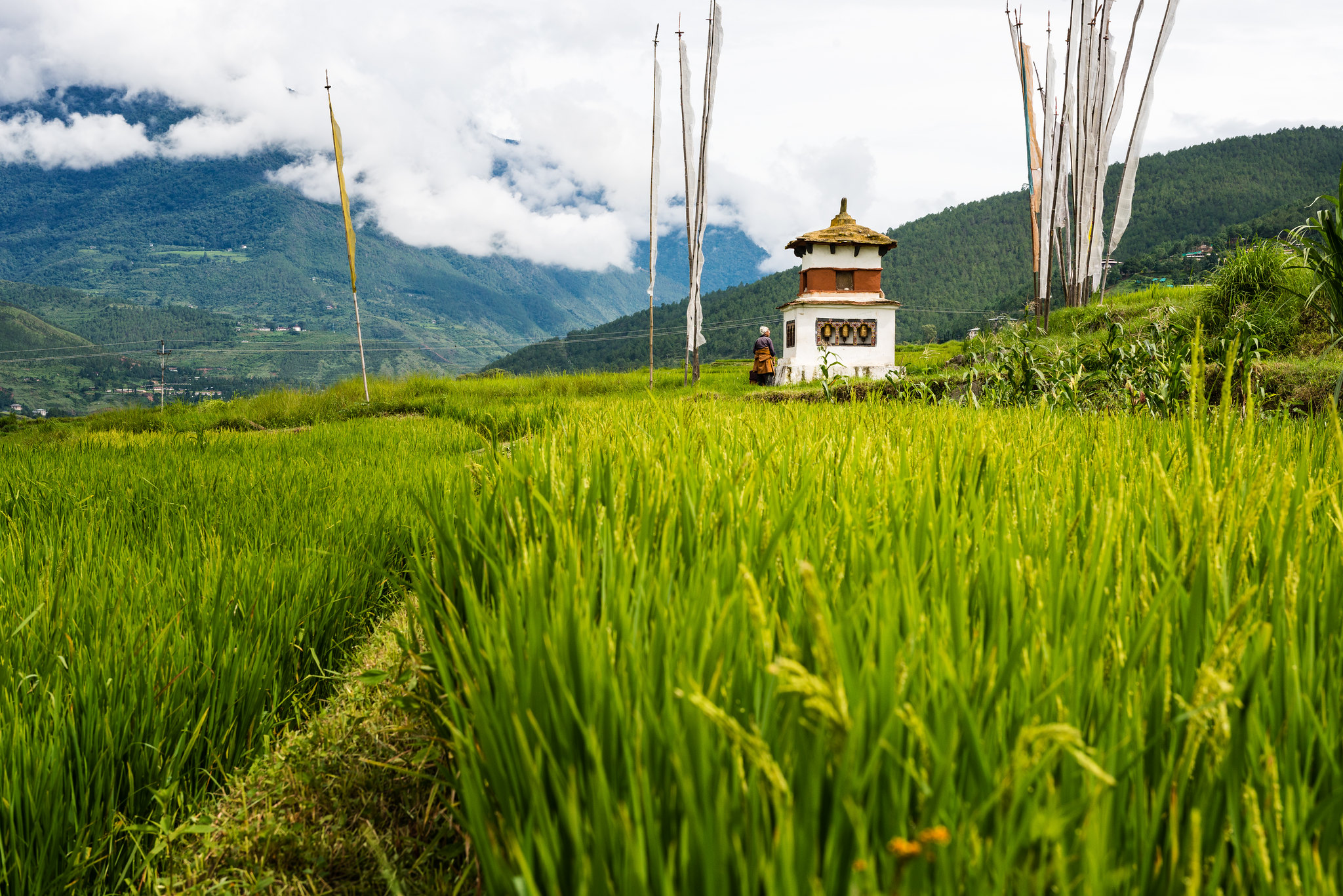
Banner Image: A chorten, or Buddhist stupa, at a rice field in Bhutan. Image by thaths via Flickr (CC BY-NC 2.0).
Notice: Transcripts are machine and human generated and lightly edited for accuracy. They may contain errors.
Bleu Tshering Dorji: I think Bhutan’s food system is built on something extremely simple. It’s the relationship between people and nature. Practices like agroforestry protecting forest, restoring degraded lands are all important, but I believe that they’re really just an expression of a much older philosophy, which is that if we take care of nature takes care of us. And working in the restaurant industry that’s something I see every day. The quality of our ingredients come from healthy soils, clean water, intact forests, and I think that’s what makes Bhutanese food unique. Our food system isn’t just about producing food. It’s about sustaining our landscapes, our communities, and our culture.
Mike DiGirolamo: Welcome to the Mongabay Newscast. I’m your host, Mike DiGirolamo, bringing you weekly conversations with experts, authors, scientists, and activists working on the front lines of conservation, shining a light on some of the most pressing issues facing our planet, and holding people in power to account. This podcast is edited on Gadigal land. Today on the newscast, we speak with Bleu Tshering Dorji, a chef and restaurateur in Thimphu, Bhutan, and Sonam Wangchuk, executive specialist at the Ministry of Agriculture and Livestock for the government of Bhutan. They join me today to talk about Bhutan’s unique food system, which is based on the national philosophy of gross national happiness. You may have heard of this term before in conversations about Bhutan. The nation is famous in that it has a policy stance prioritizing the happiness of its citizens. I was very curious to hear how this applies to sustainability and food. Bleu Dorji, who works with food and farmers, explains this from a cultural perspective, describing the challenges this mountainous nation faces in both growing and transporting food, and in sustaining the livelihoods and traditions people have relied on for generations. These are all impacted to some degree by climate change. Bhutan is what the United Nations calls a, quote, “least developed country,” which is a term that they use to describe countries that are among the poorest in the world. Most of Bhutan’s population lives in rural areas, and these two factors make it particularly vulnerable to climate change. Sonam Wangchuk explains how the government’s 13th five-year plan, which is a framework for accelerating growth and sustainable development in the country, aims to develop a sustainable economy and address the challenges posed by climate change. The plan is centered around the nation’s food system, which does employ over 40% of the population. And while the term economic growth is prioritized in this plan, it is tempered by the specific notion of sustainability, with Millions of dollars spent to support the livelihoods of smallholder farmers. In this conversation, we talk about some of these plans, how important food is to Bhutanese culture, and how gross national happiness is shaping the future of its food system. Later this month, the inaugural Global Conscious Food Systems Summit will take place in Bhutan, jointly hosted by the government and the Conscious Food Systems Alliance. The conference aims to bring together participants from both the private and public sectors, along with food system experts around the world, to develop an agenda for the future of a global food system. While I’m not able to attend this conference, listening to Dorji and Wangchuk may provide a glimpse into its priorities
Sonam Wangchuk, Bleu Dorji, welcome to the Mongabay Newscast. It’s great to have you here.
Bleu: Thank you-la. It’s a pleasure to be here .
Sonam Wangchuk: Thank you, Mike.
Mike: So the first thing I wanna ask you, both of you, is can you talk about Bhutan’s commitment to food self-sufficiency by 2029? What does that mean exactly, and, why has the nation decided to undertake this goal?
Bleu: Doctor, would you like to go first?
Sonam: Bhutan’s goal of food self-sufficiency by 2029, right? So the food self-sufficiency is a key priority for Bhutan’s 13th five-year plan. So the 13th five-year plan, it runs from 2024 to 2029. And the, the goal is not to eliminate, the food imports, but to substantially increase domestic production of priority commodities that Bhutan can produce competitively. And also, while maintaining a strategic trade wherever necessary. , In order to achieve this, the Ministry of Agriculture and Livestock is focusing on increasing productivity through improved technologies like irrigation mechanization, and supplying quality inputs. And also promoting commercial and climate-smart agriculture and livestock production. Strengthening value chains, storage, processing, and market access. And also there are programs to support farmer groups, cooperatives, agribusinesses, and youth entrepreneurs. And also encouraging the private sector, which is also known as the engine of growth, in terms of investment and innovation.
Mike: Bleu, did you have anything to add to that?
Bleu: Yes, I absolutely agree with everything Dr. Sonam said, but I think it’s also really important for us to undertake this goal because it has the potential to improve the lives of so many families who have relied on farming for generations in Bhutan. Because I believe that farming isn’t just a industry here, it’s a way of life. It’s where our food history, our traditions, our heritage, this is where it all begins, through farming. As doctor mentioned, I think it also makes economic sense. But personally, for me as a chef, it’s also about staying connected to food. I believe that when we know where our ingredients come from, who grows them, we have a greater respect for them. We have better control over quality we’re given the opportunity to preserve our indigenous varieties, and we protect the stories behind our cuisine. Yes-la.
Mike: I’d like to talk about the challenges that Bhutan faces in regards to farming. And one of them is that, you are a mountainous nation and there is a limited amount of arable land. And to some degree the country still has to rely on imports. So can you talk about this, this challenge and how this plan seeks to address it?
Bleu: I think first off, due to our geographical disposition, we are a mountainous landlocked country and only a small percentage of our land is, I think, actually suitable for agriculture. We don’t have the luxury of just expanding farmland. We have to make better use of the land that we already have. Then there’s the challenges that our smallhold farmers are currently facing. I think many farms are fragmented and family-run. We don’t have correct me if I’m wrong, doctor, I don’t think we have large industrial-sized farms in Bhutan. Maybe a few of them, but most are family-run. And labor is becoming extremely scarce as young people move away from agriculture and farmers still have to deal with issues like wildlife conflict, unpredictable weather, and also getting their produce to the market. I think one of the biggest challenges we’re currently facing is perception. We need our young Bhutanese people to be able to see farming as not a last resort, but as a profession that you could be proud of, that could be innovative and profitable. So I think those are some of the challenges we’re facing. And to how do we tackle those challenges, I think the government needs to change…this is just my personal perspective, the government needs to change the strategy of how they are supporting the farmers and the youth and everyone in the agriculture industry. I know that the government currently is giving a lot of support to farmers, but I think it needs to change. I think it needs to be more innovative more explorative. The youth need to realize that this is a profession. It’s not just something that, we’ve been practicing for generations and it’s, what our forefathers have done, and there’s no sort of gratitude at the end of that career. I think that perception really needs to change for the Bhutanese youth, Lah.
Mike: Sonam as you’re a part of the government do you have anything to add to that?
Sonam: Yeah, I completely agree with what Dorji mentioned. Bhutan being a very mountainous country and then we have lot of challenges in terms of being landlocked and mountainous. And then like now we have challenges in terms of labor shortages. We have very less people working on the farms. And then also, now we have increasing incidences of aging population. And then, human-wildlife conflict is a major issue here in Bhutan. And just to talk a little bit more about the human-wildlife conflict, the farmers they grow crops in the land the whole year round. And then previously, they had to literally spend about four to six months in the field just guarding the crops against wild animals. This is because we have a very strong conservation policies where we protect the, the wildlife and, things like that. But the farmers also lose in terms of the the food harvest. And then from the government side now we have especially for the human-wildlife conflict we have tried various innovative strategies, but there are different types of wildlife. And then we need to have different strategies for different kinds of wildlife, for example, for elephants, you need to have different strategies to protect the farmlands from the elephants. For the monkeys, you need to have different strategies, the government is spending a huge amount of funds to support the farmers to save the harvest from the wild animals.
Mike: The government’s efforts to build more wildlife fencing in Bhutan have been met with some criticism, notably from Sangay Wangchuk, who has actually published a commentary in Mongabay describing the 2,100 miles of fencing that the country is aiming to develop will actually lessen wildlife’s freedom of movement, reduce the effectiveness of migration corridors, and shift conflict with wildlife to unfenced farms. That criticism has been linked in the show notes for your consideration.
Sonam: And also, as I have mentioned that we have these five-year plans, and then now we are already in the 13th five-year plan. So the five-year plan, we have planning cycles of five year each. And then now we are already into the, I think the 63rd year, of initiating these five-year plans. The farmers, the youths, they have the opportunity to develop these plans actually, because while developing these plans these plans are very participatory. It the plans get developed right from the grassroots level, from the villages, it comes to the blocks, the needs and aspirations are taken into consideration. And then these plans, it comes at the ministry level, and that’s how it is prioritized. So if there is really a need for changes I think there are avenues created for such changes.
Mike: Hello, listeners, and thank you for tuning in. As I always like to mention, Mongabay is a nonprofit news outlet. While “The Mongabay Newscast” is our flagship podcast, this podcast specifically relies on funding from listeners like you. So if you’d like to support us, I encourage you to go to patreon.com/Mongabay to become a monthly sponsor of the show. Even donating as little as a dollar per month really helps us out. So if you’d like to donate to us, go to patreon.com/Mongabay. If you’d like to read any of the stories that I mention you can find links in the show notes.
So I’d like to discuss—because we know we’ve established that there’s limited supply of actual arable land or land for agriculture, can you talk about what you’re trying to build Bhutan’s food system on exactly? I’ve read that the government is focusing on regenerative farming practices. Would this include agroforestry? And how do you plan to help restore degraded ecosystems with these?
Sonam: If I may continue. Yeah, so as you mentioned, the food system the Bhutan’s food system actually is built on the principles of sustainability climate resilience, and environment conservation. So these are all aligned with the country’s Gross National Happiness philosophy and the 13th five-year plan. So the Gross National Happiness philosophy is a very unique concept that that has been gifted to the people of Bhutan and to the world by the fourth king of Bhutan in the 1970s. And then we have been using this the principles in our in our planning the planning activities. So some of the key pillars that would include are sustainable and climate smart agriculture, agroforestry, and integrated farming systems wherever appropriate. Sustainable management and restoration of degraded agriculture land where we have this land management campaigns in areas where the area where the farmlands are degraded. Soil and water conservation and also organic and low-input farming practices. Also the biodiversity conservation and ecosystem protection and the efficient use of the natural resources as well as the adapting to the climate change
Mike: Bleu, did you have anything to add to that?
Bleu: Just a few things. I think Bhutan’s food system is built on something extremely simple. It’s the relationship between people and nature. Practices like agroforestry, protecting forests, restoring degraded lands are all important, but I believe that they’re really just an expression of a much older philosophy, which is that if we take care of nature takes care of us. And working in the restaurant industry that’s something I see every day. The quality of our ingredients come from healthy soils, clean water, intact forests, and I think that’s what makes Bhutanese food unique. Our food system isn’t just about producing food. It’s about sustaining our landscapes, our communities, and our culture. And GNH plays a huge part in that, as Dr. Sonam had just mentioned. I think GNH allows people or reminds people to think about everything that happened before the food reaches your plate, and that’s how GNH is structured. And to really be able to understand how GNH plays a role in our food systems, you really have to understand what GNH is all about. GNH is a set of guidelines introduced by the fourth king of Bhutan to ensure that the country always puts its people first. It’s guidelines to ensure that the country creates an environment for people in which, if they choose to do so, they are able to pursue happiness. It’s not guaranteed happiness, but all these guidelines are in place to ensure that people are allowed to do so. So sustainability, protection of environment, all of these things have naturally always played a role, I think, in our food systems.
Mike: Since we’re on the subject and just for folks listening, GNH, I- I’m assuming you’re referring to gross national happiness…
Bleu: Yes, gross national happiness
Mike: What differentiates that then from the economic model of another country? I really think it’s important for people to understand that.
Bleu: So the whole concept of GNH is not just focusing on our economic growth, but the growth of its people alongside with the economic sort of aspect of it, and I think that’s what differentiates us. GNH allows us to slow down and be present, be aware of everything going on. I think the rest of the country is in a giant race. Every day is flight or fight. If you come to Bhutan, you realize that our way of life is much more laid back than the rest of the world. I think what GNH does is allows people permission, gives permission to people to slow down just a little bit, which I think the rest of the world, unfortunately, is lacking right now. Yes-la.
Mike: And Sonam did you have anything…
Sonam: If I may add a little bit on what Dorji mentioned, the gross national happiness philosophy, like we have this four pillars under the GNH that like the good governance, the sustainable socioeconomic development, the cultural preservation, the environment conservation. In order to, in order for an individual or a community to live a happy life, we need to take into consideration all these the, four pillars. The four pillars are divided into different segments. Whenever we make agricultural policies or anything like that, we need to, see that these policies are they having an adverse effect on the environment or, is it having an adverse effect on the biodiversity? So actually, we have to, take into consideration of the GNH principles, while making all these policies. So in case it has an ad-adverse effect on the environment or the biodiversity and the happiness of the people, then, the policies are again reviewed, so that’s how, the GNH is implemented here in Bhutan.
Mike: Earlier you mentioned there were some, some challenges you experienced with smallholder farmers, specifically with transporting food. Can you elaborate on that for us?
Bleu: I think the biggest challenge is basically for farmers to get their produce from farm to market. Bhutan’s terrain is absolutely stunning, but it is also very unforgiving. Many farms are located in extremely remote areas connected by n-narrow farm roads, unpaved. So transporting fresh produce takes time, and it can also be e-expensive, especially for perishable items like, mushrooms and berries. Every extra hour in transit affects quality and freshness. Farmers don’t always have access to cold storage or refrigerated transport, so I think that’s what we lack. Yes-la.
Mike: Go ahead Sonam, do you have anything to add to that?
Sonam: I think Dorji has mentioned and just to add on a little bit you know, the, challenges of transporting food here in Bhutan is mostly due to the mountainous terrain of the country. But definitely the situation has improved over, the years. And the government has been investing a lot on this transport infrastructures. Like for example the government is spending a lot of its resources in connecting the far-flung villages to the markets by building these farm roads. So now we have a very extensive network of farm roads connecting the villages to the towns, and then from the towns to the cities. Then we have the east to west national highway that the government has invested considerably. But nevertheless even we have these facilities, but the government is looking forward to improving them further through, in terms of reducing the time time taken from the, farms to the market. And then the other challenges would be, as Dorji mentioned, in terms of aggregating the products the farmer products, because, the, the farms are all scattered. And then the, the volume is very low. to aggregate is quite challenging. And in terms of economies of scale is very low. And then , the cost of transportation becomes high, right? So those are some of the challenges. And then nowadays I think due to the climate change phenomenon, we ha- we have this erratic weather patterns. We have rains when we don’t need rains. We have , very sunny weather where we don’t need these sunny weathers and then So these are some of the challenges and And then also, in terms of , the cost that is incurred in term for the logistics for the farmers. So I think these are some of the challenges. But nevertheless, I think the government is investing a lot on this infrastructures and then also the aggregation, centers, cold storages and, the, storage structures and also market sheds for these farmers so that the markets become accessible to the farmers and it could solve their problems.
Mike: So I’ve read that the, United Nations Development Program, the UNDP partners with Bhutan on various projects that are helping to restore some degraded land. Can you confirm this? And if so, what are these projects?
Sonam: Yes. We have been receiving a lot of support from our development partners like the UNDP, the UN systems. the degraded lands especially in the east where the farmlands are, the slopes are, very high. And then due to heavy rainfalls, the lands get degraded. So in those areas we have been advocating this sustainable land management practices where, the, the, the, the farmers are provided trainings and, awareness are created on how to, best manage their lands by, using terracing methods, by planting, live live grasses and things like that. We have been implementing these land management practices for quite some time, and then it has been very successful actually in the east
Mike: And earlier Bleu mentioned that she wishes the government would do more to to incentivize youth to, to see farming as a a viable profession. So I’ve read that part of the plan for self-sufficiency by 2029 is to focus on training smallholder farmers youth and also women , to do this work in rural areas. So I just want to put it to you a little bit more. Can you talk more extensively about that, about how the government is actually planning to, do that, to raise the bar on that?
Sonam: The Ministry of Agriculture and Livestock yeah, with the support from the development partners like the, the UNDP, the FAO, and the other development partners. So we have been working to strengthen the capacity of the smallholder farmers especially through training on climate-smart agriculture, improve production technologies farm mechanization post-harvest management value addition and agribusiness and business development for the women and youth. So basically it is the skills are imparted to improve – access to, to finance, technology and markets and creating an environment of entrepreneurship and and to support the farmer groups and cooperatives. So these initiatives are, are an important component in the 13th Five-Year Plan
Mike: In Bhutan, climate-smart agriculture, CSA, is a term used to describe a variety of farming practices, — the ones that are most commonly used are seed saving, crop rotation, and terracing. But there’s so much more to this, like utilizing polyhouses, agroforestry, water harvesting ponds to combat drought, drip systems, and solar-powered electric fences to deter human-wildlife conflict. A recent study I found advocated for more support for farmers like this. Looking into the 13th Five-Year Plan, which is linked in the show notes, it does indeed appear that 139 million USD is going towards supporting smallholder farmers based on the project Building Resilience of Smallholder Farmers. And I found that about 18 to 20 million USD is going towards improving farmers’ access to financial services like credit or insurance. And then about 1.33 million USD is going towards strengthening farmer groups and cooperatives, and then about 1 million USD goes towards strengthening agri-food enterprises. This is all important information because this plan was instituted in 2025. The study also found that most farmers are economically active women with small land holdings, and this is very important to note. The same study suggests that Bhutan should emphasize women-centered initiatives by enhancing access to assets, raising awareness of climate change mitigation strategies, and developing training programs to promote CSA.
But I’d like to share some more information from three recent Mongabay Fellows on how women endure climate change differently than men. So when I asked Sonam here about how the government intends to support women, I was looking for more information about how they might help mitigate the increased risks women face, such as the ones I’m about to tell you. It should be noted that according to the UNFCCC, women and girls rely more heavily on the environment, which makes Bhutan’s situation all the more notable, as historically most of the population has relied on subsistence farming for a living. Mongabay fellow Choki Wangmo, reporting from Bhutan, wrote a section in the piece describing a forager by the name of Pem Zam, and she traveled four hours to the mountains that have peaks over twenty thousand feet to gather cordyceps, which is a type of medicinal fungus that’s very popular in traditional Chinese medicine. And Pem Zam, like many women in her community, perform a lot of the labor of tending the land, caregiving, and other unpaid labor that many women around the world do in their communities. And if you recall, when I recently spoke with Noo Saro-Wiwa about the lack of government support for women in the Niger Delta, many civic leaders there, and also Noo Saro-Wiwa herself, said the government needs to put more resources into helping women. And so again, my question here was to ask exactly what’s the Bhutanese government is going to do that. But back to Pen Zam, who told Wangmo that because of climate change, warmer temps are shrinking the habitat of this particular fungus that she collects. Zam still has to fight through altitude sickness, depleting feed for rearing yaks, migraines, and insomnia. And once where her father could collect an entire bag of cordyceps in a single day due to more favorable conditions decades ago, Zam now has to contend with increasingly erratic weather conditions, collecting only a fraction of that. So I encourage you to read the story as it offers a glimpse of the challenges women and communities in Bhutan face in maintaining their traditional livelihoods. Again, I’ve linked it in the show notes for your consideration
Sonam: In this current five-year plan, the the government is prioritizing the youth and the women. And then a lot of the programs have also been focused on women. just to take an example, in farm machinery. Previously, we had this huge power tillers where those power tillers are used on the farms, and it could be operated only by the, the men. But now the government has taken the initiative to introduce a smaller capacity power tillers where it can be operated by women. So these are some of the initiatives, that we have been taking. And then also in terms of providing the, the agribusiness funds and, startup funds the government has been prioritizing on the youth and to the women farmer groups and cooperatives.
Mike: If you had to provide a message to other nations of the world what would it be? Do you see your role in food self-sufficiency as helping inspire other nations to a- adopt a similar mindset?
Bleu: Yes, absolutely-la. But that doesn’t mean that I think that Bhutan sees itself as having all the answers. Rather I think we hope to contribute to the global conversation by sharing what has worked for us personally, while also being able to learn from others, because there- we still have a long way to go. We have all the, the philosophies, the correct mindset, but I believe that what we need to do is build on that. And to be able to build on that, we will need help from other countries to see what has worked for them and possibly adapt to those type of ways of farming and the progress they’ve made-la.
Mike: And Sonam, did you have anything to add to that?
Sonam: I would like to, actually thank the visionary leadership of our monarchs, where Bhutan we are positioning ourselves as a global leader in sustainable development by demonstrating that economic progress can go hand in hand with environment conservation and human wellbeing. Bhutan is also a negative a carbon negative country with strong commitment to protecting its forest and biodiversity. Bhutan integrates sustainability into its national development through the philosophy of the gross national happiness
Mike: Bleu Dorji and Sonam Wangchuk, thank you so much for joining me today. It’s been a pleasure speaking with you both.
Bleu: Thank you so much for having us-la.
Sonam: Thank you. Thank you, Mike. Thank you for having us
Mike: As always, if you’re enjoying “The Mongabay Newscast” or any of our podcast content and you wanna help us out, we encourage you to spread the word about the work we’re doing by telling a friend and leaving a review. Word of mouth is among the best ways to help expand our reach. But as I mentioned earlier, I encourage you to support us by becoming a monthly sponsor by going to our Patreon page at patreon.com/mongabay. Again, we are a nonprofit news outlet, so when you pledge a dollar a month, it makes a huge difference, and it helps us offset production costs. So if you are a fan of this podcast, go to patreon.com/mongabay to learn more and support us. You can also read our news and inspiration from nature’s frontline at mongabay.com, or you can follow us on social media. Find Mongabay on LinkedIn at Mongabay News and on Instagram, Threads, BleuSky, Mastodon, Facebook, and TikTok, where our handle is @mongabay or on YouTube at MongabayTV.
Thank you as always for listening.
