


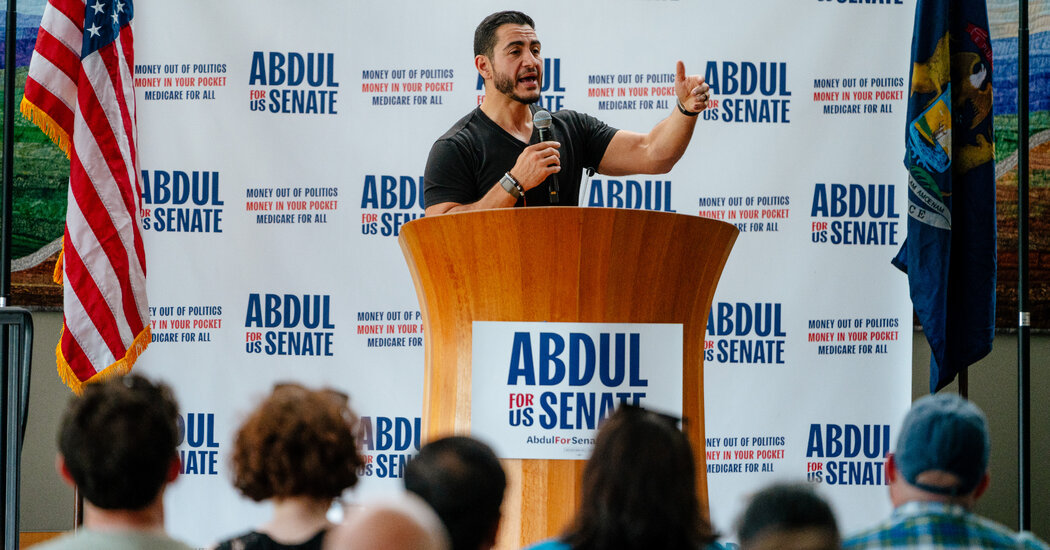
After racking up a series of high-profile wins this summer, the left looks ascendant in blue America.
In open Democratic congressional primaries this year, candidates endorsed by progressive-left groups like Our Revolution, Justice Democrats and the Democratic Socialists of America have won nearly one-third of contests in places where Kamala Harris won at least two-thirds of the presidential vote in 2024.
For all of those impressive victories, there’s still one big asterisk on the activist left’s success this primary season: Its wins have been largely confined to the most highly educated and heavily Democratic parts of urban America, the places where Ms. Harris did the best.
Based on the same endorsements, the left has almost entirely failed to break through in battleground or red districts. Where it has broken through, it’s often with candidates who are white, male, blue-collar populists in the mold of Graham Platner (before his race exit) and John Fetterman (2022 edition) — not with the young democratic socialists who seem unstoppable in New York City or who surged in Colorado.
As long as the progressive left doesn’t win outside of heavily Democratic areas, it won’t be more than a large and vocal faction in the Democratic House caucus. The red states and battlegrounds may not embody the Democratic base, but they usually decide control of Congress and the party’s presidential nomination.
That’s what makes the Democratic primaries in Michigan (Tuesday) and Wisconsin (Aug. 11) significant tests of the rise of the left. The polls show wide leads for Abdul El-Sayed in Michigan’s Senate primary and Francesca Hong in the Wisconsin governor’s primary. If they prevail, it will deal a blow to whatever remains of the assumption that candidates of the progressive left can’t compete nationwide in 2028.
Of course, it’s always a mistake to read too much into one or two idiosyncratic primary elections. Both Dr. El-Sayed and Ms. Hong have benefited from favorable matchups. In Michigan, the Democratic establishment has put forward a staunchly pro-Israel candidate (Haley Stevens) in a state where progressive activists are especially mobilized against Israel’s conduct in Gaza. In Wisconsin, the Democratic establishment has struggled to put forward a candidate at all.
But in the past, candidates of the progressive left like Ms. Hong, a democratic socialist, or Dr. El-Sayed, who doesn’t call himself a democratic socialist but seems indistinguishable from his vocal democratic socialist allies, have found it almost impossible to win primaries in battleground states, even under favorable circumstances. Now they’re positioned to win, and candidates like them could find favorable matchups in the future — even in the next presidential primary.
How to judge the progressive left’s strength
The progressive left has had its best primary season in memory, including high-profile victories against well-established Democratic incumbents. But it’s not clear whether the left is anywhere near as strong as its flashiest wins can make it seem.
Most obviously, mainstream Democrats have won most Democratic primaries so far this year. That’s partly because most incumbents are mainstream Democrats (and incumbents almost always win), but it’s not just about incumbency. Mainstream Democrats have also tended to prevail in races without a Democratic incumbent — both in Republican-held seats and in the districts where Democratic incumbents are retiring.
Another issue is that it’s challenging to define whether someone actually is a candidate of the progressive left. Everyone can agree that the self-identified democratic socialists, like Zohran Mamdani and Alexandria Ocasio-Cortez, are at the core of this new left, but it’s not limited to the people who adopt that label. Dr. El-Sayed, for instance, does not identify as a democratic socialist, even though he has few policy differences with Ms. Ocasio-Cortez or Bernie Sanders.
At the same time, simply identifying as “progressive” doesn’t automatically put you in this group. Progressives have been winning for years. Many of the progressive left’s big victories over Democratic incumbents this cycle have come against other self-identified “progressive” members of the Congressional Progressive Caucus who support Medicare for all. What’s different this cycle is the success of a new kind of young, populist, activist-backed progressive who’s either a democratic socialist or indistinguishable from one on the issues.
One of the better ways to judge whether someone is ideologically aligned with the activist left is to use endorsements from progressive-left groups and individuals, like Mr. Sanders’s Our Revolution, the Democratic Socialists of America, Ms. Ocasio-Cortez herself and Justice Democrats (basically the so-called Squad and a handful of their colleagues in Congress). This measure isn’t perfect, either. Not every candidate with progressive-left views earns such an endorsement, and progressive-left groups will sometimes choose to endorse a relatively moderate candidate in a moderate district. It’s a rough proxy at best.
But by this measure, the progressive left has won less than 20 percent of primary races in open districts where Democrats are either strongly favored to win or are expected to be competitive in November. Among these races, progressives have done quite well in solidly blue districts but struggled to win at all in the battlegrounds.
Only three candidates backed by the progressive left have prevailed in the battlegrounds, based on endorsements, and even they are not necessarily representative of the new activist left that’s shaking up Democratic politics. None identify as democratic socialists. They were each endorsed by only one progressive group: Our Revolution, which routinely endorses the most progressive candidate in a race, even if that person is not necessarily part of the activist-backed progressive left. The Texas Senate candidate James Talarico, for instance, was endorsed by Our Revolution. In more heavily Republican districts, two more progressives prevailed in Democratic primaries; they tend to be blue-collar populists in the mold of a Mr. Platner or Mr. Fetterman.
Of the progressive groups that make endorsements, only Justice Democrats and the Democratic Socialists of America appear to award endorsements exclusively to this narrower kind of activist-backed candidate. By this narrower definition, no progressive left candidate has won in a battleground district or state so far this cycle.
Just as strikingly, there are many races without any progressive-left-endorsed candidate at all. This could be interpreted as a sign of even more profound weakness for the activist left, which might be so concentrated in urban areas that it can’t recruit and elevate candidates elsewhere. Alternately, it could suggest that progressives have focused on building strength in more solidly Democratic districts, which would leave open the possibility that the left could fare relatively well in the battlegrounds if and when it wages a viable campaign.
Against that backdrop, victories for Dr. El-Sayed and Ms. Hong would be a significant breakthrough. It wouldn’t be completely without precedent; Mr. Sanders won Michigan and Wisconsin in the 2016 primaries. But since then, the progressive left — including Mr. Sanders himself in 2020 — has failed to match that support among white working-class Democrats.
If Dr. El-Sayed and Ms. Hong win, it doesn’t prove that democratic socialists are now ascendant in battleground America and sure to win the 2028 presidential nomination. It’s still just two races. But it does show that the new, activist-backed progressive left can win outside of the most Democratic districts, at least under favorable circumstances. That’s not something they’ve shown before.
