


When the writer V.S. Naipaul traveled across India decades ago, he famously described the country as a land of a million mutinies, fracturing into myriad localized particularities, each subcaste and interest group with its own sectarian voice. Recent events in India, however, show how a splintered society can start to coalesce.
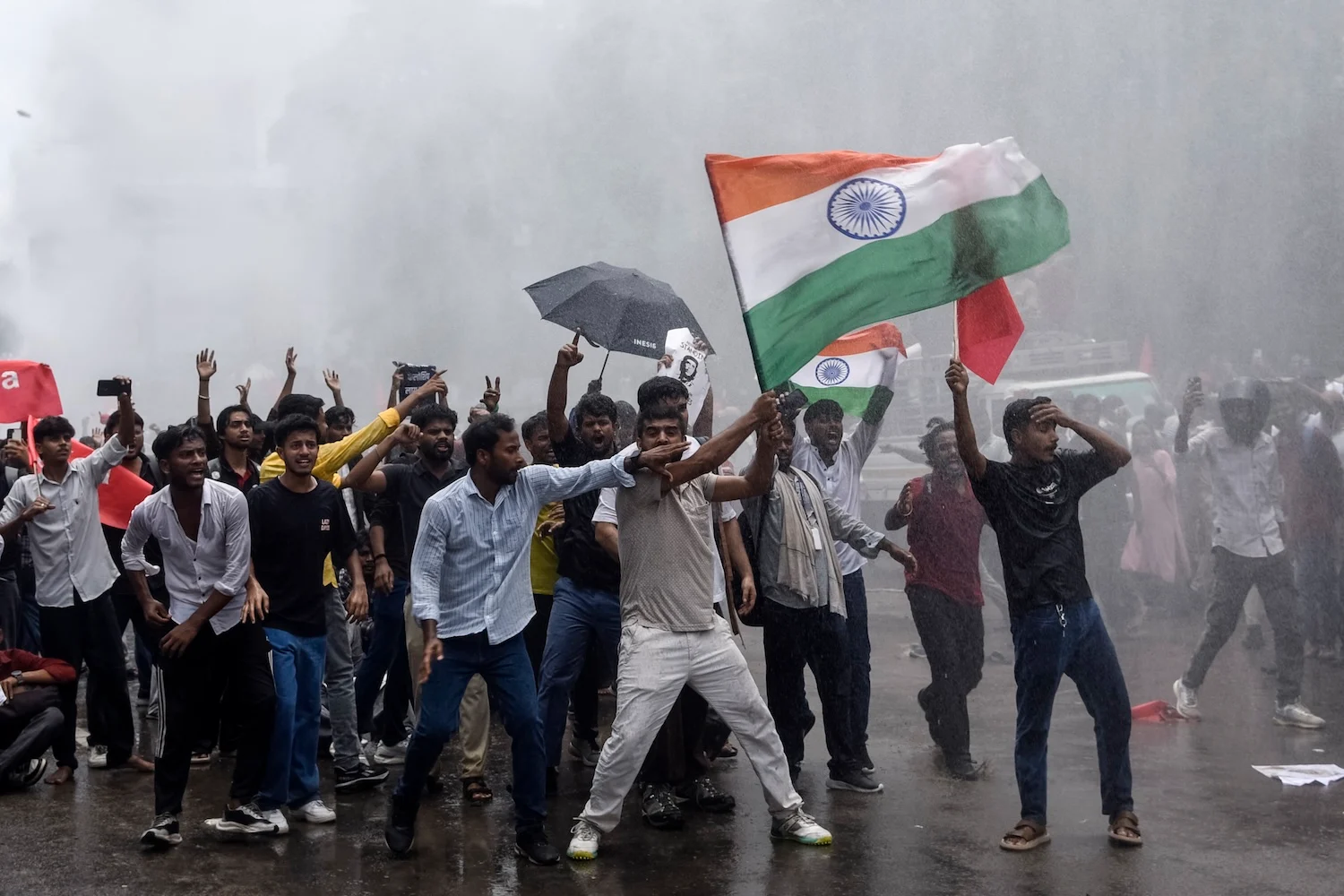
The fierce, Generation Z-led revolt that spilled over last month was directed squarely at Indian Prime Minister Narendra Modi’s government. The movement, which initially christened itself the Cockroach Janta Party in a satirical response to a derogatory remark by India’s chief justice, picked up young people’s anger over leaked exam papers and brought tens of thousands of protesters to the streets of New Delhi to march toward Parliament.
When the writer V.S. Naipaul traveled across India decades ago, he famously described the country as a land of a million mutinies, fracturing into myriad localized particularities, each subcaste and interest group with its own sectarian voice. Recent events in India, however, show how a splintered society can start to coalesce.
The fierce, Generation Z-led revolt that spilled over last month was directed squarely at Indian Prime Minister Narendra Modi’s government. The movement, which initially christened itself the Cockroach Janta Party in a satirical response to a derogatory remark by India’s chief justice, picked up young people’s anger over leaked exam papers and brought tens of thousands of protesters to the streets of New Delhi to march toward Parliament.
On July 25, they won a stunning victory with the resignation of Education Minister Dharmendra Pradhan. These young people turned anger into action and forced a powerful leader to listen, discarding the traditional Indian deference to authority or age—with smartphones in hand, even as police deployed batons and pellet guns. As with recent youth-led movements in Bangladesh, Nepal, and Sri Lanka, violent police action in India failed to deter the protesters.
The movement exposed a new form of political pressure that was faster, looser, and harder to contain, underscoring how politics now works for a generation that has grown up online. The future of Indian democracy depends on the response of the state in the coming weeks and months. If Modi responds to the protests as a security challenge instead of a warning about public sentiment, he risks deepening the grievances that sparked the unrest and transforming them into a protracted crisis.
What set the Cockroach movement protests apart was not simply their scale. India has seen bigger mobilizations, louder rallies, and more dramatic confrontations with the government. Their significance lay in how young the demonstrators were, how they were organized, how they spoke, and what they made possible. Digital media was the movement’s organizing tissue, allowing collective anger to mutate and stay alive even as police pressure increased.
As the protesters recorded and shared police brutality in real time, the state crackdown itself became part of the story. Videos seemed to define the movement around defiance in the face of police barricades, violence, and arrests—resonating beyond the specific grievances that triggered it. It became about the relationship between the state and a younger public that is less willing to accept official humiliation as a civic norm and sees little reason to trust official narratives. The ruling Bharatiya Janata Party (BJP) and its infamous propaganda machine have real limits against these digital natives.
Gen Z makes up one-quarter of India’s population. The young protesters were driven together by a kind of existential crisis: The promise of socioeconomic advancement in a hierarchical society, which was guaranteed by a fair examination system that could be cracked by hard work, has broken down. The structural failures of the Indian economy, where nearly 40 percent of graduates under 25 are unemployed, could no longer be ignored in favor of the emotive issues of religion and nationalism.
For India’s 300 million young people, there are only 15 million meaningful jobs, referring to a salaried job with a contract and social security. This severe lack of viable employment created a unified demographic of discontent, transcending fault lines of caste, class, region, and religion. Modi has repeatedly promised economic prosperity, but his government has delivered precarious gig work and stagnant wages for 12 years. A deep sense of betrayal among the youth fueled the relentless energy of these street protests.
Modi has spent a decade building an image of absolute personal authority, claiming credit for every policy success; his picture is plastered on every vaccine certificate and rice bag. In 2024, an ethnographic data project based on more than 100 interviews revealed that young people’s ire for a lack of jobs was directed at “the market” but now seems to have turned on Modi for the destruction of opportunities.
The protest rhetoric was sharp, mocking, crude, and often abusive toward Modi. The use of vulgar street slang to communicate deep grievances stripped the 75-year-old leader of his carefully cultivated authority. The most popular slogan seen during the protests roughly translates as (in polite language): “The truth is bitter like a neem tree leaf: Modi is a bloody pimp.” This seemed to shatter the manufactured invincibility of the BJP and its popular leader.
India’s ruling establishment has long built Modi into someone beyond ordinary public attack, a figure insulated by charisma, propaganda, fear, and the projection of authority. These protests punctured that aura, personally targeting Modi with an inspired insolence.
Perhaps the most consequential achievement of the protests was psychological. Fear of the Modi regime in India, classified as an electoral autocracy by global watchdogs, began to erode. That fear is difficult to measure, but it is central to Modi’s political power. To dominate public life, his government has only needed enough people to believe that speaking out is dangerous and criticism will end badly. These protests disrupted that conventional wisdom; demonstrators returned to reoccupy the protest site even after police action, showing the cost of fear was higher than the cost of defiance.
The Cockroach protests have created a rare political opening against Modi. India’s opposition parties, such as the Indian National Congress and its alliance partners, were agile enough to fuse their parliamentary strategy with the street movement, creating a unique pressure point for the BJP. These parties tried to amplify and not appropriate the voices of the protests, but they have a bigger task going ahead.
The opposition’s political strategy, organizational strength, communication techniques, and leadership will have to be more responsive and robust to translate this unrest into a decisive electoral mandate that ends Modi’s grip on power—lest this Cockroach episode end up as just one loss from which he recovers.
Institutional decay under Modi exacerbates the crisis for the opposition. During its years in power, the BJP has systematically weakened India’s judiciary, Parliament, statutory bodies, and the Election Commission. A healthy democracy should not require its youth to risk police violence to be heard. People took to the streets because the formal avenues to redress grievances are broken. This risks eroding trust across the whole political spectrum, leaving the opposition just as discredited as the incumbents.
The Cockroach protests also belong to a regional pattern in South Asia, where younger citizens are becoming more willing to directly challenge authority in visually sharp and digitally connected ways. The common thread is exhaustion with old elites, stale slogans, and political systems that seem to fatten themselves rather than serve the public.
Nepal, Bangladesh, Sri Lanka, and now India all sit in the same moment of churn. Economic strain, weak institutions, and political polarization are colliding with a world marked by war, strategic rivalry, and uncertainty. Governments have less room for error, and the public has less patience for incompetence. Instead of isolated bursts of anger, these youth-led protests have become tests of whether states can still govern with legitimacy rather than rule by fear.
The biggest lesson of last month’s protests in India is that the political atmosphere has changed. People are more willing to laugh at authority and not just denounce it. The momentum generated by these protests could rejuvenate fading democratic institutions. A democracy becomes healthier when citizens believe they can still speak freely, mock power, and force a response without being crushed.
The Cockroach movement suggests that this belief is still alive in India. By occupying the streets and demanding accountability, the youth reclaimed the meaning of popular sovereignty.
However, a darker path for India remains equally possible and perhaps more likely. The ruling political establishment will not surrender its total dominance easily. It might choose violent retaliation over democratic accommodation. India currently serves as the primary global testing ground for modern digital authoritarianism, and the Modi government could deploy newer surveillance technologies to crush future dissent completely.
Repression can suppress a movement for a time but cannot remove the conditions that produced it. In fact, it often deepens them. When public anger is met with coercion, the rulers may regain short-term order while losing longer-term political legitimacy to govern. In the coming year, as economic grievances persist, a fresh catalyst could see these decentralized youth networks mobilize faster and with greater anger. If Modi chooses to escalate to a level of visible coercion, he runs the risk of irrevocably fracturing his governing authority, widening the movement’s appeal and leading to a strategic and electoral setback.
These protests mattered because they revealed both the fragility of Modi’s political aura and the continued possibility of democratic pressure in India. The Cockroach movement seems to present a choice: The state can absorb the message and adjust—or it can harden, punish, and deepen the distrust that the protests exposed.
One path could make Indian democracy stronger, while the other would push it further toward the tendencies that weaken it. Those in South Asia and beyond will watch intently as the world’s largest democracy grapples with its youngest and angriest citizens.
—
Sushant Singh is a lecturer in South Asian studies at Yale University and consulting editor with India’s Caravan magazine. He was previously the deputy editor of the Indian Express and served in the Indian Army for two decades.
