


Welcome back to World Brief, where we’re looking at deadly Houthi strikes on Saudi Arabia, the United Kingdom’s scaled-back diplomatic mission in East Jerusalem, and trade talks between China and the European Union.
Regional War
Yemen’s Houthi rebels launched a ballistic missile at King Khalid International Airport in Riyadh on Thursday in an effort to force Saudi Arabia to shut down its airspace. The assault marked the Iranian proxy group’s second consecutive day of strikes on the facility, with a drone attack the day before killing at least one person. Material damage was reported following the incident, and Lufthansa and Air India both announced that they were suspending flights to the Saudi capital.
Welcome back to World Brief, where we’re looking at deadly Houthi strikes on Saudi Arabia, the United Kingdom’s scaled-back diplomatic mission in East Jerusalem, and trade talks between China and the European Union.
Regional War
Yemen’s Houthi rebels launched a ballistic missile at King Khalid International Airport in Riyadh on Thursday in an effort to force Saudi Arabia to shut down its airspace. The assault marked the Iranian proxy group’s second consecutive day of strikes on the facility, with a drone attack the day before killing at least one person. Material damage was reported following the incident, and Lufthansa and Air India both announced that they were suspending flights to the Saudi capital.
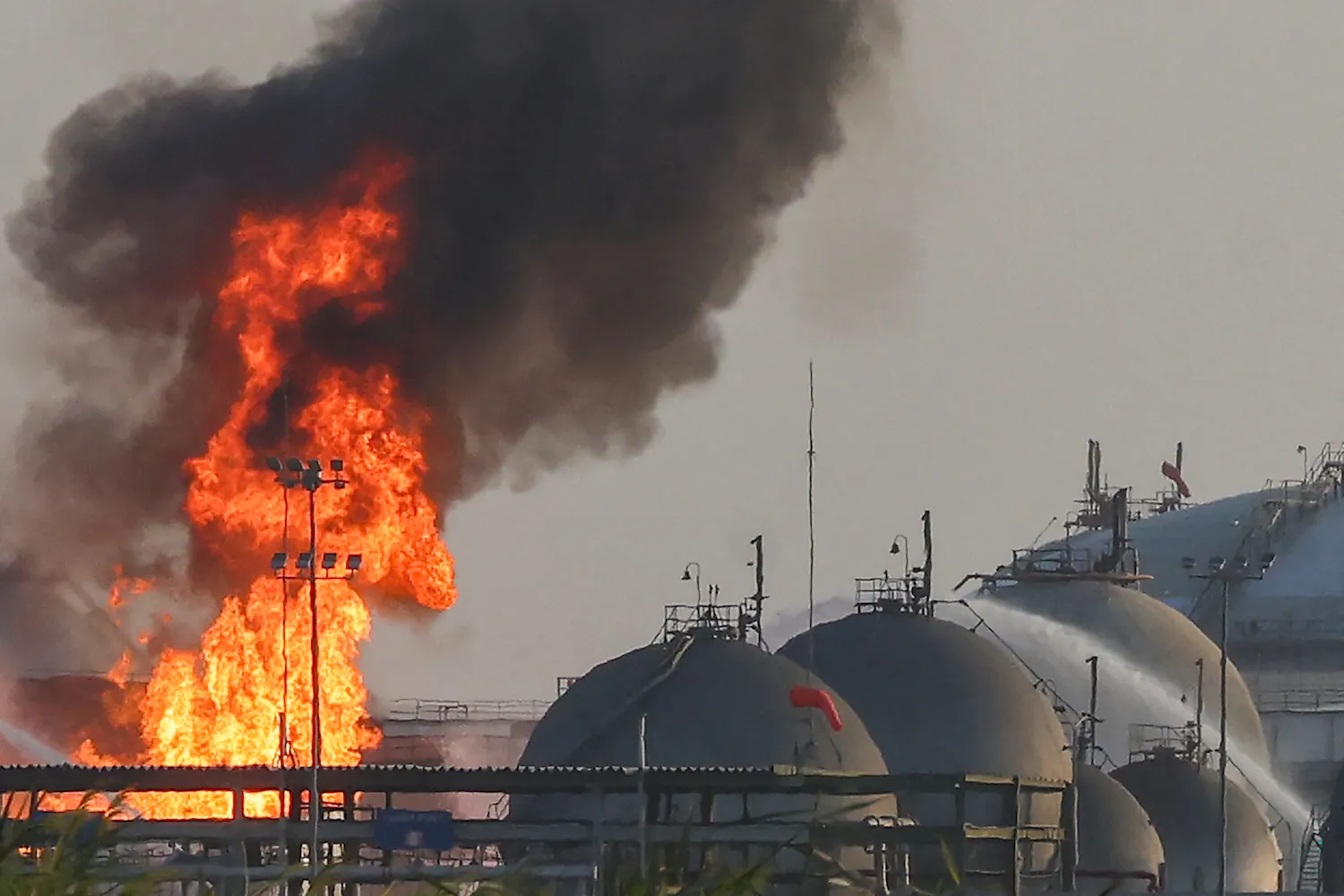
Houthi attacks on Saudi Arabia began in late July, and in recent weeks, the rebel group has only accelerated its assault on critical infrastructure, including oil refineries, and Muslim holy sites. This week, explosions have rocked several cities in southern Saudi Arabia, killing at least three people and wounding dozens of others. Debris from an intercepted Houthi missile also reportedly hit a Saudi medical complex and a kindergarten.
Yemen’s internationally recognized, Saudi-led coalition has responded with a counteroffensive. Dubbed “Dawn of Yemen,” the operation aims to retake the territory that the rebel group has seized along the Red Sea coast, including the strategic Bab el-Mandeb strait. According to the coalition, Yemeni forces have “neutralized” 1,860 Houthi fighters since launching the counteroffensive on Monday.
What was once a series of clashes between Houthi forces and Saudi-led Yemeni troops is now heading toward becoming a regional war. This week, Pakistan and Turkey triggered a recently inked mutual defense pact to come to Saudi Arabia’s aid, and on Thursday, three U.S. defense officials told Axios that Syria was considering providing military support to Riyadh, including a potential offensive deployment.
Experts argue that such involvement exacerbates the religious component of the conflict; Saudi Arabia, Pakistan, Turkey, and Syria are all predominantly led by Sunni Muslims. Yemen’s Houthis, meanwhile, follow the Zaydi Shiite sect and are backed by Shiite Iran.
It also puts new pressure on Saudi Crown Prince Mohammed bin Salman, whose efforts to transform Saudi Arabia into a business and tourism hub have been upended due to repeated attacks on the capital. Riyadh is scheduled to host several international summits in the near future, including the annual Future Investment Initiative, which has become a main avenue for the crown prince to attract foreign capital.
Today’s Most Read
What We’re Following
Consulate status. The United Kingdom reached a last-minute deal with Israel on Thursday to avoid the closure of its consulate in East Jerusalem. However, the two sides appeared to outline different futures for the diplomatic mission, leaving experts confused as to the status of London’s presence in the Israeli-occupied Palestinian territory.
Last month, Israel threatened to shutter the consulate in response to the United Kingdom’s decision to sanction Israeli settlements in the occupied West Bank. London reportedly warned that the building’s closure would result in retaliatory measures, including the possible expulsion of Israeli diplomats, and it reiterated its belief that Israel has no legal right to close a foreign mission located in Palestinian territory. Britain has repeatedly condemned Israeli settler violence in the West Bank and East Jerusalem.
On Thursday, British Foreign Secretary Ed Miliband said the U.K. consulate will be transformed into a new “independent, operational” facility that will continue to deliver vital services to Palestinians, going on to suggest that its reduced staff will only be temporary and will be built back up in the coming months. Yet Israeli Foreign Minister Gideon Saar said that the “British Consulate in Jerusalem is ending its operations today” and that its task force of only seven diplomats will have a “very limited” mandate. It is unclear what that mandate will entail.
Reducing Europe’s reliance. European Union trade chief Maros Sefcovic kicked off two days of trade talks with China on Thursday focused on decreasing the bloc’s growing trade deficit with the country, which is estimated to be worth more than $1.12 billion each day, to better protect European industries and reduce the bloc’s reliance on Beijing. Among Brussels’s top priorities, it seeks to limit imports of Chinese hybrid vehicles and get clarity regarding Beijing’s curbs on exports of rare earths.
Negotiations are likely to be a delicate balancing act. Some EU members, specifically Germany and France, have called for stronger defense measures against China, including the creation of a last-resort mechanism that could cut off Beijing from the bloc’s single-market economy. According to Sefcovic, the EU wants “tangible results” that it can present to EU leaders during a meeting in Brussels later in October.
However, other European officials fear that pushing China too hard could result in retaliatory measures. As of now, it is unclear which products Beijing might agree to curb, if any. The Financial Times reported on Wednesday that China had already rejected a request to limit plug-in hybrid electric vehicle shipments to the EU, which had increased by 86 percent year-over-year as of September.
The death of a national symbol. Thousands of Spaniards took to the streets on Wednesday following the death of María del Carmen Abascal, an 87-year-old Madrid resident who became the symbol of Spain’s housing crisis. Abascal was evicted from her home of more than 70 years in late September after the investment firm that had purchased her apartment hiked her rent by 230 percent. Although Abascal’s legal team was able to successfully fight the eviction notice, the stress appeared to be too much for the woman, who was transferred to a hospital where she was treated for severe anxiety and exhaustion after being removed from her home via stretcher. Abascal died on Wednesday.
“This is not a death. It’s a murder!” protesters chanted at Puerta del Sol, a central Madrid square where demonstrators had set up a tent encampment to demand greater tenant protections. Marches also took place in Barcelona on Wednesday, and Spanish trade unions announced a nationwide general strike on Nov. 11 in support of the cause.
Abascal’s death is likely to inflame already heightened tensions across the country. On Monday, Prime Minister Pedro Sánchez called for snap elections after his minority government failed to pass emergency measures to address protesters’ demands. And on Thursday, members of Spain’s left-wing parties held a minute of silence outside of Madrid’s town hall in remembrance of Abascal.
Odds and Ends
Canadian poet and essayist Anne Carson was awarded the Nobel Prize in literature on Thursday for transforming ancient Greek texts into contemporary prose. Her most notable works include Autobiography of Red: A Novel in Verse, which retells Hercules’s 10th labor as a modern teenager’s tragic love affair; and Eros the Bittersweet, which traces representations of love through ancient texts. When Carson learned of her Nobel win on Thursday, she reportedly told Ingrid Carlberg, the Swedish Academy’s permanent secretary, that she was in Iceland “listening to the wind.” Very poetic, indeed.
