


Three days was all it took for the Trump administration’s Colorado River plan to see a legal challenge from, somewhat ironically, Nevada.
Of the seven states that rely on the river, Nevada gets the smallest amount by law.
Nevada water managers said the long-term impacts from the proposed cuts could be devastating—with Las Vegas bearing some measure of the pain.
Under the federal plan, southern Nevada could—in future years—lose over 70 percent of its already-sparse Colorado River allocation while Colorado, Utah, New Mexico and Wyoming won’t face any mandatory cuts, Nevada officials said Monday.
The reductions “could have catastrophic impacts on our economy and the way people live here in southern Nevada,” John Entsminger, general manager of the Southern Nevada Water Authority, told Inside Climate News.
Entsminger highlighted that the Colorado River provides 90 percent of the water supply for 76 percent of Nevada’s population.
“This is a statewide issue in terms of the economic impacts that would be felt if these sorts of arbitrary and draconian cuts were imposed upon us,” Entsminger said.
Given those fears, the state asked the U.S. District Court of Nevada to order the federal Bureau of Reclamation to revoke its plan, according to the 31-page lawsuit. The Trump administration’s plan violates a complicated set of policies, laws, court cases and prior agreements (known as the “Law of the River”), unfairly makes life tougher for three states and does not require four other states to make water restrictions, Nevada officials said.
The Department of the Interior could not immediately be reached for comment Monday.
Brandon Gebhart, Wyoming’s state engineer and lead Colorado River negotiator, said the Cowboy State is concerned by any assertion that the Bureau of Reclamation should consider and impose mandatory conservation measures and reductions in the Upper Basin.
“We take involuntary, hydrology-driven cuts every single time there is a drought,” Gebhart said in a statement to Inside Climate News. “We will oppose any attempt to use federal administrative guidelines to unnecessarily drain our limited storage or burden Wyoming citizens with additional hydrologic risks.”
The Colorado River supplies water to between 35 and 40 million people across seven Western states, 30 Native tribes as well as two Mexican states. The river is also crucial to about 5 million acres of farmland.
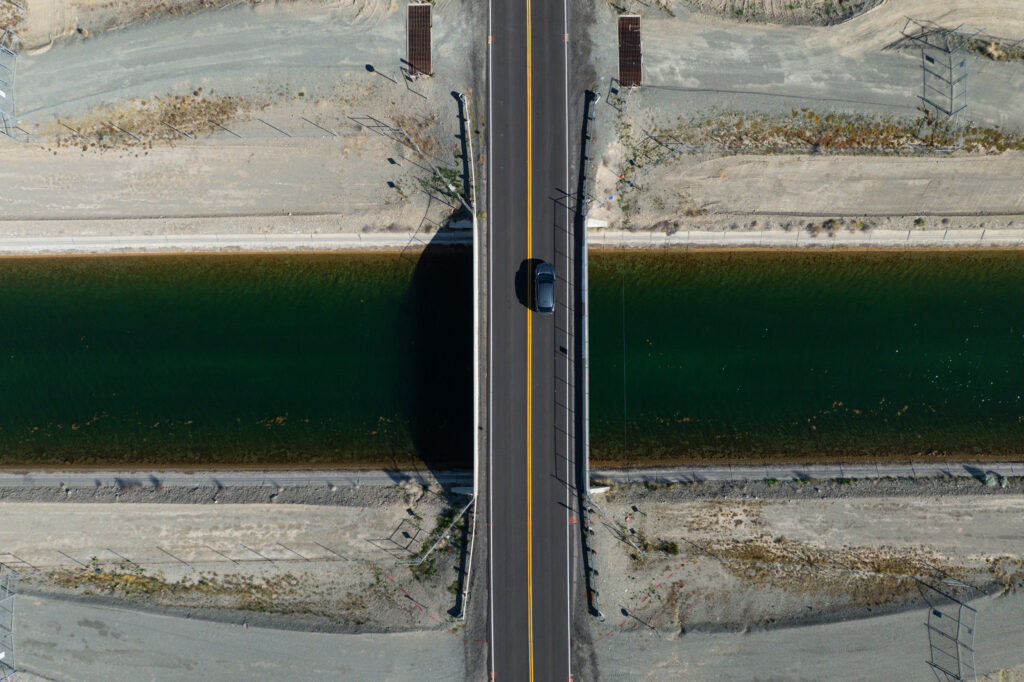
Last week, the Trump administration released a plan that requires Nevada, Arizona and California to cut water use by roughly 20 percent over the next two years. More substantial cuts would be permitted if needed in the next decade to keep the river’s drought-stricken reservoirs from dipping to dangerously-low levels.
“This isn’t about political posturing,” Nevada Governor Joe Lombardo, said in a statement after the lawsuit was filed. “This is a matter of survival for a community that represents about two-thirds of our state’s citizens and the lion’s share of its economy.”
The 1922 compact between the Colorado River’s users assumed that about 17.5 million acre-feet of water was available to the river’s upper and lower basins and Mexico. However, the historical average of the river’s natural flow has only been roughly 14.7 million acre-feet. That fell to an average of 11.2 million acre -feet between 2020 and 2024, according to provisional data from the Bureau of Reclamation.
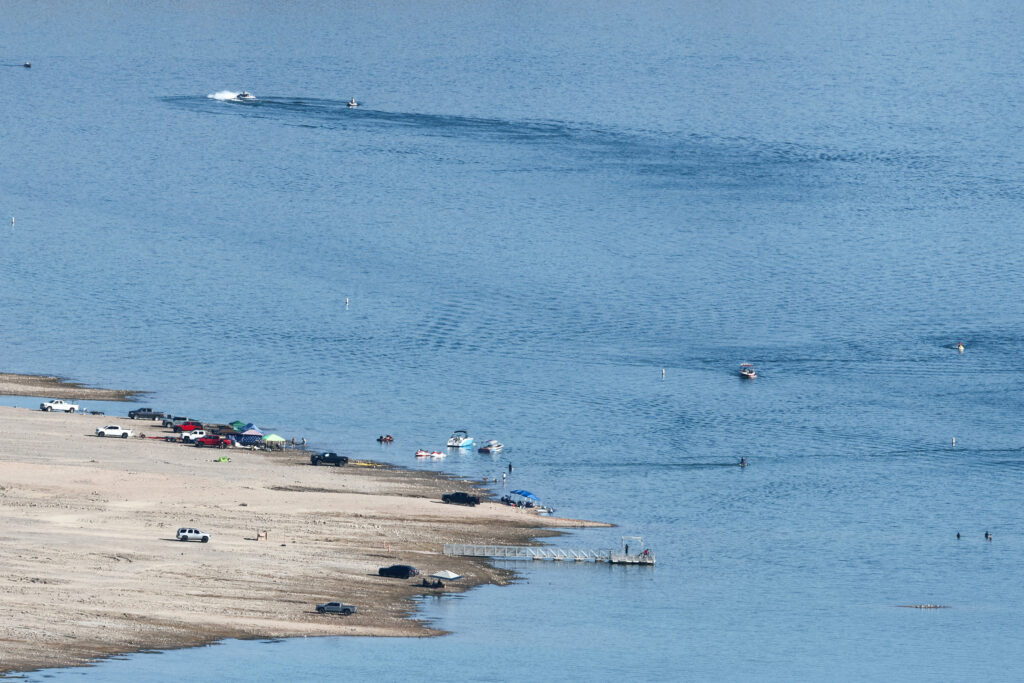
The Colorado River’s reservoirs have declined amid a historic 26-year drought that researchers say is being exacerbated by climate change. Lake Mead and Lake Powell, the river’s largest reservoirs, have fallen to record lows.
While Nevada has had ongoing talks with California and Arizona on the Colorado River negotiations, Entsminger said Nevada filed the lawsuit on its own.
Experts said Monday that the other two states may sign on to the suit as well.
This story is funded by readers like you.
Our nonprofit newsroom provides award-winning climate coverage free of charge and advertising. We rely on donations from readers like you to keep going. Please donate now to support our work.
An Arizona Department of Water Resources spokesperson said Monday the state was still evaluating Nevada’s complaint and working on next steps. Officials in California said the state was also reviewing the complaint and was unable to comment.
Colorado officials said Monday they are reviewing Nevada’s filing.
With Monday’s lawsuit, Nevada is challenging the Trump administration ten-year plan they said cuts the state’s annual portion of 300,000 acre-feet of water to as little as 86,500.
The highly-contentious matter may ultimately reach the Supreme Court.
“It isn’t unexpected that there would be litigation over the new rules from the Department of the Interior for operation of the Colorado River,” Anne Castle, a senior fellow at the Getches-Wilkinson Center at the University of Colorado Law School and a former assistant secretary for Water and Science at the Interior Department, said Monday.
Castle—noting that Arizona was widely expected to litigate—said it was only somewhat surprising Nevada took “the first shot.”
Nevada’s complaint requests that even the two-year, short-term plan for the Colorado River be rescinded, but Castle noted operations would need to continue to supply states with water.
The Department of the Interior “has to operate the Colorado River and its infrastructure while any lawsuits are pending, and it’s unlikely that a court would take it on itself to define how the river will be operated,” Castle said.
David Feldman, a professor emeritus in the Department of Urban Planning and Public Policy at the University of California, Irvine, said what complicates matters on the Colorado River further is that self-imposed cuts by states have not been enough over the years. That includes drastic cutbacks from Las Vegas.
“For starters, consider that all seven states have either initiated plans or taken actions to conserve or reduce water uses—especially urban uses, so it is not true that they have taken no measures in light of the multi-year mega-drought,” Feldman said Monday.
However, he said the amount of reductions that will be required to sustain and stabilize the basin’s water supply will require annual cuts in consumption of at least 3 million acre-feet (or 980 billion gallons), and probably 4 million acre-feet, or 1.3 trillion gallons.
Legal challenges like those filed this week are only bound to complicate, and lengthen the timeline for, any negotiations that happen going forward, various experts said.
Does Entsminger—who leads talks for Nevada— hope Monday’s lawsuit forces parties to come to an agreement outside the courts?
“I do,” Entsminger said.
“I think the best solution is always giving the seven states and the federal government room to agree upon a solution that maybe nobody loves, but that everybody can live with.”
Wyatt Myskow and Jake Bolster contributed to this report.
About This Story
Perhaps you noticed: This story, like all the news we publish, is free to read. That’s because Inside Climate News is a 501c3 nonprofit organization. We do not charge a subscription fee, lock our news behind a paywall, or clutter our website with ads. We make our news on climate and the environment freely available to you and anyone who wants it.
That’s not all. We also share our news for free with scores of other media organizations around the country. Many of them can’t afford to do environmental journalism of their own. We’ve built bureaus from coast to coast to report local stories, collaborate with local newsrooms and co-publish articles so that this vital work is shared as widely as possible.
Two of us launched ICN in 2007. Six years later we earned a Pulitzer Prize for National Reporting, and now we run the oldest and largest dedicated climate newsroom in the nation. We tell the story in all its complexity. We hold polluters accountable. We expose environmental injustice. We debunk misinformation. We scrutinize solutions and inspire action.
Donations from readers like you fund every aspect of what we do. If you don’t already, will you support our ongoing work, our reporting on the biggest crisis facing our planet, and help us reach even more readers in more places?
Please take a moment to make a tax-deductible donation. Every one of them makes a difference.
Thank you,

Reporter, California
Steven Rodas covers water, wildfires and agriculture throughout California for Inside Climate News. Based in Los Angeles, he previously reported on the environment in New Jersey, covering energy, pollution, wildlife and development. Steven’s work has appeared in the San Francisco Chronicle, NJ.com/The Star Ledger and Grist. He worked as a copywriter at Google. Steven has a master’s degree from Syracuse University’s S.I. Newhouse School Of Public Communications. He is fluent in English and Spanish (and welcomes your tips).
