


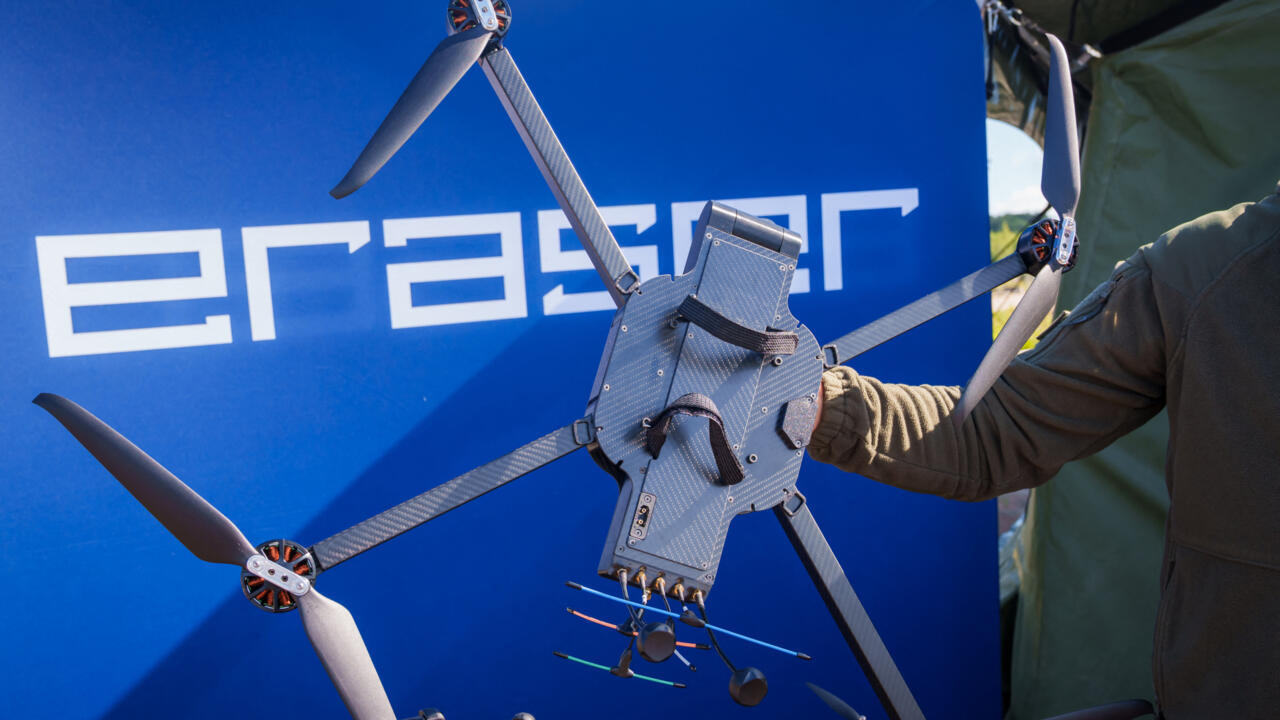
One of the lessons of the war in Ukraine is that military technology evolves very rapidly, with the world’s first-ever drone war making it harder for conventional armies to make gains on the battlefield.
But they may also herald a new dystopian future, where ordinary civilians become targets of flying objects manned by faraway operators.
Entrepreneurs in Lithuania, Latvia and Estonia have taken note.
The Baltic region is already home to several companies that are well known internationally, such as Bolt, Skype and Vinted. Since Russia launched its full-scale war in Ukraine in February 2022, the startup scene has focused on developing defence technologies.
The resulting innovations may be a low-cost and scalable solution to deterring Russian aggression, experts told FRANCE 24.
Faced with technological shifts on the battlefield in Ukraine, “startups tend to be able to equally rapidly develop technologies themselves”, said Tony Lawrence, research fellow at the International Centre for Defence and Security.
“It’s about providing niche solutions that bigger defence primes don’t traditionally have the ability to deal with,” he added.
The startups focus on autonomy – combining AI with hardware, drones and edge computing to operate in environments where GPS or communications have been jammed – as well as domains like software, cybersecurity and electronic warfare.
The Baltic states are quite conscious of their strategic weaknesses in the face of the Russian threat and aware that Moscow has been waging a hybrid war against them for years.
Read moreDrones, sabotage, surveillance: Moscow’s hybrid warfare takes to the high seas
“The whole rearmament process that the Baltic States and NATO in general are going through at the moment is dealing with the potential of a Russian attack on one of the NATO member states, including one of the Baltic states,” said Lawrence.
But the hybrid threat is more of an immediate worry, added Lawrence.
Read moreRussian secret services target Latvia as Ukraine’s drone offensive worries the Kremlin
Innovations to counter Moscow
The Baltic states face frequent disinformation and propaganda from Russia. “After Soviet occupation, many people in the region still understand Russian. As a result, it is easier for Russian propaganda to spread its lies,” said Darius Antanaitis, a defence analyst from Lithuania.
One of the most promising AI startups to counter the propaganda is Repsense in Vilnius, according to Antanaitis. “It has developed tools capable of identifying the original sources of propaganda, tracing its dissemination, measuring its impact, and more.”
The company “helps uncover the truth and prevent propaganda from spreading in the future, or perhaps even neutralize it before it spreads”, he said.
Another startup with potential is DefSecIntel based in Tallinn, said Lawrence. The company, which provides surveillance for borders and critical infrastructure protection, helps conceptualize “the hybrid environment and being able to respond to it”.
Faced with a potential US disengagement from its security obligations over the European continent, the Baltic states have massively invested in their defence systems. Lithuania directs more than 5% of its GDP on defence in 2026, the highest share among NATO allies.
Read morePoland prepares to stand its ground with massive new civil defence programme
Yet “not as much money as you would imagine” is trickling down to the startups, said Lawrence. “The three [Baltic] states are spending a lot on defence in GDP terms; but in cash terms, it doesn’t amount to a huge amount. They also have other priorities in terms of conventional armaments, long-range weapons and artillery.”
For startups to be self-sustaining, they must be in the export business, Lawrence explained. “That said, Estonia is encouraging its defence companies more than it did, perhaps, three or four years ago, with various grant schemes that can assist the companies for the domestic market but also for export markets.”
Defence innovation also works in the Baltic states because of the nurturing startup culture that exists there.
A deterrent effect
“The three Baltic states all started from scratch in basically everything when they became independent in the early ’90s,” Lawrence said. “That included, particularly in Estonia, e-governance and a digital state. You didn’t have a legacy that it had to maintain. It was starting from scratch. This kind of innovative spirit as to how you might run a state started back then and that kind of culture has been retained.”
Defence also has strong public consensus in the Baltic countries.
“Everybody thinks it’s important and everybody is ready to do their part. Part of that might be finding venture capital to fund startup companies who can make a difference in defence,” he said.
And it is hoped that this sort of rapid innovation will have its own deterrent effect.
Estonia wants Russia to think twice, knowing that it cannot just bring its “war-tested defence technology and use it against Estonia, and expect that Estonia will not have the ability to innovate … and find countermeasures to what [Russia is] bringing to the game”.
