


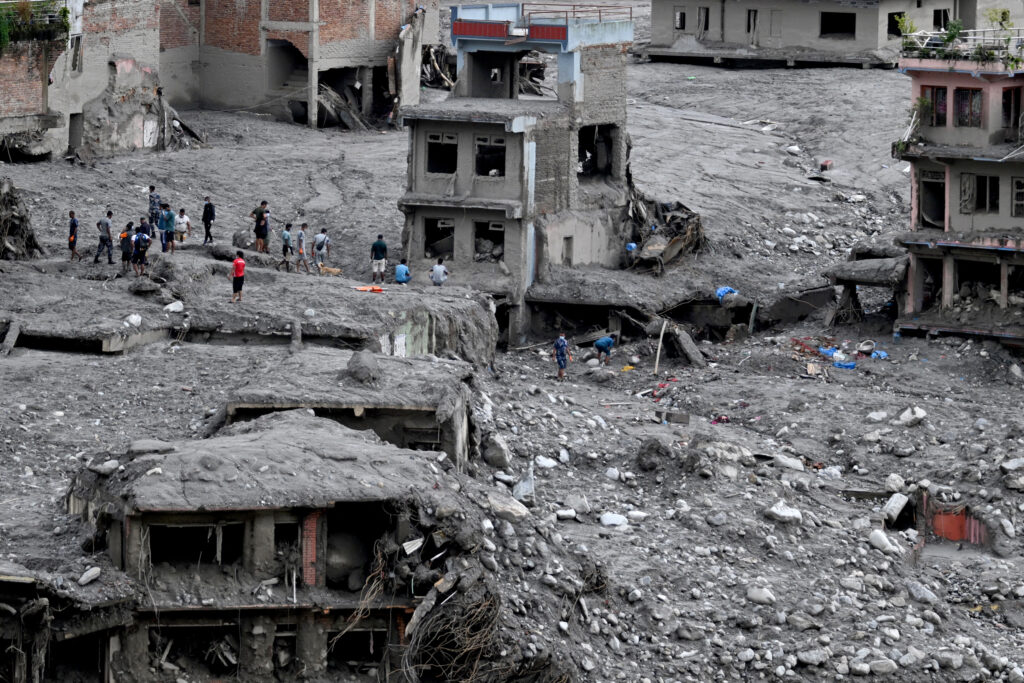
Climate attribution researchers say “there is absolutely no doubt” that decades of global warming set the stage for the deadly rock and glacier collapse on Langtang Lirung Mountain in Nepal.
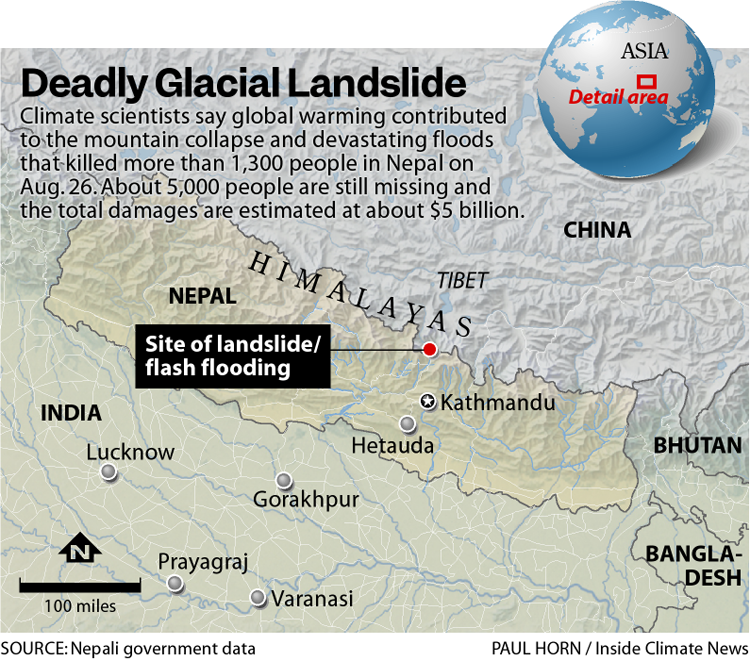
At least 1,300 people died in August when a cascade of semi-frozen sludge, boulders, trees and other debris roared through the region at speeds up to 100 mph and crested up to 300 feet high. The disaster destroyed and damaged towns, farms, orchards, roads, bridges and energy infrastructure, devastating livelihoods across the region. The total losses are now estimated at about $5 billion.
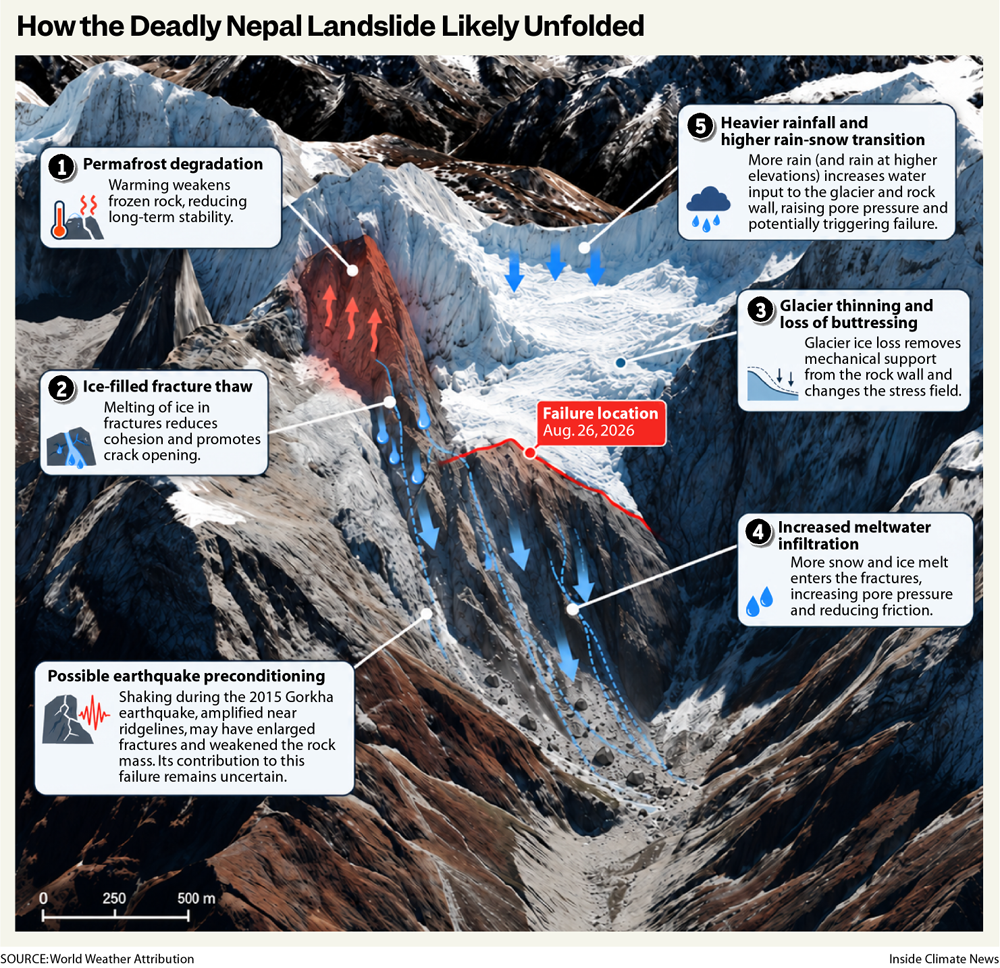
In a new analysis of the Aug. 26 disaster, a team of scientists with World Weather Attribution highlighted that record-hot temperatures baked the region in the months before the disaster. That was preceded by unusually high snowfall in late 2025, which is usually a very dry time for the region. Additional meltwater from the snow was probably another element in a complex chain of climate-linked factors contributing to the disaster, said Walter Immerzeel, a co-author of the new analysis.
Warming has hollowed out ancient ice and thawed the permafrost, the frozen ground that helps bind high mountain slopes together, leaving them increasingly vulnerable to collapse.
According to new estimates, about 116 million cubic meters of rock and ice initially broke away from the face of the mountain, the equivalent of a 96-square-block area of Manhattan breaking off all at once and plunging several thousand vertical feet within minutes. The size of the initial disintegration is unprecedented in the Himalayas, said Immerzeel, a mountain hydrologist at Utrecht University in the Netherlands who spent years researching in the region affected by the recent catastrophe.
The volume is about five times that of the most comparable mountain collapse and flood in the region, the 2021 Chamoli disaster in Uttarakhand, India. The increasing frequency and scale of mountain and glacier collapses and subsequent floods are signs of “fundamental, irreversible shifts in Himalayan mountain environments,” Immerzeel said.
Nepal has sought aid from an international fund for climate losses and damage set up through the United Nations climate framework. But the fund only has about $800 million pledged, with roughly $350 million available for claims, a fraction of the estimated damage from this single disaster.
The flood first swept through the upper Lhende valley and the settlements of Rasuwa district, including Rasuwagadhi and Timure, before surging through the Bhote Koshi and Trishuli river systems, about 100 miles downstream. About 5,000 people are still missing.
Immerzeel said the new analysis highlights the changes in background conditions that affect hazards for people and resources. That may be more consequential than identifying the exact trigger for a single specific event, several co-authors said during a press briefing on the new analysis.
“When you combine high-elevation permafrost degradation with glacier retreat and record summer heat, the structural integrity of these mountain walls is compromised.”
— Walter Immerzeel, analysis co-author
Immerzeel said climate change from burning fossil fuels is pushing the freezing line upward by roughly 100 meters per decade, heating bedrock that has been frozen in place for thousands of years and spreading that heat beneath the glaciers.
Some of the melting ice has been frozen for tens of thousands of years. Warm meltwater flows deep into cracks in the rocks, exerting enormous hydraulic pressure. Then it refreezes in winter, widening the fissures; when it melts again in spring, gravity takes hold.
“When you combine high-elevation permafrost degradation with glacier retreat and record summer heat, the structural integrity of these mountain walls is compromised,” he said. “The catastrophic impacts of what can then happen are clear for all to see.”
Co-author Fredi Otto, a climate scientist at Imperial College London, said the analysis shows how permafrost thawing, glacier thinning and more rain instead of snow had the effect of “preconditioning” the mountain for collapse.
She said scientists could be even more specific about how much human-caused warming contributed to the disaster with more detailed glacier modeling and readings from nearby glaciers. But that shouldn’t matter in the context of funding to cover the cost of climate impacts, she added, addressing the question of who should help Nepal pay for a climate disaster caused by billions of tons of carbon dioxide emissions from rich, developed countries.
Co-author Madhab Uprety, a technical expert with the Red Cross Red Crescent Climate Centre, said the extreme flood challenged basic assumptions about what communities in the region must prepare for.
This story is funded by readers like you.
Our nonprofit newsroom provides award-winning climate coverage free of charge and advertising. We rely on donations from readers like you to keep going. Please donate now to support our work.
Keeping pace with the rising risk requires continually reassessing how hazards are changing in a rapidly warming climate, and also “making sure preparedness systems keep pace with some of these emerging and cascading hazards,” he said.
Long-term development patterns in Nepal have also heightened the risk, as drought, water scarcity and declining agricultural productivity are spurring some people to relocate into steep and vulnerable mountain valleys, he added.
With rising global temperatures expected to increase the risk of catastrophic mountain system failures, the scientists said more measures could be taken to keep people safe.
Immerzeel said it would be impossible to monitor every potentially dangerous rock wall in the region. The best approach, he said, is to identify exposed river corridors with hydropower, infrastructure, towns and villages; scan upstream with radar and optical satellite imagery to find hotspots; and then use on-site rock-movement sensors and routine radar monitoring along with drones.
Timely warnings would require seismometers to detect the volume of material early, as well as remote cameras and more stream flow sensors in the highest valleys.
But even with such systems in place, Immerzeel said it might be impossible to predict a disaster as extreme as the collapse on Langtang Lirung Mountain.
About This Story
Perhaps you noticed: This story, like all the news we publish, is free to read. That’s because Inside Climate News is a 501c3 nonprofit organization. We do not charge a subscription fee, lock our news behind a paywall, or clutter our website with ads. We make our news on climate and the environment freely available to you and anyone who wants it.
That’s not all. We also share our news for free with scores of other media organizations around the country. Many of them can’t afford to do environmental journalism of their own. We’ve built bureaus from coast to coast to report local stories, collaborate with local newsrooms and co-publish articles so that this vital work is shared as widely as possible.
Two of us launched ICN in 2007. Six years later we earned a Pulitzer Prize for National Reporting, and now we run the oldest and largest dedicated climate newsroom in the nation. We tell the story in all its complexity. We hold polluters accountable. We expose environmental injustice. We debunk misinformation. We scrutinize solutions and inspire action.
Donations from readers like you fund every aspect of what we do. If you don’t already, will you support our ongoing work, our reporting on the biggest crisis facing our planet, and help us reach even more readers in more places?
Please take a moment to make a tax-deductible donation. Every one of them makes a difference.
Thank you,

Reporter, Austria
Bob Berwyn is an Austria-based reporter who has covered climate science and international climate policy for more than a decade. Previously, he reported on the environment, endangered species and public lands for several Colorado newspapers, and also worked as editor and assistant editor at community newspapers in the Colorado Rockies.
