


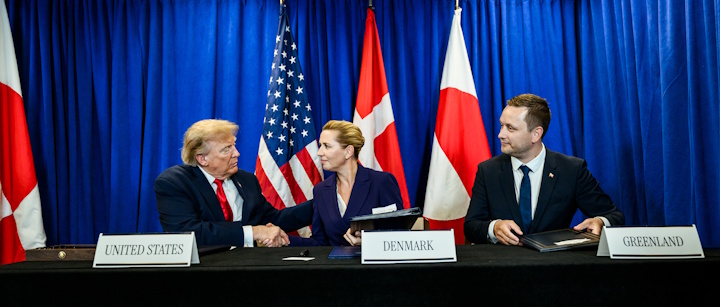
Under the terms of a new defense agreement between Greenland, Denmark and the United States, Greenland remains a self-governed territory of Denmark with the right to declare its independence in the future. The U.S. did not “get” Greenland, nor does it now “own” Greenland, as President Donald Trump has misleadingly said recently.
In January, at the World Economic Forum in Davos, Switzerland, Trump talked about wanting the U.S. to have “ownership” of Greenland, an Arctic island home to about 57,000 people, in order “to defend” it, and as part of a broader American national security strategy. “And all we’re asking for is to get Greenland, including right, title, and ownership, because you need the ownership to defend it. You can’t defend it on a lease,” he said.
He initially wouldn’t rule out taking Greenland over by force, as he had teased, but then said in his Davos speech: “I won’t use force.”
The new trilateral agreement doesn’t go as far as giving Greenland to the U.S. Primarily, it indefinitely allows the U.S. to expand its military presence in Greenland and prevents U.S. adversaries from doing the same. But as we’ve written, the previously existing defense framework already gave the U.S. great latitude to expand military operations in Greenland.
Greenlandic lawmakers formally approved the agreement on Nov. 3. It will go into effect if Danish lawmakers approve it after debate on the agreement later this month.
Trump talked about the pending deal at some of his midterm campaign rallies and in recent interviews, but he sometimes made it sound like something it’s not.
In a Fox News interview on Nov. 3, Trump said, “I got Greenland. We have Greenland, and nobody talks about it.” He said, “If I didn’t get it, there’d be massive fanfare, I can tell you. But we got it, and it’s permanent. It’s forever.”
In another Fox News interview earlier that day, Trump said Europe “gave the United States the greatest gift we were ever given … Greenland.”
Before that, during remarks in Washington, D.C., on Nov. 2, he said that “we also have Greenland now,” saying it was on “an unlimited basis.” When Trump brought up the military deal at an Oct. 25 campaign rally in Michigan, he said that “we own Greenland.”
He has also said the U.S. “got it for nothing” and that there was an “acquisition” of Greenland “for zero dollars.” (During his first term, Trump expressed interest in buying Greenland.)
We asked the White House about the president’s claims but have not received a response.
Update, Nov. 9: After publication, a White House spokesperson said the deal “secures permanent American security control over Greenland, ensures that Greenland will forever be a part of the strategic defense area of North America, and excludes any adversary from Greenland and the surrounding region.”
What’s in the Agreement
The agreement was originally signed on Sept. 22 by Trump, Danish Prime Minister Mette Frederiksen and Greenlandic Prime Minister Jens-Frederik Nielsen. It amends and supplements a 1951 defense pact, updated in 2004, that allowed the U.S. to establish a military base in Greenland.
Greenland served as a foothold for the U.S. amid competition with the Soviet Union in the Arctic during the Cold War. American interest in the region, which lapsed during the post-Cold War period, has been renewed in recent years because of “strategic competition” with Russia and China, according to a Congressional Research Service report from July 2025.
Under the new deal, activities at the U.S. base in Greenland, renamed Pituffik Space Base in 2023, can be modernized and expanded. The base conducts space surveillance and provides missile warning and defense.
In addition, the agreement says the U.S. “shall be allowed to establish an additional Defense Area at Narsarsuaq and Mestersvig in accordance with modalities and technical details to be mutually agreed” upon. It adds that the U.S. “may establish additional defense areas in Greenland and strengthen its military operations or facilities,” as long as those additional defense areas are agreed upon as well.
The new agreement also grants U.S. vessels and aircraft free movement between defense areas, including undersea access to Greenland’s territorial waters.
Unless the signatories all agree, nations that are not members of NATO will not be allowed to establish military installations in Greenland nor have “a persistent presence of military forces” in the territory. The U.S. will also get a say in whether countries that are not in NATO, a NATO partner or in the European Union, can invest in “sensitive sectors or activities” in Greenland, such as for the extraction of minerals and natural resources.
At the same time the agreement grants the U.S. more access in the region for defense purposes – including the establishment of a “Golden Dome” missile defense system that Trump has proposed – it also reiterates in its preamble that Greenland remains a part of Denmark with the right to self-determination, as was reaffirmed in a 2009 Greenland self-government law.
Should Greenland ever exercise its right to become an independent country, the agreement says the treaty will remain binding and Greenland will stay in NATO. The U.S. and Denmark are already members of the international defense alliance.
Not Much Different Than Before
While Trump has boasted about the new deal, experts in international relations have said it doesn’t grant the U.S. much more access in Greenland that it didn’t, or couldn’t, already have.
In a commentary piece published Oct. 2, Otto Svendsen, an associate fellow with the Europe, Russia, and Eurasia Program at the Center for Strategic and International Studies, said, “The deal gives the United States greater flexibility to augment its Arctic military posture, binds Greenland to NATO even if it achieves independence, and boxes U.S. adversaries out of the island.” But he also called it “only a marginal improvement” over the previous defense agreement.
“Existing agreements already allowed the United States to expand its presence in Greenland, and Copenhagen had long kept U.S. adversaries from investing in Greenland,” Svendsen wrote.
As we wrote earlier this year, Danish Minister of Foreign Affairs Lars Løkke Rasmussen said in January, following a meeting between U.S., Danish and Greenlandic officials, that “the U.S. has already a wide military access to Greenland,” and could ask for more under the 1951 defense pact. “We would examine any such request constructively,” he said.
For a story that same month, Mikkel Runge Olesen, a researcher at the Danish Institute for International Studies in Copenhagen, told the New York Times, “The U.S. has such a free hand in Greenland that it can pretty much do what it wants.”
And Svendsen wrote in his October piece, “The one genuinely new breakthrough — permanently binding a future independent Greenland to NATO and to U.S. basing — would likely have been on the table without threats to use military force against a treaty ally. Those threats have alienated one of the United States’ staunchest allies and damaged U.S. credibility across Europe.”
He said given that Trump once demanded full control of Greenland, “the deal is a considerable climb-down.”
Others have also said that the new agreement is a lot of what existed before.
Writing for the Council on Foreign Relations in a Sept. 29 piece, Diana Roy, the senior editor, and Jonathan Masters, the deputy managing editor, said, “Despite U.S. President Donald Trump’s previous calls to acquire Greenland, the deal preserves the status quo, maintaining the island’s status as a semiautonomous territory of Denmark.”
Similarly, Jacob Funk Kirkegaard, a nonresident senior fellow with the Peterson Institute for International Economics, wrote in a Sept. 24 piece, “Substantively, the new deal entrenches the existing status quo, making it a significant accomplishment for Danish and Greenlandic diplomacy, while affording Trump just enough changes to also claim victory.”
Editor’s note: FactCheck.org does not accept advertising. We rely on grants and individual donations from people like you. Please consider a donation. Credit card donations may be made through our “Donate” page. If you prefer to give by check, send to: FactCheck.org, Annenberg Public Policy Center, P.O. Box 58100, Philadelphia, PA 19102.
