


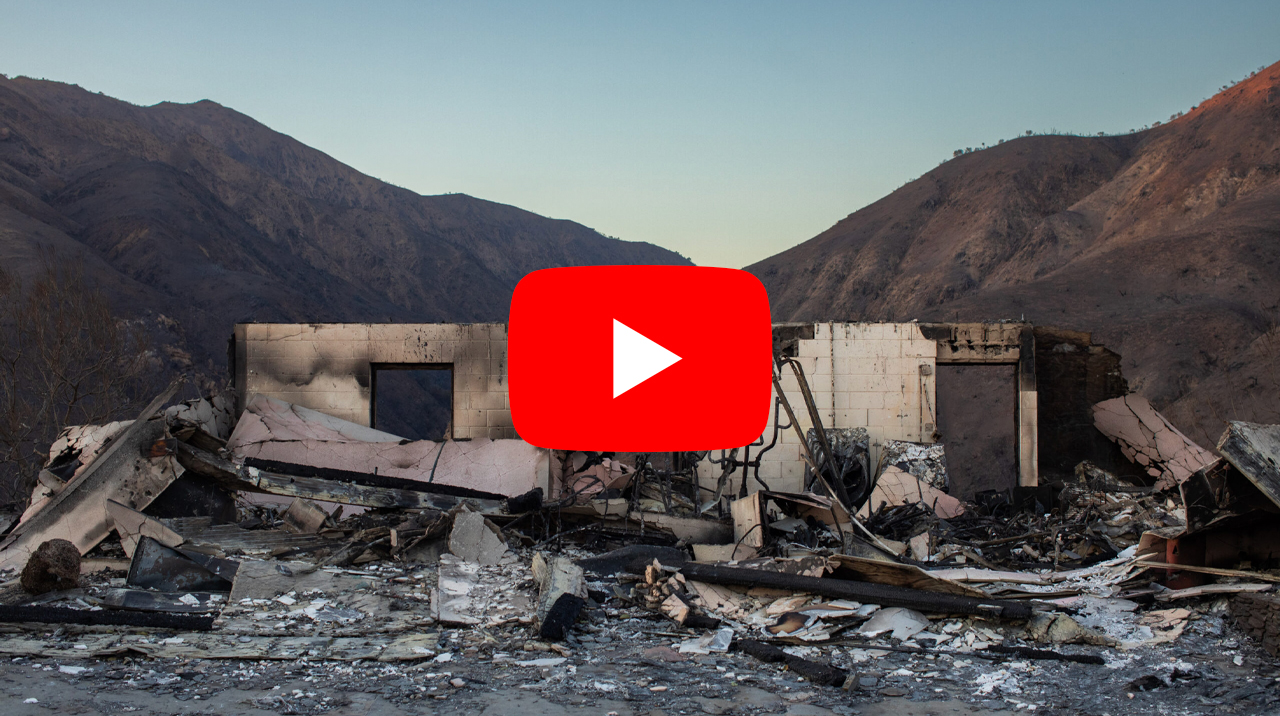
Welcome to Inside Climate, a podcast from the staff of Inside Climate News. Powerful wildfires upended life for residents in Maui, Hawaiʻi, in 2023. In early 2025, the Eaton and Palisades fires caused similar devastation in greater Los Angeles. Years have passed since the fires were contained but researchers are still trying to understand the lasting effects of these disasters. Co-host Kiley Price discusses those efforts with Inside Climate News reporter Keerti Gopal, who has chronicled the recovery in Maui, and contributor Nina Dietz, who has covered the health impacts of the fires in Los Angeles.
Listen and subscribe on YouTube, Spotify, Apple Podcasts, Amazon Music, and iHeart.
KILEY PRICE
It’s been three years since high winds spread multiple wildfires across Maui and eviscerated the town of Lahaina.
KEERTI GOPAL: The Maui wildfires were the deadliest fires that the U.S. has seen in more than a century.
Since then, researchers have been closely following thousands of survivors, trying to understand the fire’s lingering effects on human health.
KEERTI GOPAL: They’re finding elevated levels of these metals in survivors’ urine months after the fires.
MEDICAL WORKER: You’re gonna take a huge inhale.
KEERTI GOPAL: Some of these metals are linked to elevated cancer risks.
Meanwhile, Los Angeles is on a similar recovery path to Maui, due to the deadly Palisades and Eaton fires that covered portions of Los Angeles in ash almost two years ago.
NINA DIETZ: There’s this huge issue of contaminated homes. They have things like lead and cadmium, and in some cases, even cyanide and arsenic in crawl spaces.
As large, urban wildfires burn more synthetic materials, researchers are racing to better understand health impacts.
NINA DIETZ: A few scientists have actually brought up 9/11. There’s this real concern that we’re going to see this major cancer cohort that we do not have the capabilities to deal with and that could have been prevented.
That’s coming up on Inside Climate.
Welcome to Inside Climate. I’m your host, Kiley Price.
On Aug. 8, 2023 a red flag alert was issued by the National Weather Service in Honolulu, warning of “high fire danger with rapid spread.” That same day, fires tore across parts of Maui and leveled thousands of structures on the island’s western shore.
The flames have been extinguished, but the fire continues to leave its mark on thousands of survivors who have struggled to rebuild their lives. Many battle insurance companies over homes and hospital bills. Others endure lingering health issues, but can’t afford to seek medical care.
A multi-year research project spearheaded by the University of Hawaiʻi aims to chronicle the health impacts of the fire. Its early findings indicate that urban wildfires could have far more damaging impacts than previously known.
Meanwhile, a couple of scientists who studied the Maui aftermath have since relocated to California to conduct similar analyses following the Los Angeles wildfires of 2025. Both places have struggled to maintain funding for research as the Trump administration reshapes FEMA and other agencies that have historically supported disaster recovery and response.
We’ll speak to ICN reporter Keerti Gopal, who traveled to Maui earlier this year to follow the researchers studying and addressing survivor health and raising funds to expand the study.
And then we’ll talk to contributor Nina Dietz, who has been reporting on the health risks of the LA wildfires as part of ICN’s “After the Fires” series, supported by the Pulitzer Center.
Fallout From the Flames
KILEY PRICE
Keerti, thanks so much for coming on the show today.
KEERTI GOPAL
Thank you for having me.
KILEY PRICE
Keerti covers the intersections of climate change, public health and environmental justice at Inside Climate News. She’s a National Geographic Explorer and has received several fellowships from Fulbright, the Solutions Journalism Network and the National Press Foundation.
So you traveled to Hawaiʻi a few months ago to report on the aftermath of the devastating Maui wildfires, which broke out in August 2023. That wildfire killed more than 100 people and destroyed more than 2,200 buildings, costing around $5.5 billion in damages. How are things looking three years later?
KEERTI GOPAL
Recovery is definitely moving forward, but there’s still a lot of work to be done and it’s going pretty slowly in some ways. As of October, according to the county, there are about 300 single-family homes that have been completed and another 300 homes in multifamily units. And that’s part of only about 30 structures. Overall, that’s about 330 buildings out of 2,200 that were destroyed, like you said. And more than 12,000 people were also displaced in these fires. So there’s a lot of people that are still living in temporary housing.
KILEY PRICE
So how have the wildfires and this recovery process itself affected people’s health?
KEERTI GOPAL
Yeah, so I went to Maui to write about the Maui Wildfire Exposure Study, which is a multi-year research effort from the University of Hawaiʻi, and they’re really looking to chronicle both the short- and long-term health impacts of the fires. In the past three years, they’ve had more than 2,500 participants in the study, and they’re looking at a range of kind of dimensions of health. So they’re looking at lung function, metabolic health, mental health. They’re looking at cancer risks and environmental exposures, things like heavy metals in survivors’ urine.
They’ve found so far that the health impacts are ongoing. So there have been widespread mental health impacts, including high levels of depression, anxiety and PTSD. And they’ve also found that those are really closely related to things like housing instability and lack of employment. And they’ve also found things like breathing troubles with survivors and links between elevated levels of heavy metals, some metals that were found in the burn zone ash as well, and links between that and impaired lung function in survivors.
So food insecurity and declining levels of social support are also two things that are persistent issues three years on. And they’ve found that in children there are some pretty concerning results with ongoing emotional stress and trauma and some issues with blood pressure and lung health that you wouldn’t be expecting to see in young kids.
KILEY PRICE
Yeah, and you kind of touched on this, but this is an interesting place for a fire to happen because it’s partially urban. How is that different from a forest wildfire? And can you explain to me how and why Maui wildfire victims were exposed to those heavy metals that you mentioned?
KEERTI GOPAL
Yeah, so the Maui wildfires were the deadliest fires that the U.S. has seen in more than a century. And when a wildfire burns through an urban environment where people are living, it’s burning up all of the chemicals that are part of our daily lives. So things like cars, homes, electronics, other synthetic materials that we have in our homes, and that brings a lot of unique health concerns that you might not see in a forest fire that’s burning through organic materials, so like a forest, trees, things like that, not the kind of man-made synthetic types of things that we have in our urban environments, which can contain chemicals, contain toxins. And in urban environments, fires can also kind of dislodge some of the contamination that might be existing in a soil from another era of a place. So on Maui, they’re continuing to research this, and it’s actually really difficult to pinpoint the source of some of the heavy metals that you’re mentioning. So they’re finding these elevated levels of these metals in survivor’s urine months after the fires. And right now they’re trying to understand better, like, where those could be coming from. Some of those sources might predate the fires. They’re looking into, kind of, the history of agriculture and industry and plantations on Maui to try to see what connections there might be there.
KILEY PRICE
And what health impacts might those specifically have?
KEERTI GOPAL
So some of these metals are linked to elevated cancer risks and widespread health risks. And specifically in this study, they found an association—so they’re not necessarily able to say causal yet—but they found an association between elevated levels of some of these metals and lower lung function, so trouble breathing. And that’s months after the fires happen. So it’s really kind of underscoring the need for continued monitoring and the fact that these fires can have an impact on people’s bodies long after the smoke is gone.
KILEY PRICE
Right. ’Cause in the context of fire and recovery, three years is not that long, right?
KEERTI GOPAL
Absolutely. Something this study has really underscored that is broadly applicable to disasters is how long the aftermath is, both for people’s like literal recovery, rebuilding, getting home and also health and mental health and ongoing trauma. So, yeah, the researchers are hoping to keep this study going for several more years. And it’s something that’s a conversation in the post-disaster research space, is that we need to be doing these kind of longitudinal studies looking long term at these health impacts, because you can’t know right after the fires what the long-term health impacts are gonna be.
KILEY PRICE
It makes sense that researchers would want to study survivors and understand these health impacts, but how does this project differ from other response efforts?
KEERTI GOPAL
This is a really unique study. It’s called the Maui Wildfire Exposure Study. It’s also known as MauiWES for short. And it’s kind of unique because they’re combining research with interventions. And they’re working to kind of get participants connected with things like therapy, food assistance, in some cases, like cash support, healthcare providers, in some cases even health insurance, and so they’re really hoping that this could potentially become the new norm for post-disaster research. And I’ve spoken with a lot of post-disaster researchers in other parts of the country about this study. And there’s a broad consensus, it seems like, that this is a really unique and kind of remarkable study. Some participants even said that the study saved their lives.
KILEY PRICE
Wow, can you tell me more about that?
KEERTI GOPAL
There’s one participant who I met, her name is Amy Jackson, and she came into MauiWES about a year after the fires. And she had such a low hemoglobin count that it wasn’t even registering on MauiWES’s system. And so the team immediately was like, “You need to go see your doctor.” She went to urgent care, they sent her to the hospital, and at the hospital she had to get a blood transfusion because her hemoglobin was so low, and the doctors told her that, you know, she was in critical condition. So she really sees MauiWES as having saved her life. And she actually was a trauma nurse, and she said that she, like, never really goes in to get medical care typically, and she had only signed up for the study because she wanted to get the $100 cash incentive that they were giving out to give her daughter for her birthday. So she herself was like, “I would never have gone in to see a doctor if it wasn’t for this study.” And that was something that I heard a lot because, you know, there is a provider shortage on Maui and it is kind of difficult to see specialists. It can also be difficult to see primary care providers. And so when MauiWES did their kind of first round of testing, about six to 12 months after the fires, that was a lot of people’s first time ever seeing a health care provider since the fires, which is pretty intense considering what people had been going through.
KILEY PRICE
Can you tell me more about this provider shortage?
KEERTI GOPAL
Yeah, so that’s something that affects across the state of Hawaiʻi, and it’s particularly severe on Maui. Maui is a relatively rural island, so they have kind of like a more rural healthcare infrastructure, and it’s been a challenge to get physicians to come to and stay in Hawaiʻi. So that’s something the state is dealing with. There’s a shortage in primary care providers across the board, and then there’s also a real shortage in specialists.
KILEY PRICE
I think this is probably at odds with how a lot of people who are not from Hawaiʻi might understand what Maui looks like. Can you talk to me about what the full time population is on Maui?
KEERTI GOPAL
Maui overall is really diverse, and Lahaina in particular, which is where the fires hit hardest, is a really diverse community. So before the fires, from census data, about a third of Lahaina residents are immigrants, and Maui also has a really strong Filipino population, partially because of the plantation history of the island.
And something that the researchers mentioned was that for some of the immigrant population, and particularly undocumented immigrants, that kind of access to healthcare was even more of a challenge and even more of a concern. There was one participant who I met who is undocumented and she came into the study with kind of persistent symptoms of, like, bronchitis and pneumonia. She’d had them for months, she hadn’t seen a doctor. And she was showing kind of signs of a potentially serious lung infection. And some of the physicians who were volunteering with MauiWES were really concerned and they said she needed medical attention. But she didn’t have insurance and she was also one of the 10 percent of study participants who had lost their jobs in the fire, so she didn’t really have options. And this was a pretty unique situation where the study actually was able to partner up with this local community organization called Roots Reborn that works with immigrants on Maui. And they worked with Kaiser Permanente, a private insurance company, to get her charitable insurance and then she was actually able to get surgery that she needed. And that has happened through MauiWES and their partnership with Roots Reborn. They’ve done that for hundreds of people, getting them get connected with health insurance.
KILEY PRICE
There’s been a lot of reporting about challenges to post disaster recovery and funding under the Trump administration as it aims to reshape FEMA and other related agencies. Has that impacted MauiWES at all or the broader wildfire recovery?
KEERTI GOPAL
Yeah, it’s definitely a big conversation in the wildfire recovery and post disaster recovery space. Something that has been an ongoing challenge for MauiWES is funding and keeping the study funded. Partially because they are trying to do this as a long-term effort, and it’s expensive to keep that up. So when they first started, they kind of like hit the ground running after the fires, trying to get testing up as quickly as they could, and they did that with kind of early charitable funding from some organizations and companies on Maui. And then they got some funding from the state. And then about a year after the fires, they got funding from the NIH, National Institutes of Health. But that support kind of came into question after Donald Trump took office because he was slashing a lot of the programs focused on diversity and health outcomes, and their funding was from the Minority Health Disparities Program. And so they weren’t really sure what that was going to look like going forward.
KILEY PRICE
Where do things stand now? Is this study going to continue?
KEERTI GOPAL
Yes, so it’s a happy ending. They actually ended up getting their federal funding through. And that came through this summer and in the fall. And they also got another $2 million from the county, Maui County, and that one’s really focused on kind of expanding the initiative to other more remote corners of the island and kind of places that are impacted by those healthcare shortages we were talking about.
KILEY PRICE
When you’ve spoken to the researchers, how are they talking about some of the lessons learned from their experiences and passing it on to other communities, places like California, which is no stranger to fires, and other places around the country?
KEERTI GOPAL
Yeah, that’s been really striking. Something that’s been coming up a lot is that climate change is bringing more of these intense and severe disasters with more frequency. I mean, Hawaiʻi this summer alone has been kind of hit with back to back storms. There’s been a lot of damages and just a lot of kind of like very little time to recover in between these storms.
Building that resilience and trying to figure out how do we respond to disasters better and more quickly and more holistically is super important right now. And so they’ve been talking to researchers in Utah after the fires there. They were talking to researchers across the country and in particular, in Los Angeles and Southern California. There’s a big health study effort that’s happening right now following the fires there in 2025. And they’ve been partnering really closely with MauiWES and kind of talking about how do we incorporate a lot of the same kind of holistic structures and things like that into that study there.
KILEY PRICE
Keerti, I think this is the perfect place to pause because we’re going to speak with Nina Dietz, who has been doing related reporting on the Palisades and Altadena wildfires that happened in 2025. Thank you so much for sharing about your reporting.
KEERTI GOPAL
Awesome. Thank you for having me.
This story is funded by readers like you.
Our nonprofit newsroom provides award-winning climate coverage free of charge and advertising. We rely on donations from readers like you to keep going. Please donate now to support our work.
Tiny Particles and Big Problems
KILEY PRICE
Nina, it’s great to have you join the show given all the extensive reporting you’ve done at Inside Climate News on the series “After the Fires,” which examines the health risks following the LA wildfires. Welcome.
NINA DIETZ
Thanks. And thanks for having me here to talk about this series.
KILEY PRICE
Yeah, Nina is a contributor at Inside Climate News and frequently writes about climate, environmental health and accessibility in the environmental context as a freelance journalist. Her work has appeared in Sierra Magazine, Wired and Science Friday, among others.
Nina, we just heard from Keerti Gopal about the health impacts victims of the Maui wildfires are experiencing, but they are in year three of their recovery. You’ve been documenting the health impacts of the wildfires in Los Angeles, which took place in January 2025. The Eaton and Palisades fires burned through more than 38,000 acres, destroyed more than 16,000 structures and killed 31 people. They also displaced 205,000 people.
Where do things currently stand with recovery efforts in the Palisades and Altadena?
NINA DIETZ
So the recovery’s been pretty slow. More than 70 percent of survivors are still displaced and there’s this huge issue of contaminated homes. A lot of the homes that were left standing were at first assumed to be safe, but we’ve learned that they are pretty toxic. They have things like lead and cadmium and in some cases, even cyanide and arsenic in crawl spaces, just soaked into the paint. And the cleanup itself has had a number of issues because the Army Corps of Engineers and EPA declined to do post-remediation soil testing. So though it had been cleaned up, it’s not really clear to what standard.
KILEY PRICE
Yeah, and as I mentioned, we just spoke about the Maui wildfires. You’ve been following researchers studying fire impacts in the spring of 2025 in LA. Have any of their efforts mirrored what happened in Maui or diverged?
NINA DIETZ
One of the saving graces in the case of the LA wildfires, if such a thing can be said to exist, is that this occurred in a state that has a very robust university system where there are a lot of interlinked universities, where as soon as it became clear that the government was not going to be stepping in to do the testing, the UC system and individual scientists just sort of jumped in, as well as the Harvard T.H. Chan School, who’s also done a lot of work in Maui. So I think some of the same scientists who actually spent several months out in Maui afterward were ones I interviewed for my initial story.
KILEY PRICE
Yeah, you, you mentioned some federal involvement right after the fires, but why isn’t the Army Corps collecting soil samples? And have the cleanup efforts been satisfactory in LA?
NINA DIETZ
It comes down to some rather bureaucratic bid issues. They couldn’t get a contract or bid that was within their budget. Part of that has to do with the scale of the wildfires, and another part of that has to do with how underfunded the post-disaster branch of these major agencies is. So I would not be surprised if this is not the last time we see this happening.
KILEY PRICE
Yeah, we heard from Keerti that Maui victims had elevated levels of heavy metals in their samplings. Did researchers discover similar findings with LA victims of the fire?
NINA DIETZ
They found a lot of high levels of lead. There was, some of that testing is still ongoing, and some of it has yet to be released. Of what’s been released, some of it has to do with the firefighters themselves, where they actually took samples before the fire season and samples again right after the LA fires, and they found really elevated levels of inflammation proteins in the blood and inflammatory markers.
KILEY PRICE
And what might that indicate?
NINA DIETZ
It can indicate a variety of things, but in this instance it indicates probably that something has done some damage somewhere in the body, or that the immune system is noticing something that it does not like in the body. The immune system is sort of the bouncers of the body. And that works really well if you’ve got a virus or bacterial infection, but if you have tiny particles that are really embedded in your cells, it can actually become a problem because the body’s attempts to get it out can actually cause more damage.
KILEY PRICE
Was there anything else the researchers discovered with exposures to heavy metals?
NINA DIETZ
So the toxic metals actually showed up in these really ultrafine particles known as nanoparticles that are under one micron. They’re small enough to reach the heart, the lungs, and like I said, really embed themselves in your cells. UCLA’s Candace Tsai says there’s no safe exposure level for these particles. They really just embed themselves all over your body. And they can end up in your brain, which is particularly terrifying to me.
KILEY PRICE
Are researchers finding that various air, water or soil tests and results for certain hazards are within the range that the EPA deems safe?
NINA DIETZ
So the academic community has known for a long time that the EPA limits are too high. A lot of them are based on OSHA limits, which are set based on occupational exposure, which assumes either a certain level of PPE or eight hours a day of exposure, and it’s not at all expected for kids. So there’s particular compounds, especially lead, lithium and barium, that people are particularly concerned about in this instance. But the rulemaking is very slow, and the Trump administration is actually currently walking things back instead of making things stricter. So while on paper things might look OK—which isn’t the rule across the board, but in some instances things do look OK on paper—that doesn’t mean that they’re safe for human health.
KILEY PRICE
We heard of funding issues that threaten to end Maui’s health impact study. Have LA researchers faced similar issues in regards to funding or any setbacks to their research due to state or the federal government?
NINA DIETZ
So the fires happened at a really bad moment in terms of funding. It was just before Trump’s inauguration. There sort of seemed to be a very big show being made of trying to do the clean cleanup quickly without really funding the studies to make sure it was done thoroughly. That got even worse when the Trump administration and UCLA were at loggerheads, and the administration decided to freeze all federal funding. It really disrupted a lot of studies. I know that one lab actually tried to buy the equipment that they would need and the reagents that they would need for the year, and tried to plan ahead before their funding was frozen.
KILEY PRICE
People have said that the LA fires burn materials that have stark similarities to substances that caught fire in the aftermath of 9/11. What have researchers said about concerns they have comparing those two events?
NINA DIETZ
So a few scientists have actually brought up 9/11, especially from the fine particulate asbestos standpoint. But one scientist in particular pointed to research suggesting that the exposure might be similar to what we saw after the World Trade Center collapse. People living nearby during cleanup later had elevated cancer mortality due to the exposures of the burning urban structures that released heavy metals, asbestos and synthetic carcinogens. There’s a very similar concern for the workers who were doing the cleanup and the people who were working on the pile after 9/11, and there’s this real concern that we’re going to see maybe 10 years out, this major cancer cohort and this major COPD cohort that we do not have the capabilities to deal with it, and that could have been prevented.
KILEY PRICE
LA is obviously a big place, but research has shown that the impacts of a wildfire can expand far beyond the burn zone and can sometimes be invisible to the eye. Do you feel like people understand the risks that they’ve been exposed to across LA?
NINA DIETZ
I feel like that varies. The Palisades actually were relatively, I mean it’s hard to say lucky, but the people around that area weren’t exposed nearly as badly because the Santa Anas were blowing the debris and the dust straight out over the Pacific. But the Eaton fire was on the eastern edge of the city, so it had a whole city to blow over before it reached the Pacific. We’re not quite sure how far away this damage extends, or what the long-term outcomes will be, but we can definitely say that it is probably not just within the burn scar. That being said, people who were instructed, like right after the fires, that all they needed to do was go back to their homes if they were still standing and vacuum up and wipe down walls and things like that, we now know that that was not the correct thing to do. Things were really driven into the homes by 100 mile per hour winds in such a way that they were really heavily contaminated. And that it’s very hard to actually get all of that unless you’re taking a house apart and down to the studs or you have some experienced professional remediation.
KILEY PRICE
So people might have thought that their homes were clean and they weren’t. You mentioned that some LA researchers have previously studied the Maui wildfires. What can California learn from Hawaiʻi, which is further along in its process in some ways?
NINA DIETZ
I will say that there’s a same sort of toxic fingerprints in certain areas. And the need to approach it with care and clean things correctly has become clear that it’s running parallel in both places. I will also say that much like in Maui, in LA, there are also undocumented immigrants and children that are at higher risk of health issues and a lack of medical care and funding is impacting both. Scientists sampling in the field have also noted that many of the workers on the cleanup did not speak English in LA. I believe the same was noted in Maui in some areas and that they often didn’t have PPE. And even when they did, they did not necessarily know what the dangers they were trying to protect themselves from were. It was not explained to them in their language. So there is a significant concern for their health in the long term.
KILEY PRICE
Nina, thank you so much for all of this in-depth reporting. We’ll look for more of it as the second anniversary of the fires approaches this January.
NINA DIETZ
Sounds good. Thank you for having me.
Final Thought
As people look to repair and rebuild after a disaster, a number of scams have further complicated those efforts. Dozens of individuals who lost their homes in the 2023 Maui wildfire have contacted state and local officials reporting serious problems with contractors. No criminal charges have been filed against contractors, for now.
To avoid becoming a victim of construction scams, experts recommend hiring licensed contractors, consulting a lawyer before signing a contract and withholding payment until any outstanding issues are resolved.
California has several laws that protect consumers from contractor and home improvement fraud. But in the wake of the Eaton fire that destroyed the community of Altadena, many residents have encountered predatory developers that are buying up property and making it harder for locals to rebuild.
To prevent further expansion by developers, this fall California Gov. Gavin Newsom signed the “Keep Altadena Land in Altadena Hands Act.” The law will limit the number of controversial high-density developments in two Altadena ZIP codes.
While the law will help limit future developments, it won’t have much impact on the 60 new housing proposals that have already been approved and represent between 200 and 300 new structures in Altadena.
About This Video
Perhaps you noticed: This video, like all the news we publish, is available for free. That’s because Inside Climate News is a 501c3 nonprofit organization. We do not charge a subscription fee, lock our news behind a paywall, or clutter our website with ads. We make our news on climate and the environment freely available to you and anyone who wants it.
That’s not all. We also share our news for free with scores of other media organizations around the country. Many of them can’t afford to do environmental journalism of their own. We’ve built bureaus from coast to coast to report local stories, collaborate with local newsrooms and co-publish articles so that this vital work is shared as widely as possible.
Two of us launched ICN in 2007. Six years later we earned a Pulitzer Prize for National Reporting, and now we run the oldest and largest dedicated climate newsroom in the nation. We tell the story in all its complexity. We hold polluters accountable. We expose environmental injustice. We debunk misinformation. We scrutinize solutions and inspire action.
Donations from readers like you fund every aspect of what we do. If you don’t already, will you support our ongoing work, our reporting on the biggest crisis facing our planet, and help us reach even more readers in more places?
Please take a moment to make a tax-deductible donation. Every one of them makes a difference.
Thank you,
