


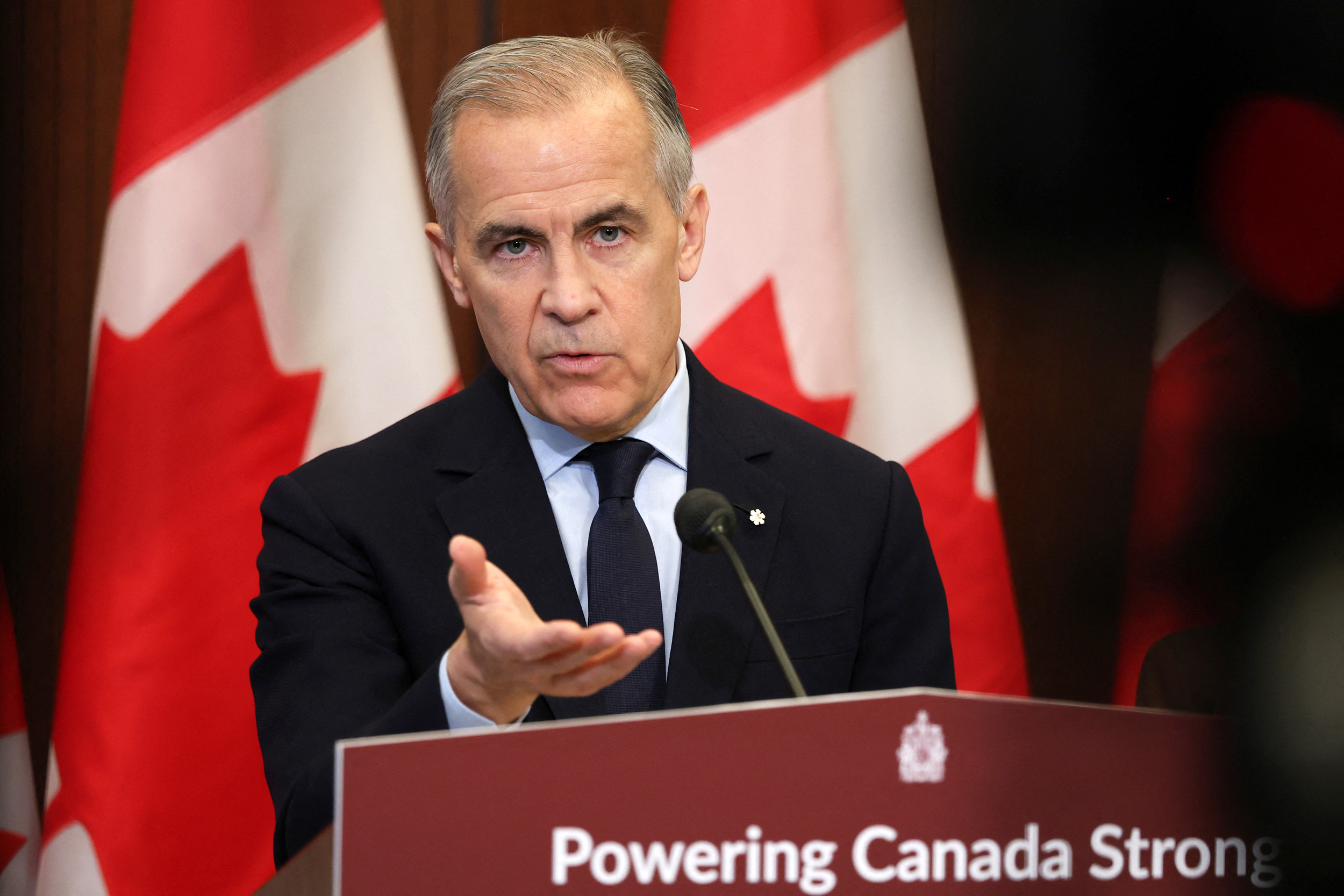
Canadian Prime Minister Mark Carney said the country will build the largest clean energy investment in North America’s history—a package of hydropower, onshore wind and transmission projects aimed at meeting electricity needs while also exporting power to Massachusetts and New York.
The investment of about $70 billion Canadian (U.S. $50 billion) announced on Monday is notable for its contrast with the fossil-fuel-centered priorities of the Trump administration, but Carney and Canada have a mixed record on the transition to cleaner energy sources. Carney’s government also is taking steps to boost production in the oil sands of the western province of Alberta, alongside plans to build additional pipelines to get the oil to market.
“We’re coming together,” Carney said, against a backdrop of the Atlantic Ocean off of St. John’s, Newfoundland and Labrador. The project would “power tomorrow’s economy to strengthen Canada’s place in the world to give ourselves more than any other nation can take away, because when we work together, there is nothing that Canada cannot do.”
The funding would come from the federal government, provincial governments and the companies that operate the hydropower plants, and is subject to ongoing approval processes. The resulting electricity would be enough to power and heat all of the homes in Toronto, Montreal and Vancouver, Carney’s office said.
New U.S. tariffs on Canadian goods are set to take effect this week, underscoring Carney’s desire to make his country less dependent on an often-uncooperative neighbor.
The plan says the federal government would help to pay for the following, most of which is in Newfoundland and Labrador:
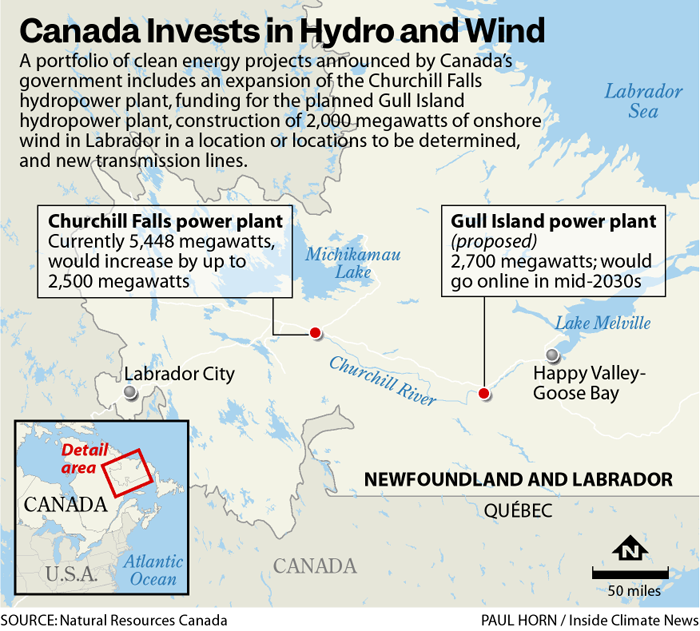
- Churchill Falls, the 5,428-megawatt hydropower plant, would be expanded by replacing current turbines with more efficient ones, increasing the plant’s capacity by up to 2,500 megawatts.
- Gull Island, a proposed 2,700-megawatt hydropower plant, would go online in the mid-2030s. This project was already in development, but the details on federal financing are new.
- Onshore wind would get a substantial push, with a target of building 2,000 megawatts of new capacity.
- The region would get two new transmission lines to help deliver power from the new generating capacity and enable development of mining and other industries in mineral-rich areas.
The plan for new energy projects was drafted in consultation with Indigenous leaders and includes an opportunity for the Innu Nation to become partial owners of the wind and transmission projects. This is a shift from a history of companies damaging tribal communities and depriving tribes of financial benefits.
Previous energy agreements also were bad deals for the provincial government, providing only a small share of the proceeds.
The United States would buy some of the electricity from these projects, with up to 240 megawatts available to New York City via the Champlain Hudson Power Express transmission line, and up to 200 megawatts available to Massachusetts via the New England Clean Energy Connect transmission line, according to Carney’s office. U.S.-based buyers would also have access to an additional 280 megawatts available in spot markets.
Having the opportunity to buy renewable energy from Canada is significant, given how the Trump administration has undermined states’ ability to build their own renewable energy, including hostility toward offshore and onshore wind.
This story is funded by readers like you.
Our nonprofit newsroom provides award-winning climate coverage free of charge and advertising. We rely on donations from readers like you to keep going. Please donate now to support our work.
Carney has spent his tenure, since assuming office last year, dealing with tariffs, insults and other threats from the Trump administration.
On energy issues, he has worked to increase oil production and expand renewable energy, which isn’t surprising given the relationship with the United States, said Chris Bataille, a global fellow at the Columbia University Center on Global Energy Policy and a faculty member at Simon Fraser University in British Columbia.
“Canada is playing two sides of the game,” he said. “And they kind of have to at this point in time, where they need to earn as much export revenue as possible in a nervous relationship with the U.S., where tariffs go up, tariffs go down, what have you. They need to diversify exports of all kinds.”
While Canada claims it as the largest clean energy investment in North American history, whether that is the case is unclear.
President Joe Biden’s Inflation Reduction Act included more than $350 billion in projected clean energy spending, but much of that was later rolled back by the Trump administration.
But Canada’s announcement covers specific projects, rather than a national law spanning multiple sectors. In interviews Monday, experts couldn’t immediately name anything larger in North America based on the anticipated cost.
David Widawsky, U.S. program director for the World Resources Institute, a nonprofit research organization, said he is “envious” of the way Canada is investing in renewable energy compared to the policy reversals of the U.S. government.
It’s significant, he said, that Canadian leaders are emphasizing how these projects will help with energy affordability at a time when many people in Canada and the United States are struggling to pay utility bills. For example, the agreement says households in Newfoundland and Labrador will get a 15 percent rebate on the first 2,000 kilowatt-hours they use each month, which lead to projected savings of about $350 per year per household.
Widawsky said the transmission projects are an important part of affordability, allowing for power to flow more easily across Canada and into the United States.
The Canadian plan is “an important example of connecting generation to transmission to access to affordability,” he said.
About This Story
Perhaps you noticed: This story, like all the news we publish, is free to read. That’s because Inside Climate News is a 501c3 nonprofit organization. We do not charge a subscription fee, lock our news behind a paywall, or clutter our website with ads. We make our news on climate and the environment freely available to you and anyone who wants it.
That’s not all. We also share our news for free with scores of other media organizations around the country. Many of them can’t afford to do environmental journalism of their own. We’ve built bureaus from coast to coast to report local stories, collaborate with local newsrooms and co-publish articles so that this vital work is shared as widely as possible.
Two of us launched ICN in 2007. Six years later we earned a Pulitzer Prize for National Reporting, and now we run the oldest and largest dedicated climate newsroom in the nation. We tell the story in all its complexity. We hold polluters accountable. We expose environmental injustice. We debunk misinformation. We scrutinize solutions and inspire action.
Donations from readers like you fund every aspect of what we do. If you don’t already, will you support our ongoing work, our reporting on the biggest crisis facing our planet, and help us reach even more readers in more places?
Please take a moment to make a tax-deductible donation. Every one of them makes a difference.
Thank you,

Reporter, Clean Energy
Dan Gearino covers the business and policy of renewable energy and utilities, often with an emphasis on the midwestern United States. He is the main author of ICN’s Inside Clean Energy newsletter. He came to ICN in 2018 after a nine-year tenure at The Columbus Dispatch, where he covered the business of energy. Before that, he covered politics and business in Iowa and in New Hampshire. He grew up in Warren County, Iowa, just south of Des Moines, and lives in Columbus, Ohio.
