

Close Menu
NCIJ Network NCIJ Network
    What's Hot

    Can I Vote By Mail in the 2026 Midterm Elections? What to Know. — ProPublica

    September 16, 2026

    “A Recurring Pattern”: Civilians Paying the Price in Mali’s Drone Campaign

    September 16, 2026

    The Guardian view on Sweden’s election result: an opportunity that progressive parties must not squander | Editorial

    September 16, 2026
    Facebook X (Twitter) Instagram
    Trending
    • Can I Vote By Mail in the 2026 Midterm Elections? What to Know. — ProPublica
    • “A Recurring Pattern”: Civilians Paying the Price in Mali’s Drone Campaign
    • The Guardian view on Sweden’s election result: an opportunity that progressive parties must not squander | Editorial
    • Manchester United lose 3-2 to Brighton, crash out of League Cup | Football
    • I have faced abuse, assaults and death threats because I’m an MP. It’s making politics a no-go zone | Dawn Butler
    • How September’s Pixel Drop changes the way you call and message important contacts
    • Knowledgator Releases GLiFormer: A 575M-Parameter Encoder That Hits 91.10 F1 on Nested JSON Extraction Without Generating Tokens
    • Iranian hackers use CHOSEN BRICK Windows malware to spy on targets
    • About
      • Our Team
      • Editorial Policy
      • Editorial Independence
      • International Support
    • Trust & Standards
      • AI Usage Policy
      • Conflict of Interest Policy
      • Corrections Policy
      • Ethics Policy
      • Fact-Checking Policy
      • Source Protection
    • Get Involved
      • Guide for Sources
      • Support Independent Journalism
    • Legal
      • Cookie Policy
      • Privacy Policy
      • Terms of Use
    Facebook X (Twitter) Instagram
    NCIJ Network NCIJ Network
    Wednesday, September 16
    • Home
    • World
    • Ai
    • Business
    • Politics
    • Health
    • Crypto
    • Science
    • Technology
    • Cybersecurity
    • Defense & Security
    • Economy
    • Energy
    • Europe
    • More
      • Fact Check
      • Investigations
      • Opinion & Analysis
      • Environment
    NCIJ Network NCIJ Network
    Home»Environment

    Safeguarding passageways is the next step for India’s growing tiger populations

    NCIJ NETWNCIJ NETWORKBy NCIJ NETWNCIJ NETWORKAugust 17, 2026 Environment No Comments3 Mins Read
    Share
    Facebook Twitter LinkedIn Pinterest Email

    As Bengal tiger numbers rebound in India and increasingly disperse into human-dominated areas, conservationists are urging the government to prioritize protecting ecological corridors that connect vital habitats and tiger populations. But they also warn that corridors shouldn’t become sticking plasters for compromised core habitats, reports contributor Nirmal Ghosh for Mongabay.

    India is home to roughly 75% of the world’s wild tigers. The national population has more than doubled from an estimated 1,827 in 1972 to an estimated 3,682 in the 2022 census. However, this conservation success has created new challenges.

    Experts estimate that 35% of India’s wild tigers (Panthera tigris tigris) now live outside protected areas. Young tigers leave their mothers to establish large home ranges, which for males can cover up to 200 square kilometers (77 square miles).

    In doing so, tigers frequently navigate a highly fragmented matrix of roads, railways and urban sprawl. Without safe pathways, isolated tiger populations risk inbreeding and local extinction.

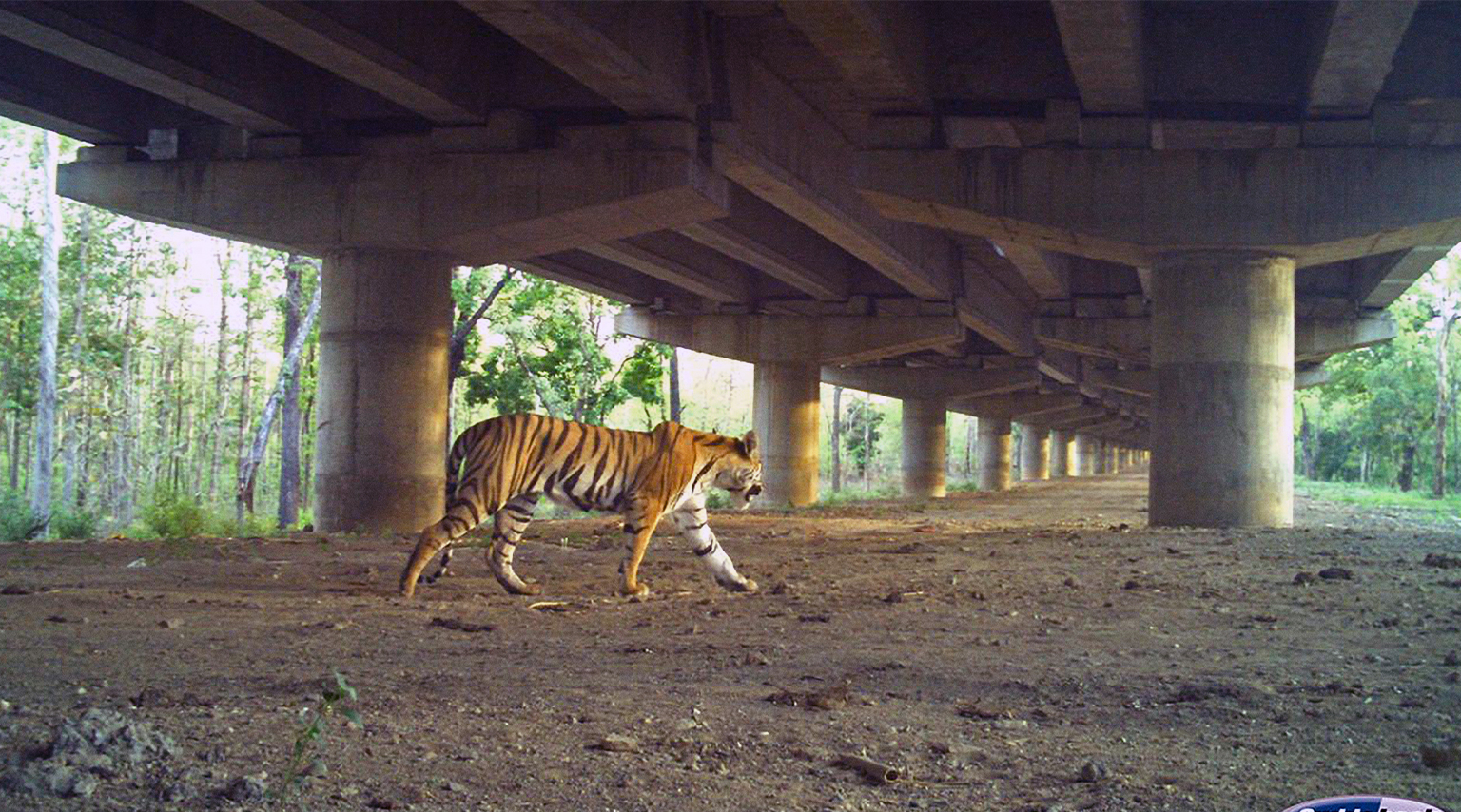
    In response to rapid infrastructure development, India has constructed more wildlife underpasses and overpasses than any other Asian country, according to Bilal Habib, a scientist at the Wildlife Institute of India (WII), a government-run research center. This includes the world’s 10 largest wildlife mitigation structures built since 2017, such as a 12-kilometer (7.5-mile) underpass beneath a newly opened expressway connecting New Delhi to the city of Dehradun.

    “I don’t think anywhere in the world, any developing country has spent as much money as we have on mitigation, exclusively for wildlife conservation,” Habib told Mongabay.

    At the same time, linear infrastructure and projects like mining continue to divert forests. Prakriti Srivastava, a former principal chief conservator of forests in the southern state of Kerala, and Prerna Bindra, a researcher and author, have documented how the National Board for Wildlife, which reviews projects in critical wildlife habitats, has essentially become a rubber-stamp body: It approved 97% of project proposals brought before it over a 12-year period. Bindra was a former member of the board’s Standing Committee.

    Ullas Karanth, a tiger expert and emeritus director of the Bengaluru-based Centre for Wildlife Studies, told Mongabay that tigers will only use corridors if there is a motivation to cross, which requires healthy habitats on both sides. “To me the context is first to secure the core habitat,” Karanth said. “India could, in fact, accommodate up to 10,000-20,000 tigers if habitats are adequately protected.”

    While there’s a common belief that animals restrict themselves to wildlife corridors, that’s not how it works in reality, according to wildlife biologist Ravi Chellam. “Elegantly and clearly demarcating narrow wildlife habitats on a map and calling them corridors is not the solution,” he said. “Animals don’t limit their movements to corridors. They use a matrix of habitats available in the landscape.”

    Read the full story by Nirmal Ghosh here.

    Banner image: Tigress negotiating an underpass beneath National Highway 44, India’s longest highway. Image courtesy of Wildlife Institute of India.


    growing Indias passageways populations safeguarding step tiger
    NCIJ NETWNCIJ NETWORK
    • Website

    Keep Reading

    Bolivia’s mining law overhaul raises environmental and community concerns

    Labour holds No 10 drinks party for donors amid growing calls for donations cap | Labour

    Texas Oil and Gas Regulator Doubles Down and Defies State Legislature

    Dhaka’s waste-to-energy project faces opposition from pollution-weary residents

    For the first time, Congolese NGO to manage a DRC protected area

    Venezuela’s historic oil deal with the US reignites environmental, human rights concerns

    Add A Comment
    Leave A Reply Cancel Reply

    Editors Picks

    Can I Vote By Mail in the 2026 Midterm Elections? What to Know. — ProPublica

    September 16, 2026

    “A Recurring Pattern”: Civilians Paying the Price in Mali’s Drone Campaign

    September 16, 2026

    The Guardian view on Sweden’s election result: an opportunity that progressive parties must not squander | Editorial

    September 16, 2026

    Manchester United lose 3-2 to Brighton, crash out of League Cup | Football

    September 16, 2026
    Latest Posts

    What is Trump Media’s Truth API and why is it controversial?

    August 4, 2026

    How ProPublica Tested Hundreds of Omaha Homes for Lead — ProPublica

    August 4, 2026

    Golar LNG raises $600 million loan with FLNG business expansion in mind

    August 4, 2026

    Subscribe to News

    Get the latest sports news from NewsSite about world, sports and politics.

    NCIJ Network is an independent digital news platform delivering trusted investigative journalism, European and global news, in-depth analysis, and fact-based reporting with accuracy, transparency, and integrity.

    Facebook X (Twitter) Instagram Pinterest YouTube

    Can I Vote By Mail in the 2026 Midterm Elections? What to Know. — ProPublica

    September 16, 2026

    “A Recurring Pattern”: Civilians Paying the Price in Mali’s Drone Campaign

    September 16, 2026

    The Guardian view on Sweden’s election result: an opportunity that progressive parties must not squander | Editorial

    September 16, 2026

    Subscribe to Updates

    Get the latest creative news from FooBar about art, design and business.

    Type above and press Enter to search. Press Esc to cancel.