


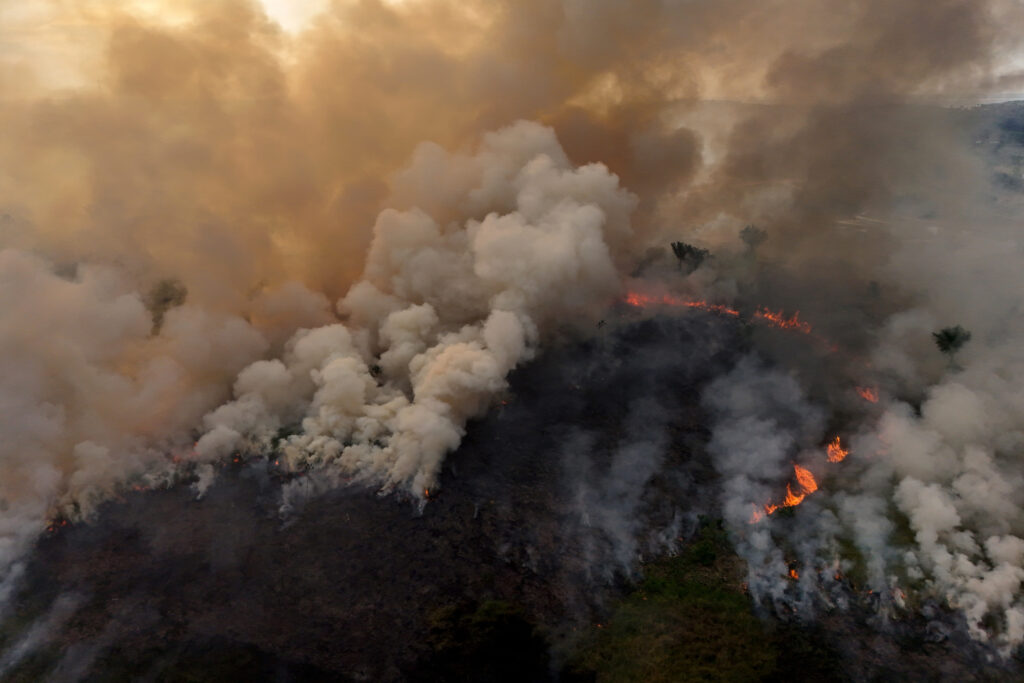
Ozone pollution from fires, along with extreme heat and drought, is further weakening the Amazon rainforest’s ability to absorb carbon dioxide, new research shows.
The Amazon and other forests absorb more than a quarter of human-caused CO2 emissions each year, more than 11 billion metric tons. But in recent decades, increasingly larger areas of forests have begun releasing more CO2 than they absorb, especially during droughts and heat waves.
One study, published Monday in the journal Communications Earth & Environment, documents how smoke from wildfires, agriculture and forest-clearing burning contributes to leaf-damaging ozone formation far from the flames.
This means fires in the Amazon have a double impact on the climate. They directly release climate-warming CO2 as vegetation burns and reduce the ability of remaining trees to absorb and store CO2. The reduction is equal to about 24 percent of the carbon released by the fires.
That “hidden effect is a significant loss to the Amazon’s carbon budget that hasn’t previously been considered,” said lead author Flossie Brown, an atmospheric chemist at ETH Zürich, a university in Switzerland.
The second study, published Monday in the American Geophysical Union journal Earth’s Future, found that the extreme heat and drought that gripped the Amazon and other tropical forests in 2023 and 2024 during El Niño conditions could occur nearly every year within 20 to 30 years, cutting CO2 uptake severely and even disrupting the self-regulating forest-to-atmosphere moisture cycle.
Repeated extreme heat events can “trigger self-perpetuating rainfall losses,” warned
lead author Johanna Van Passel, an ecologist at Ghent University in Belgium. “You have this feedback loop,” she said. “If the forest is suffering, it will cause less rain to fall in other parts, and those forests will also start suffering.”
All tropical forests stayed unusually hot for an 18-month period overlapping with El Niño conditions, on average, and 80 percent of the forests were drier than average. The Amazon rainforest was particularly hard-hit. After a full two years of drought, water levels at the port of Manaus sank to the lowest level in more than a century of record-keeping. Globally, three-quarters of tropical forests endured extreme heat and drought simultaneously for an average of six months, the study found.
Even if human carbon emissions are eliminated or neutralized by 2075, extreme heat and drought will still be six times more likely across tropical regions by the end of the century than they have been over the past 25 years.
Under any higher-emissions climate scenario, the extreme, forest-damaging conditions seen in 2023 and 2024 are projected to become the annual norm across most tropical regions by the 2040s, with or without El Niño. It’s a “very striking” projection for the near future, Van Passel said.
Brown, the lead author of the ozone study, said the research offered a way to connect the often-invisible atmospheric chemistry of the atmosphere with real-world effects “that felt really relevant and important to me.”
This story is funded by readers like you.
Our nonprofit newsroom provides award-winning climate coverage free of charge and advertising. We rely on donations from readers like you to keep going. Please donate now to support our work.
Some of the data came from enclosed growth zones at TropOz laboratory “where we can control conditions like ozone concentration and really measure the trees,” she said. Other measurements used to understand ozone’s effects come from satellites that track vegetation reflectivity and from flux towers installed in the rainforest canopy that detect changes in the air’s chemistry.
One surprising result was that, during the 1997 to 2024 study period, there was “on the whole, a decline in ozone damage, coming from increasing CO2 concentrations,” Brown said. One reason is that, as the concentration of CO2 rises, trees can photosynthesize more efficiently, so they take up less air, and less ozone, through their stomata.
But the overall decline was outweighed by the effects of extreme events. Fires, smoke-driven ozone, drought and heat are becoming more frequent and more damaging, with impacts far greater than similar events would have had in a cooler climate.
The next cycle of extremes is already beginning, with a powerful El Niño driving drought in the region and the season for agricultural burning starting in the coming weeks.
The fires are not intended to become huge or burn the forest, but during droughts, they often escape control and release significant amounts of nitrogen oxides that can be carried distances and combine with other reactive organic molecules to form ozone.
Brown said ozone damage is just one of many pressures on the Amazon, as drought and high temperatures are “already moving the Amazon into conditions that it didn’t grow to withstand.” Limiting the damage requires changes in the way agricultural fires are managed, including using practices other than burning, and slowing deforestation and other degradation, she added.
Her biggest single concern is extreme drought. The Amazon evolved as an environment that is always wet, “and now, this isn’t the case,” she said. “A natural rainforest shouldn’t burn. It’s too wet. So even the fact that we create and see these fires that spread into the Amazon is already some kind of tipping point.”
About This Story
Perhaps you noticed: This story, like all the news we publish, is free to read. That’s because Inside Climate News is a 501c3 nonprofit organization. We do not charge a subscription fee, lock our news behind a paywall, or clutter our website with ads. We make our news on climate and the environment freely available to you and anyone who wants it.
That’s not all. We also share our news for free with scores of other media organizations around the country. Many of them can’t afford to do environmental journalism of their own. We’ve built bureaus from coast to coast to report local stories, collaborate with local newsrooms and co-publish articles so that this vital work is shared as widely as possible.
Two of us launched ICN in 2007. Six years later we earned a Pulitzer Prize for National Reporting, and now we run the oldest and largest dedicated climate newsroom in the nation. We tell the story in all its complexity. We hold polluters accountable. We expose environmental injustice. We debunk misinformation. We scrutinize solutions and inspire action.
Donations from readers like you fund every aspect of what we do. If you don’t already, will you support our ongoing work, our reporting on the biggest crisis facing our planet, and help us reach even more readers in more places?
Please take a moment to make a tax-deductible donation. Every one of them makes a difference.
Thank you,

Reporter, Austria
Bob Berwyn is an Austria-based reporter who has covered climate science and international climate policy for more than a decade. Previously, he reported on the environment, endangered species and public lands for several Colorado newspapers, and also worked as editor and assistant editor at community newspapers in the Colorado Rockies.
