


- A report from funders of a pledge to support Indigenous peoples and local communities’ land rights found that donors delivered $2.35 billion between 2021 and 2025, exceeding the $1.7 billion target made at the 2021 U.N. Climate Change Conference by 38%.
- The findings also show that 7.2% of funding in 2025 went directly to Indigenous peoples and local communities, up from 2.9% in 2021.
- Authors of the report warn that underfunded regions remain particularly vulnerable to aid cuts, deforestation and extractive pressures.
- A new $1.8 billion five-year pledge announced at COP30 aims to expand its reach to support Afro-descendant communities and other ecosystems, promising more direct, flexible and long-term financing.
Funders of the $1.7 billion pledge to support Indigenous peoples and local communities’ land rights, announced at the 2021 United Nations Climate Change Conference, say they have exceeded the target by 35%, delivering $2.35 billion between 2021 and 2025.
According to the final report of the Forest Tenure Funders Group (FTFG), in 2025 alone, donors provided about $486 million.
Sources say the five-year pledge was a major accomplishment, but problems around direct access, regional inequality, funding for women and youth and aid sustainability persist. In 2025, only 7.2% went directly to Indigenous and local community organizations, the latest report found, while the vast majority still flowed through intermediaries, such as NGOs, consultancies and development banks.
According to recently updated data in the report, the share of direct funding has increased over the five-year period, from 2.9% of the $351 million provided by donors in 2021, decreasing to 2.1% of the $514 million in 2022. By 2023, this number had risen to 10.6% of the $533 million provided that year, and in 2024, 7.6% of the $467 million provided went directly to these groups.
“The pledge was good news, but the figure of the result doesn’t tell us how much actually reached the territories,” Myrna Cunningham Kain, of the Indigenous Miskito community of Waspam and chair of the Guiding Committee at the Pawanka Fund, told Mongabay over email. The Pawanka Fund is a global organization led by Indigenous people that channels financial and technical resources directly to Indigenous peoples and other local communities around the world.
“As we saw, a significant share of resources still flows through intermediaries, and when we look at the data we still see major inequalities in distribution by region and by country,” she said. “Women and youth received a very small amount.”
According to the report, 71% of funding went to Latin America, followed by 16% to Asia-Pacific and 13% to Africa. It warned that underfunded regions remain particularly vulnerable to aid cuts, deforestation and extractive pressures.
Most went to the world’s major tropical forest basins, with 85% of Latin American funding directed to Amazon countries, 97% of Asia-Pacific funding to the Borneo-Mekong-Southeast Asia basin and 34% of African funding to Congo Basin countries.
“The decline in funding for Africa in the Pledge’s final years can be explained in part by the fact that several FTFG funders with substantial programmatic work in Africa did not report funding to the FTFG for 2025; this includes USAID due to its closure early last year,” the FTFG Secretariat told Mongabay in an email.
As Cunningham pointed out, women and young people are also far behind. Only 4% of 2025 “funding had gender equality as a principal objective, down from 15% in 2024,” the report said. For youth, the figure is even lower. Less than 1% of 2025 funding focused on young people as a principal objective.
Cristián Samper, managing director and leader for nature solutions at the Bezos Earth Fund, a major financial contributor to the pledge, told Mongabay in an email that increasing the share of funding to Indigenous peoples and local communities requires multiple, complementary pathways, such as direct funds to Indigenous organizations with the institutional capacity to manage those relationships, supporting Indigenous-led financing mechanisms and working through, or in close coordination with, trusted intermediary organizations.
“One of our key lessons is that direct funding can be highly valuable, but it is not inherently simpler or more effective,” he said. “It works best when organizations have the institutional capacity to manage the funding and when funders are prepared to provide sustained engagement, support, and oversight.”

Giuseppe Olo Villalaz, an Indigenous Guna leader from Panama who serves as a representative and board member for the Mesoamerican Alliance of Peoples and Forests (AMPB), told Mongabay over WhatsApp voice messages that he has noticed an uptick in Indigenous-led territorial funds. But he has also seen an increase in the number of Indigenous people, Afro-descendant groups and other local community representatives selected by intermediaries, such as NGOs, to be a part of their organizations so that they can claim the status of ‘Indigenous funds.’
“We have observed this practice being used to gain access to philanthropic funding,” said Olo Villalaz, reinforcing the importance of Indigenous-led territorial funds. “The territories themselves are the owners — not government organizations, and not NGOs created solely to access these funds by recruiting Indigenous brothers to sit on their boards. We are territorial funds that manage land, resources, and governance. That is the crucial difference.”
He said this distinction matters because, often, the approaches of traditional intermediaries fail to incorporate their worldview. “Whereas our model does, which helps us immensely. We know that investments made through our funds go directly to the territories that need them most.”
At the 2025 U.N. climate conference in Belém (COP30), 39 government and philanthropic donors committed $1.8 billion for 2026 – 2030. This new pledge has increased in scope from the previous by explicitly including Afro-descendant communities and other ecosystems, as well as promising to increase the share of direct, flexible and long-term financing.
Cunningham is concerned that history will repeat itself. To break this cycle, she said, as well as direct support, there needs to be a shift in the relationship donors have with Indigenous peoples, viewing them as beneficiaries and rights holders deserving of real participation in decisions about resources. There also needs to be greater respect for Indigenous knowledge, mutual accountability and greater transparency, she said, on how much funding is channeled through intermediaries, direct to communities and how much actually reaches communities.
Cunningham says at least 20% of resources should go directly to Indigenous-led funds, “particularly in the Global South, so that funding reaches the territories.”
“While we are pleased that the COP26 Pledge exceeded its commitment, securing and sustaining tenure is a long term process that requires consistent funding,” the FTFG Secretariat wrote. “The COP26 Pledge did not fully meet the funding needs of those who are advancing this critical work, but it was an important step.”
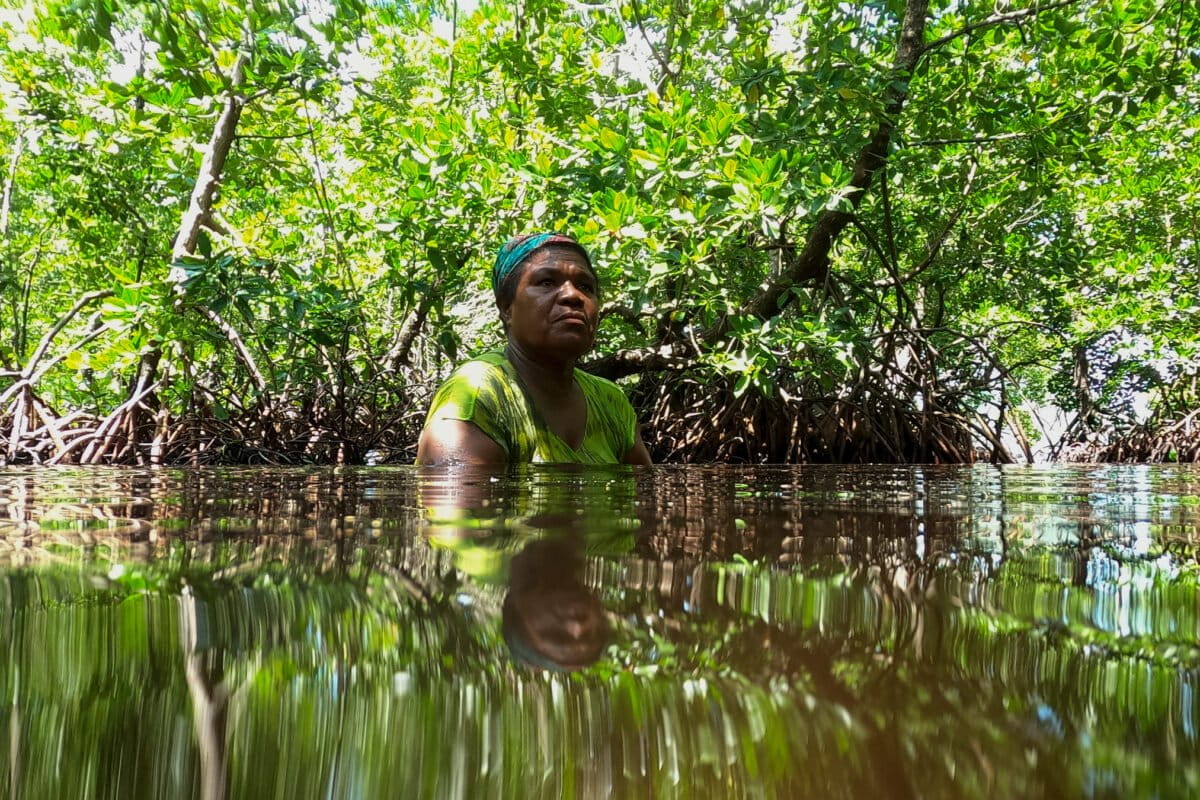
Banner image: Debora Sanyi, an Indigenous woman, stands chest deep in water as she collects clams in a mangrove forest where only women are permitted to enter in Jayapura, Papua province, Indonesia in 2024. Image by AP Photo/Firdia Lisnawati.
COP26 pledge to support Indigenous & local forest tenure was just met. What was learned?
Questions over who gets the billions pledged to Indigenous causes at COP26

