


Along England’s southern coast lies a fishing community whose existence can be traced back almost a millennium. From its shingled shore, Hastings once housed the largest beach-launched fleet in Europe. But when retired fisherman Jerry Percy visited a few weeks ago, he could count the operational boats on his fingers.
“If you take the argument to the end game, then you’ll have nothing but a picture-postcard fleet bobbing about in little pretty harbors and bugger-all else,” said Percy, describing a “spiral of decline” across the U.K.’s small-boat fleet.
This hollowing out of coastal livelihoods is part of a “rigged system,” according to a new report by Oceana UK. Unequal government subsidies, outdated quota systems and catch limits that routinely ignore science have concentrated wealth in large corporate fleets at the expense of coastal communities and the marine ecosystems they rely on.
“The non-compliance, the discards, the very poor transparency and the quota inequality is all really adding up,” said Izzy Ross, Oceana UK’s habitats and fisheries campaign manager. “It’s not a fair playing field for those who want to do things right and want to do things more sustainably.”
Fishing vessels over 39 feet were found to have falsified logbooks, deployed illegal gear or dumped fish during 66 percent of at-sea inspections in English waters between April 2025 and March 2026, according to Freedom of Information data obtained from the Marine Management Organisation.
For vessels under 33 feet, these activities were documented just 10 percent of the time.
Operating “out of sight and out of mind” in rough seas where boarding is often impossible, larger vessels easily evade scrutiny, said Percy, who spent decades fishing the entire circumference of the U.K., and jokes he’s been both “poacher and gamekeeper.” Even when violations were documented, authorities merely issued “verbal advice” in almost 70 percent of cases.
Only 1 percent of infringements resulted in any financial penalty—totalling less than $37,000 across the entire fleet between April 2024 and March 2025.
“When you compare it to the amount of millions of pounds going out in fuel subsidies and some of the profits that these large [boats] are pulling in, that’s a very, very small amount,” said Ross. “It’s not even something they probably notice.”
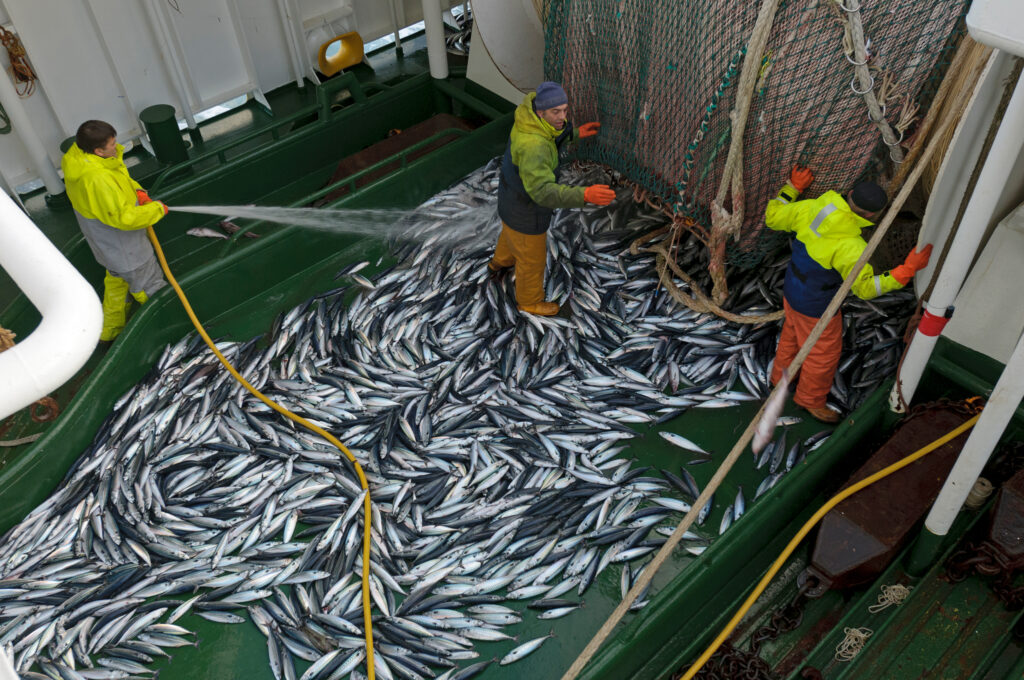
Crews scrapped more than 100,000 metric tons of dead or dying fish, across 57 U.K. quota stocks, last year—equal to the weight of around 8,300 of London’s red double-decker buses. From spotted dogfish and silver smelt to haddock and whiting, crews often chuck lower-value catches to keep space for potentially more profitable products, or dump “choke species” with low quotas that would otherwise force boats back to port.
Ross warns the “disgusting level of discards” is pushing some populations toward total collapse. For Irish Sea plaice, a popular flatfish, over 80 percent caught between 2023 and 2025 was thrown back overboard, despite unsustainable fishing pressure for the species and a recommendation of no catches for 2027.
Because accurate discard data relies on occasional observers and voluntary disclosures, the 100,000-ton figure is likely an underestimate. When remote monitoring cameras were deployed on fishing boats in New Zealand in 2024, the true discard rate jumped 46 percent above original estimates.
Though the U.K. government recently announced the requirement of cameras and GPS monitoring for large pelagic boats—those that catch fish in the water column rather than from the seabed—from November 2028, the rules exclude bottom trawlers, which have the highest discard rates.
“It’s a step in the right direction, but it’s not far enough,” said Ross. “It’ll be 2028 before that’s implemented, and we’d like to see the government going further because it’s a really pressing issue. If we’re discarding another 100,000 tons next year and the year after, we need it to come sooner.”
A Marine Management Organisation spokesperson told Inside Climate News the agency “takes non-compliance with fisheries rules seriously and uses a risk-based, intelligence-led approach to target inspection and enforcement activity where the risk is greatest,” highlighting discards are not always illegal, and said it’s working with regulators to keep monitoring “operationally effective.”
While boats under 33 feet make up three-quarters of the fleet, they’re allocated just a few percent of the quota—part of what Oceana UK describes as the “systemic injustices” of British fisheries.
Nearly 90 percent of U.K. quota is still allocated based on what vessels caught between 1994 and 1996, turning a brief historical snapshot into a tradeable commodity controlled by a small handful of large companies.
“Our ocean is for everyone, and our fish stocks are a public resource. Yet successive governments have created a system that favours a handful of large companies, allowing them to profit at the expense of the ocean and local communities,” said Hugo Tagholm, executive director of Oceana UK in a press release.
This story is funded by readers like you.
Our nonprofit newsroom provides award-winning climate coverage free of charge and advertising. We rely on donations from readers like you to keep going. Please donate now to support our work.
Last year, the five largest quota-holding companies pocketed over $160 million in combined profits while drawing disproportionately from taxpayer-funded fuel subsidies. Traveling farthest offshore with the heaviest gear, vessels over 130 feet benefited from an estimated $300 million in British fuel subsidies between 2012 and 2022.
Across European waters, these “mega-industrial” trawlers burn the most fuel, scrape the seafloor with vast trawl nets and swipe the most marine life.
Percy, now senior advisor to the Low Impact Fishers of Europe organization, believes the small-boat fleet he’s spent decades advocating for is “finished” if current trends continue.
The reality echoes a warning he heard from a fisherman on a beach several years ago. “You’re wasting your time, because one day there’ll be a bloody great boat comes up here with Tesco written down its side, and it’ll take more in a day than we take in a year,” the skipper told him, referencing the U.K.’s largest grocery store chain. “And they’re just waiting for us to die.”
Percy laughed at the time. But looking at Britain’s coastal towns today, he no longer thinks the fisherman was wrong.
“The support that is available shouldn’t be going disproportionately to the biggest vessels, the most energy-hungry vessels,” said Ross. “The money should be used to support those trying to do things better and trying to build an industry that will actually have a long-term future.”
Even if vessels adhered to discard rules, Ross warns overfishing would persist: “If everyone was compliant, we still wouldn’t solve overfishing because the government is continually setting catch limits over the recommendations by the International Council for the Exploration of the Sea,” referencing the intergovernmental science body whose data is used to determine quotas.
A spokesperson for the U.K.’s Department for Environment, Food and Rural Affairs told Inside Climate News they are “making sure fishing limits are sustainable and based on the best available scientific advice, as well as changing how fishing quotas are shared out to support our economy, local communities and the environment.”
Since Brexit, more than half the U.K. catch limits have exceeded scientific advice, resulting in dwindling and overfished stocks. Even the nation’s iconic cod has now received a zero-catch recommendation for the Irish Sea, Celtic Sea and North Sea after a decade of population decline.
Five years ago, Percy said, the majority of calls he received from small-scale fishers were about unfair quotas. Today, as overfishing runs rampant, most calls he fields are about a lack of fish left in inshore waters.
Full-time fishing jobs in England’s small-scale fleet almost halved between 2008 and 2022. “Fishing,” Percy emphasized, “should provide a living for the many rather than a fortune for the few.”
About This Story
Perhaps you noticed: This story, like all the news we publish, is free to read. That’s because Inside Climate News is a 501c3 nonprofit organization. We do not charge a subscription fee, lock our news behind a paywall, or clutter our website with ads. We make our news on climate and the environment freely available to you and anyone who wants it.
That’s not all. We also share our news for free with scores of other media organizations around the country. Many of them can’t afford to do environmental journalism of their own. We’ve built bureaus from coast to coast to report local stories, collaborate with local newsrooms and co-publish articles so that this vital work is shared as widely as possible.
Two of us launched ICN in 2007. Six years later we earned a Pulitzer Prize for National Reporting, and now we run the oldest and largest dedicated climate newsroom in the nation. We tell the story in all its complexity. We hold polluters accountable. We expose environmental injustice. We debunk misinformation. We scrutinize solutions and inspire action.
Donations from readers like you fund every aspect of what we do. If you don’t already, will you support our ongoing work, our reporting on the biggest crisis facing our planet, and help us reach even more readers in more places?
Please take a moment to make a tax-deductible donation. Every one of them makes a difference.
Thank you,

Fisheries Reporter
Johnny Sturgeon is a London-based reporter covering fisheries and aquaculture. Joining us from the Outlaw Ocean Project, he has experience producing in-depth maritime investigations for nonprofit newsrooms. A former boatbuilder, he holds a B.A. in History & Politics from the University of Oxford, and an M.S. from Columbia Journalism School.
