


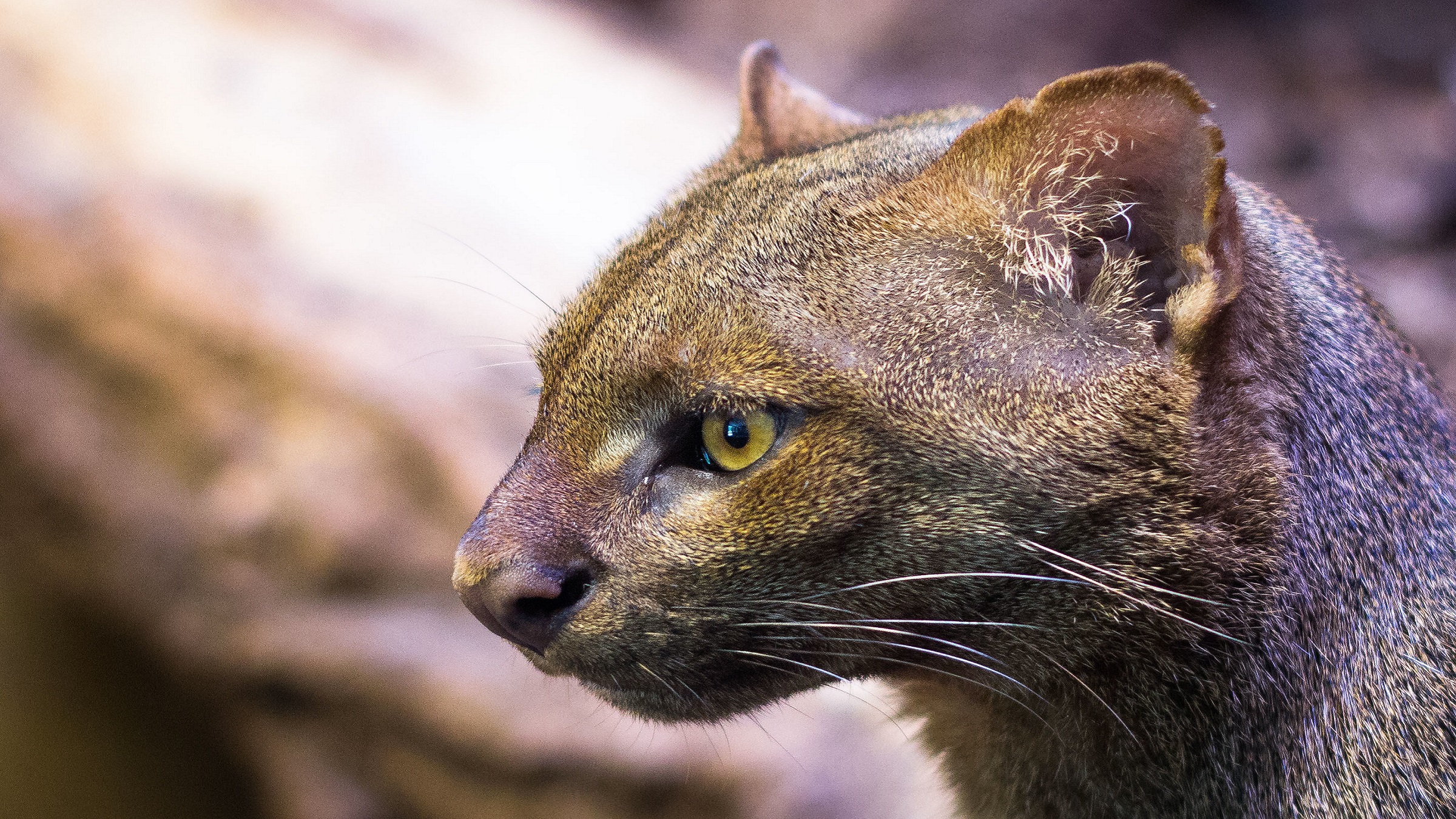
- The jaguarundi needs more attention, researchers say. This small cat, ranging from Mexico to Argentina, was recently recategorized from least concern to near threatened on the IUCN Red List.
- Despite the species’ large territory, monitoring data suggests it’s rare, now among the least abundant felids across its range. Conservationists also warn some populations are in decline due to human-wildlife conflict, dangerous roadways, attacks by dogs and infectious disease.
- With relatively little field study or funding for research, there are huge gaps in researchers’ understanding of this cat, but conservationists hope this change in conservation status will spark greater attention.
Distinct for their rather uncat-like appearance, jaguarundis have long flown under the research and conservation radar. However, its latest uplisting to near threatened on the IUCN Red List could change that.
These small cats — weighing up to around 7 kilograms (15 pounds) — roam savannah and forest landscapes across a massive range stretching from Mexico through Central America and all the way to southern Brazil and Argentina.
Tadeu de Oliveira, co-chair of the IUCN Cat Specialist Group, who led the latest review, said the assessment had to battle against the perception that jaguarundis are common and, thus, not threatened.
That’s partly because, as a diurnal species, they roam and hunt in open spaces during the day, making them more visible than many other feline species, he said. They also inhabit degraded, less-than-pristine landscapes.
“If you have a forest and that becomes savannah-like, it will mimic the ideal habitat for the species,” de Oliveira said. “It’s not [the jaguarundi’s] favorable habitat, but it will allow it to be there.”
As this cat moves through open spaces, it is more frequently seen than other feline species that live in dense forest.
“It’s easier to be seen and because of that, people perceived it as common,” de Oliveira said. “But when you quantify it data-wise, it shows to be otherwise.”
After gathering available data from researchers along the length and breadth of the jaguarundi’s range — and canvassing experts’ views — de Oliveira and his team found that the species is not only rare, it’s among the least abundant felids in most of its range, save for a couple of locations in Mexico and Brazil. The population of mature jaguarundis is estimated at 13,000.
Another decisive factor is that the Amazon was previously considered a possible safe haven for this small cat, but that’s no longer the case. That’s partly due to its large home range, with males roaming up 100 square kilometers (38.6 square miles) in some locations.
“The absence of the Amazon as a safe haven for the species allowed it to fit into the [near threatened] criteria,” de Oliveira said. “The cat is really not abundant anywhere.”
Flávia Tirelli led Brazil’s last assessment of the jaguarundi, when it was classified as vulnerable, and currently coordinates the Geoffroy’s Cat Working Group. She noted that, “this change highlights the need to pay closer attention to species that, despite wide distributions, can have highly varying abundances across different locations.”
“Wide ranges face a broader variety of threats at different intensities, which means we might be losing genetic variability in certain areas,” Tirelli said.

Moving beyond ‘bycatch’ data
That shift in status could mean greater research and conservation attention for a species that’s long moved in the shadows, said Mariam Weston-Flores, who co-authored the assessment and serves as chair of the Ocelot Working Group, said.
Even among small cat species that are understudied, the jaguarundi is an outlier, with few dedicated studies. Most available data have been gathered during research focused on other species, known as “bycatch” data, often with images of this cat walking through camera traps set to census other animals.
“It’s hard to get records of it because nobody’s targeting the species,” Weston-Flores said in an interview with Mongabay.

Part of the challenge is that typical conservation strategies — such as protecting forests or promoting habitat restoration — aren’t necessarily suitable for this species. Though the assessment highlights the need for protection of key habitats, such as Brazil’s Cerrado — tropical savanna — and the semi-arid forests of the Caatinga, it emphasizes the need for strengthening connectivity, experts say.
“It’s a very opportunistic species,” Weston-Flores said. “If you have conservation strategies that … focus only on protecting habitat, maybe you’re not targeting the right threats for this cat.”
These include wildlife conflict with farmers and chicken owners, retaliatory killings when cats kill poultry, as well as dangers they face on roadways and disease, such as mange spread by domestic and feral dogs and rabies.

The report included a host of recommended conservation interventions, such as constructing predator-proof chicken coops and “jaguarundi-friendly infrastructure” to protect wildlife corridors with underpasses beneath busy roadways in prime habitat. Dog vaccination campaigns organized across the Americas are also helping to stem the spread of disease.
Weston-Flores hopes that this near threatened listing will help garner greater interest in the species from funding organizations. Tirelli echoed this: “I hope it encourages more targeted studies using different methodologies tailored for a rare, diurnal open-area species,” she said.
With declines observed in some locations, the assessment authors recommend ongoing, targeted monitoring, as this cat could move closer to vulnerable status.
“I would say the take-home message is for people to rely on data, on information. Not on perceptions when trying to assess a species’ status,” de Oliveira said.
“Let’s rely on information. Let’s try to get data on populations. Let’s monitor populations. Because without this, we wouldn’t have been able to switch the jaguarundi to a proper criteria of threat.”

Banner image: A jaguarundi at a zoo in Germany. Image by Cloudtail the Snow Leopard via Flickr (CC BY-NC-ND 2.0).
More to explore:
Elusive jaguarundi inspires biologists to share data across Latin America
Brazil’s wildcats face multiple diseases due to habitat fragmentation
FEEDBACK: Use this form to send a message to the author or editor of this post. If you’d like to post a public comment, you can do so at the bottom of the page.
Cite this article
Sean Mowbray (2026). Increasingly rare: Jaguarundi moves up a notch on the endangered species list. Mongabay Conservation news. DOI: https://doi.org/10.66709/news-326352

