



The volume of patients in Dr. Robert Brewer’s upstate New York emergency room isn’t always predictable, but when there’s a heat wave, he knows he needs to staff up.
Heat waves mean more dehydration and kidney problems. As patients’ bodies struggle to regulate temperature, dilating blood vessels strain their hearts, sometimes leading to heart failure. Brewer sees more frustration, outbursts and patients less able to manage mental health conditions. Last summer, when the Northeast was hit with uncharacteristically severe heat waves as climate change continues to worsen, all that was especially true.
“It definitely strains hospital resources,” said Brewer, the associate director of emergency medicine at St. Peter’s Hospital in Albany. “We definitely feel it in the emergency department, and the hospital feels it, hospital-wide.”
A new study from researchers at Harvard University and Boston University backs him up.
The study, published Monday in Nature Health, found that roughly 1 in 10 emergency department visits across 19 states were driven by heat during two severe heat waves last summer.
Across the three summers studied, higher temperatures were associated with more emergency visits across all causes, but the difference was especially pronounced for psychiatric and kidney-related emergencies.
Experts have long known that high temperatures cause myriad health harms and heat waves drive medical emergencies, particularly related to chronic illnesses. But although academic research on a particular heat event can sometimes take years to complete, the study’s team was able to start researching last summer’s heat waves just two weeks after they happened, using data from a private company called Truveta, which aggregates de-identified electronic health records from medical systems across states.
Amruta Nori-Sarma, an assistant professor of environmental health at Harvard and the study’s lead author, said she hopes using near real-time data to track the strain of a heat wave on medical systems can inform mitigation and adaptation.
Hospital beds are a limited resource, Nori-Sarma noted.
“We need to be able to allocate those efficiently,” she said. “What happens as we start to see longer summertime seasons that are more intense and happening more frequently with these heat waves?”
That’s especially important as climate change brings more frequent and severe heat waves to regions that aren’t historically used to them, like the Northeast, where the Harvard study found elevated heat risks.
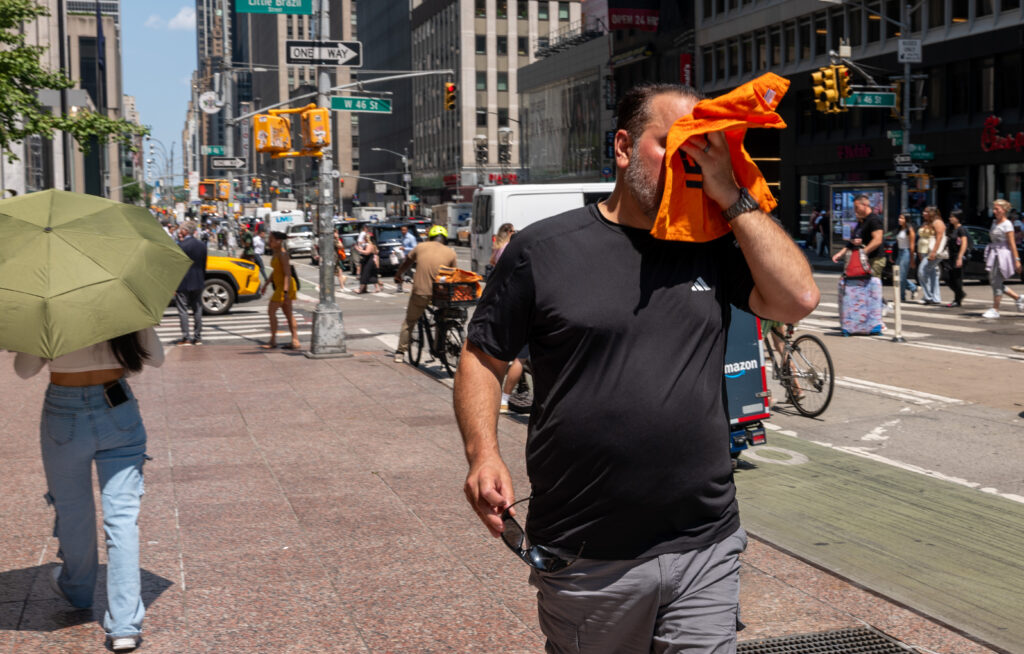
Last summer in Albany, Brewer saw patients who simply weren’t expecting or prepared for the weather. In some cases, elderly patients and those with chronic illnesses faced medical emergencies because they didn’t have interventions like air conditioning. Earlier this summer, he saw an elderly patient come in with rhabdomyolysis: a life-threatening condition in which muscle tissue breaks down, gets into the bloodstream and can cause serious kidney damage. It’s not uncommon in the heat, he said.
Getting information closer to real time is useful for hospitals like his, Brewer added.
“If we know that we’re going to have a heat wave, and we know the volume is going to increase by an average of about 10 percent, then we can staff appropriately,” he said.
Using Near Real-Time Data
Nori-Sarma and her team analyzed Truveta data for more than 8 million emergency department visits over three summers from 2023 to 2025.
“One of the major challenges in epidemiology is always that we’re just too late,” said Mary Willis, an assistant professor of epidemiology and environmental health at Boston University and co-author of the paper.
This story is funded by readers like you.
Our nonprofit newsroom provides award-winning climate coverage free of charge and advertising. We rely on donations from readers like you to keep going. Please donate now to support our work.
Dr. Abel Kho, who wasn’t involved with the new study, said its broad geography was a big strength. The results aligned with his own recent findings on heat in Chicago’s emergency departments, said Kho, an internist and professor of medicine at Northwestern University’s Feinberg School of Medicine in Chicago.
Heat is the top weather-related killer in the U.S., and this week alone the National Weather Service has issued extreme heat warnings in parts of the South and the Midwest. After a summer of storms and high temperatures, including two heat waves in July, the Chicago area is again under an advisory, with a heat index up to 105 this week. Cook County, which includes Chicago, recorded 13 heat deaths this summer, most on the historically disenfranchised South and West sides of the city.
Kho, the director of the Institute for Artificial Intelligence in Medicine at Feinberg, is also the principal investigator for CAPriCORN, a research network in the Chicago area that connects healthcare institutions with researchers, community organizations and others to safely share de-identified health data for analysis. That system is built for transparency.
He noted that the use of a commercial dataset like Truveta brings both benefits and limitations.
“The upside is it’s faster and potentially more efficient,” Kho said. “The downside is maybe it’s not quite as obvious or transparent as to what exactly is in there, unless it’s shared with you by the company.”
The Harvard and Boston University researchers noted some related limitations in their analysis, including less geographic granularity—because they were given state-level data—that could miss elevated temperatures in some urban areas, for example. Health systems, meanwhile, self-select into the Truveta network, so the data may not include a fully representative population, potentially excluding some uninsured or unhoused patients, who are often especially vulnerable to heat.
Still, Kho said the study’s results are useful, especially as health systems globally are increasingly paying attention to extreme weather.
“All over the world, heat, weather, is having greater and greater impacts on society and it really hits home because it affects people’s health directly,” Kho said. “Studies like this help us recognize that and hopefully help us prepare.”
About This Story
Perhaps you noticed: This story, like all the news we publish, is free to read. That’s because Inside Climate News is a 501c3 nonprofit organization. We do not charge a subscription fee, lock our news behind a paywall, or clutter our website with ads. We make our news on climate and the environment freely available to you and anyone who wants it.
That’s not all. We also share our news for free with scores of other media organizations around the country. Many of them can’t afford to do environmental journalism of their own. We’ve built bureaus from coast to coast to report local stories, collaborate with local newsrooms and co-publish articles so that this vital work is shared as widely as possible.
Two of us launched ICN in 2007. Six years later we earned a Pulitzer Prize for National Reporting, and now we run the oldest and largest dedicated climate newsroom in the nation. We tell the story in all its complexity. We hold polluters accountable. We expose environmental injustice. We debunk misinformation. We scrutinize solutions and inspire action.
Donations from readers like you fund every aspect of what we do. If you don’t already, will you support our ongoing work, our reporting on the biggest crisis facing our planet, and help us reach even more readers in more places?
Please take a moment to make a tax-deductible donation. Every one of them makes a difference.
Thank you,

Reporter, Health and Justice
Keerti Gopal covers intersections between climate change, public health and environmental justice at Inside Climate News. Previously, she covered climate activism and movement repression. She is a National Geographic Explorer and has received fellowships from Fulbright, the Solutions Journalism Network, The Lever, and the National Press Foundation.
