


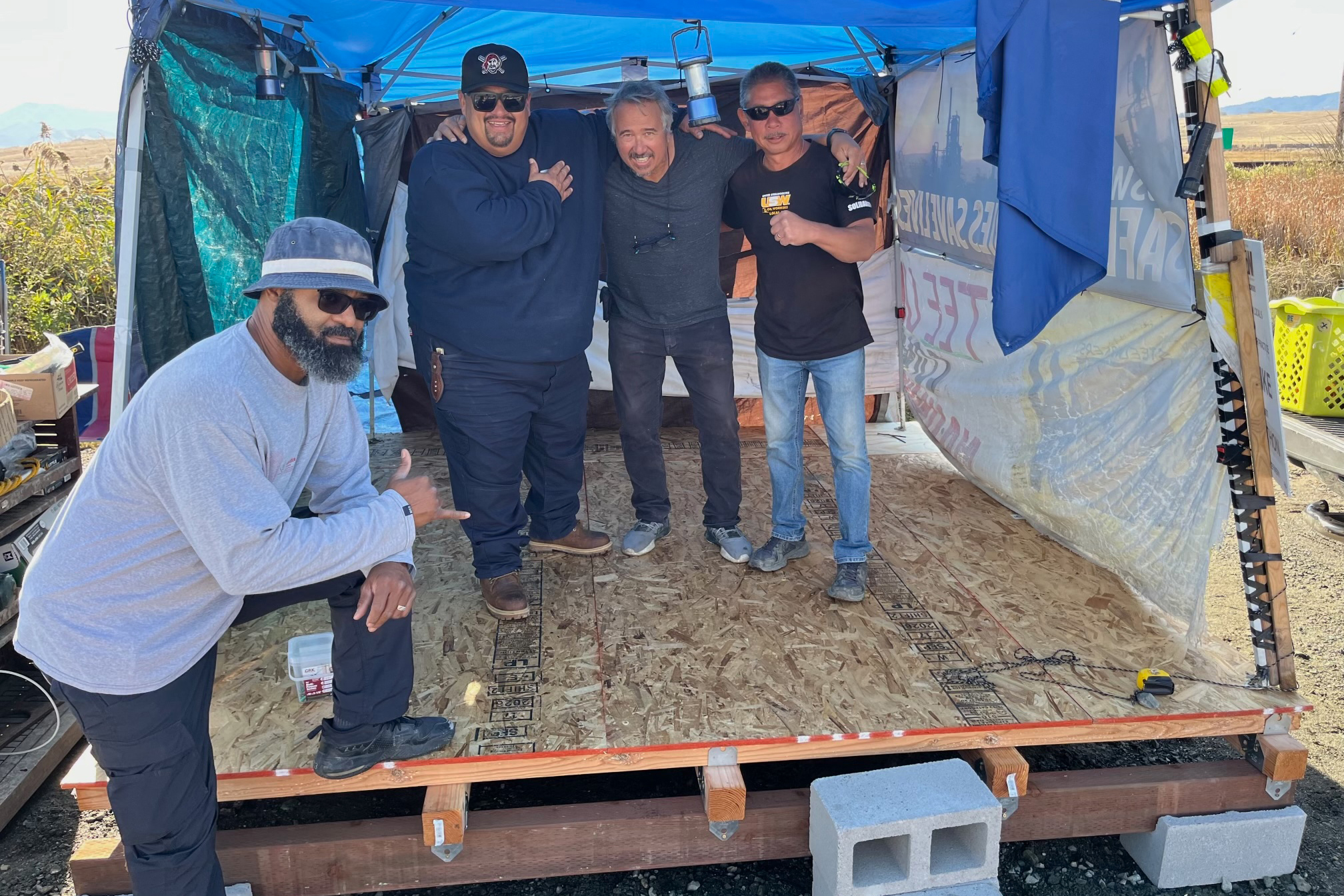
When refinery operators went on strike to demand safer conditions at a renewable fuels facility northeast of San Francisco in April, they worried that workers brought in to replace them hadn’t been adequately trained to run their potentially explosive processing units. The strikers’ concerns grew as they saw unusually frequent and intense flaring, giant flames shooting up from stacks that burn flammable gases to prevent explosions—a sign of problems inside the plant.
California inspectors confirmed workers’ concerns last month. The state’s Division of Occupational Safety and Health, known as Cal/OSHA, cited Marathon for several violations. Among the most serious was the failure “to train each employee before starting work in a newly assigned process” and “provide the training curriculum … and training certification for newly assigned employees,” documents reviewed by Inside Climate News reveal.
Marathon USW Local 5 members raised their safety concerns during months of contract negotiations with the company, which rejected workers’ proposals to address fatigue from relentless overtime shifts resulting from chronic understaffing. The strike turned into a lockout in June, when Marathon rebuffed the union’s unconditional return-to-work offer.
Operators’ fears about safety emerged as soon as they left the plant to go on strike at midnight on April 27. They realized the people who were taking over their shift had not been trained on their units, said Nick Plurkowski, United Steelworkers Local 5 president. “We had safety concerns with the way the shift turnovers went,” he said.
Plurkowski called Cal/OSHA the next day to outline the workers’ concerns.
Now the workers are even more concerned about inadequate operator training and oversight of the plant’s volatile operations, which they blamed for the catastrophic accident that nearly killed their co-worker Jerome Serrano three years ago on Nov. 19.
The federal agency that investigates the causes of industrial accidents agreed with the workers.
Marathon Martinez’s failure to identify problems with the furnace that processes flammable materials or properly label equipment led to the explosion that enveloped Serrano in a fireball, the U.S. Chemical Safety and Hazard Investigation Board concluded in March 2025.
“Inadequate operating procedures and operator training for safe burner operation and inadequate engineering controls for operators to identify combustion issues inside the fired heater also contributed to the incident,” the board concluded in its final report.
Workers decided to walk out a year later, saying Marathon rejected their proposals to address safety concerns and refused to offer them the same terms it had negotiated with the national bargaining units that covered more than 30,000 workers across the petroleum and renewables industry.
Cal/OSHA found many of the same problems identified by the Chemical Safety Board over the course of several inspections between April and October. Inspectors determined that at least a dozen employees hadn’t received proper training, including two shift supervisors and 10 operators.
Martinez Renewables has appealed the citations to the state Occupational Safety and Health Appeals Board, said Marathon Petroleum Corp. spokesperson Jamal Kheiry. “We continue to staff the Martinez Renewables facility with highly qualified Marathon personnel, including supervisors, engineers and technical experts with extensive experience and training in safe, reliable plant operations,” Kheiry said. The company looks forward to working with state officials “to resolve the alleged violations,” he said.
Denisse Gómez, a Cal/OSHA spokesperson, confirmed that Marathon appealed the citations. She said the agency is unable to comment on the findings while the appeal is pending.
Altogether, Cal/OSHA cited Marathon for 10 violations, including three classified as serious: inadequate training, uninsulated high-temperature equipment and faulty emergency eyewash stations.
This story is funded by readers like you.
Our nonprofit newsroom provides award-winning climate coverage free of charge and advertising. We rely on donations from readers like you to keep going. Please donate now to support our work.
Other violations include failures to provide warning labels on fuel-storage containers; inaccessible fire extinguishers; potential tripping and electrocution hazards; and lack of a heat-illness prevention plan that provides adequate shade, breaks and water for employees loading railcars outside or performing strenuous tasks in rubber suits in high-heat areas. Inspectors spoke with employees who did not know how to acclimate to hot working conditions, as required by California’s heat-illness prevention standard.
Those precautions are critical in refineries, which rely on high heat for processing fuels. California requires pipes or other surfaces that reach 140 degrees Fahrenheit to be insulated to limit harm from accidental contact. Inspectors found uninsulated equipment with average heat readings exceeding 550 degrees F.
That finding outraged Plurkowski, who wondered how workers are supposed to stay safe while doing hour-long tasks while sweating nonstop and standing a foot away from a surface that will melt their skin if they touch it.
While those types of safety issues must be corrected, he said, it’s the lack of training that’s most troubling.
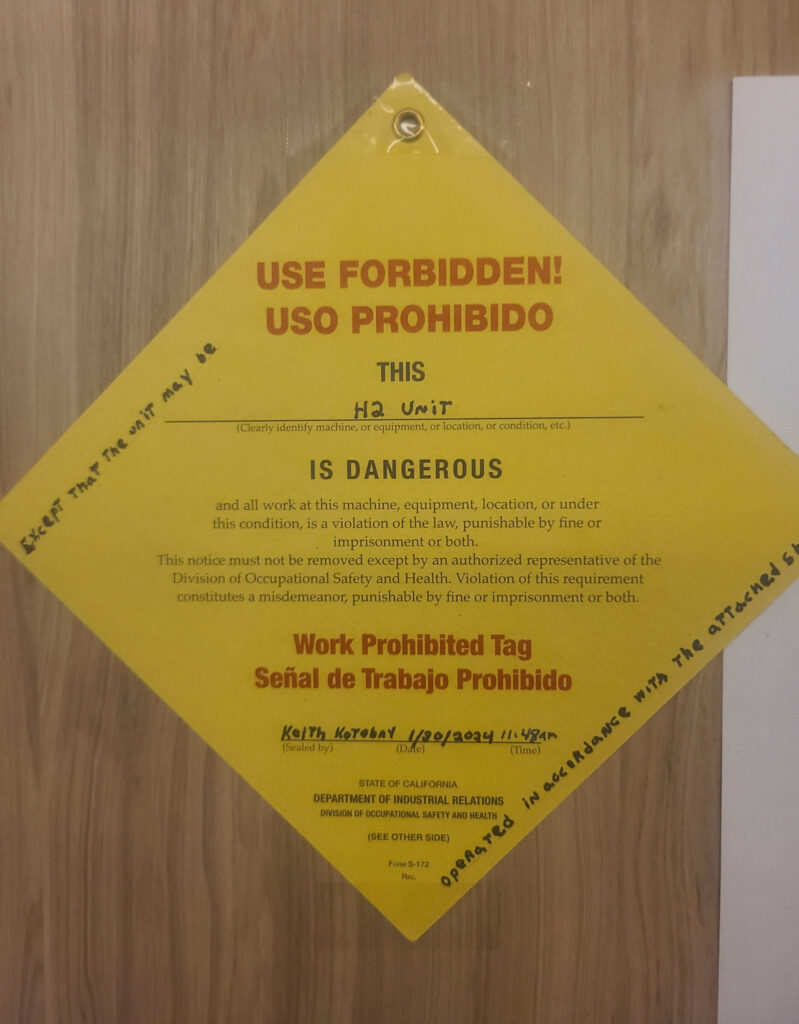
Cal/OSHA “yellow tagged” the unit that burned Serrano, which prohibited anyone from running it until the agency could confirm that employees were sufficiently qualified to operate it safely. Violating a yellow tag results in fines, jail or both.
But the units were tagged only because of “Jerome’s horrific accident,” Plurkowski said. “I just asked OSHA today if they would yellow tag a unit due to lack of training, and they said probably not.”
He asked because he believes the amount of flaring coming from the plant means things are not running smoothly.
Flaring is a necessary precaution, but it shouldn’t be happening so much and to such a large degree, said Plurkowski, who worked at another refinery years ago. When multiple flares are throwing 20-foot flames into the air at the same time, that’s a problem, he said. “The amount of product that is getting thrown out of these units should be very alarming to the communities.”
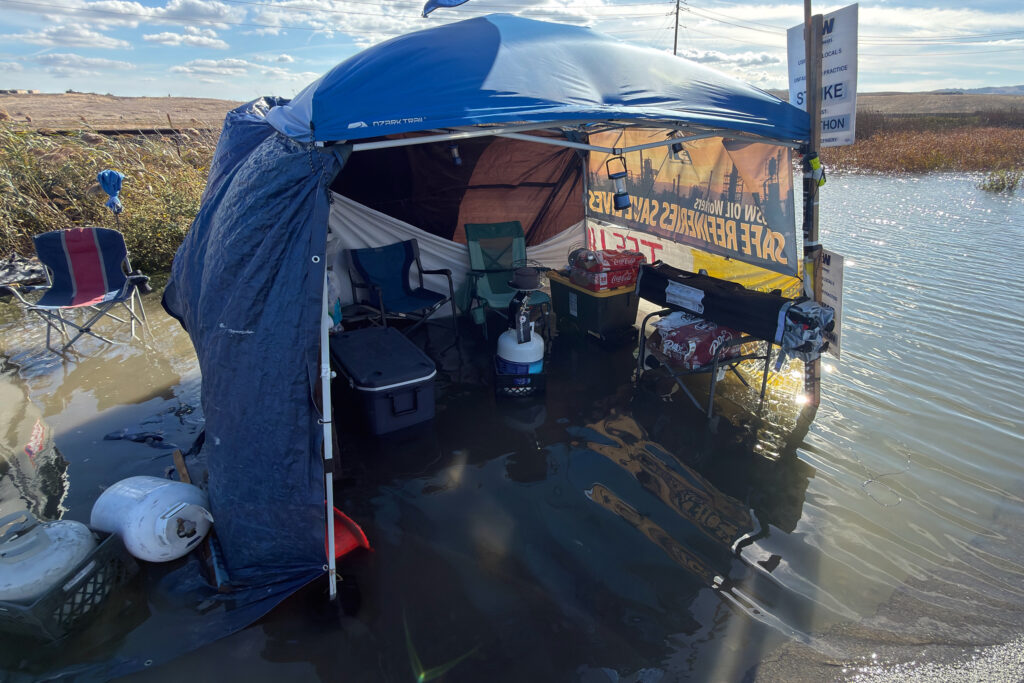
Local 5’s union chair, Criff Reyes, sat through nearly eight hours of the Contra Costa County Board of Supervisors meeting on Tuesday to ask for help resolving the strike.
“We’ve been out for six months and 22 days and our members are starting to suffer,” said Reyes, who leads the bargaining unit.
He told the board that the Cal/OSHA citations confirm that Marathon is letting unqualified workers run the plant, while more than 100 highly trained operators are ready to get back to work.
“I’m asking you to help us out,” he said, noting that “massive flaring” over the last couple days indicates serious issues. “I don’t know what we need to do to try to get these guys back to work because the community is going to suffer.”
Marathon’s Kheiry said they are scheduled to resume negotiations with the union Dec. 1, with the support of a federal mediator.
Plurkowski is not convinced the company is willing to reach a fair resolution. “This whole thing could have been settled 200 days ago if they were bargaining in good faith,” he said.
The incident that burned Jerome Serrano happened shortly after the plant transitioned from petroleum to renewable fuels, when union workers were not in the refinery for a lengthy period of time, Plurkowski said.
“I’m worried that when we get through this labor dispute, my members will be walking back into a dangerous facility,” he said. “We cannot let what happened to Jerome ever happen again.”
About This Story
Perhaps you noticed: This story, like all the news we publish, is free to read. That’s because Inside Climate News is a 501c3 nonprofit organization. We do not charge a subscription fee, lock our news behind a paywall, or clutter our website with ads. We make our news on climate and the environment freely available to you and anyone who wants it.
That’s not all. We also share our news for free with scores of other media organizations around the country. Many of them can’t afford to do environmental journalism of their own. We’ve built bureaus from coast to coast to report local stories, collaborate with local newsrooms and co-publish articles so that this vital work is shared as widely as possible.
Two of us launched ICN in 2007. Six years later we earned a Pulitzer Prize for National Reporting, and now we run the oldest and largest dedicated climate newsroom in the nation. We tell the story in all its complexity. We hold polluters accountable. We expose environmental injustice. We debunk misinformation. We scrutinize solutions and inspire action.
Donations from readers like you fund every aspect of what we do. If you don’t already, will you support our ongoing work, our reporting on the biggest crisis facing our planet, and help us reach even more readers in more places?
Please take a moment to make a tax-deductible donation. Every one of them makes a difference.
Thank you,

Reporter, California
Liza Gross is a reporter for Inside Climate News based in Northern California. She is the author of The Science Writers’ Investigative Reporting Handbook and a contributor to The Science Writers’ Handbook, both funded by National Association of Science Writers’ Peggy Girshman Idea Grants. She has long covered science, conservation, agriculture, public and environmental health and justice with a focus on the misuse of science for private gain. Prior to joining ICN, she worked as a part-time magazine editor for the open-access journal PLOS Biology, a reporter for the Food & Environment Reporting Network and produced freelance stories for numerous national outlets, including The New York Times, The Washington Post, Discover and Mother Jones. Her work has won awards from the Association of Health Care Journalists, American Society of Journalists and Authors, Society of Professional Journalists NorCal and Association of Food Journalists.
