


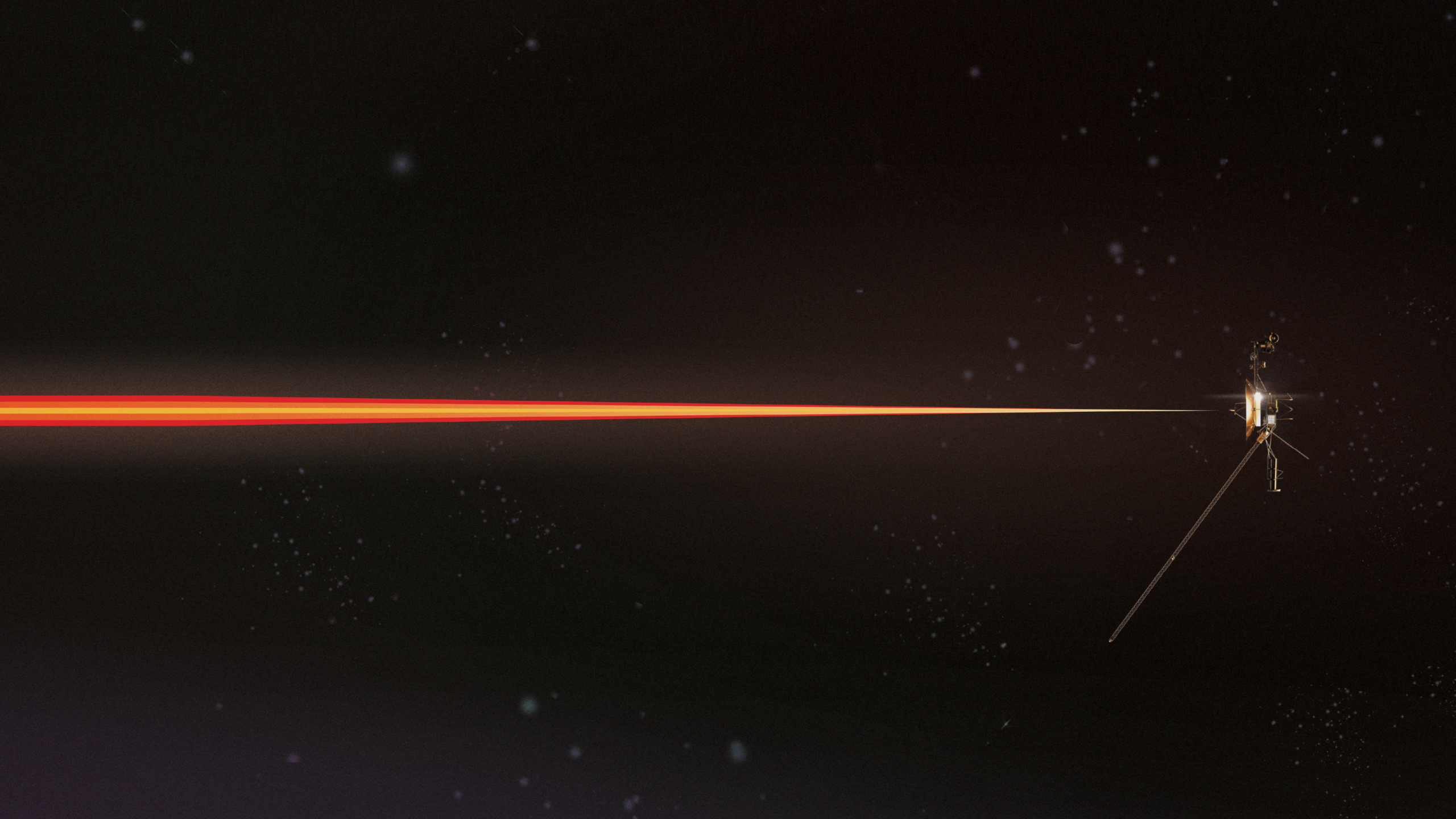
NASA’s Voyager 1 probe, humanity’s farthest-flying spacecraft, has reached one light-day from Earth, after more than 49 years of constant travel. A light-day is the distance light travels in 24 hours, equaling about 16.1 billion miles (25.9 billion kilometers). The spacecraft achieved the milestone at 2:16 a.m. PST (5:16 a.m. EST) Nov. 18.
Voyager team members at NASA’s Jet Propulsion Laboratory in Southern California, managed by Caltech, heard from the probe 24 hours later, the time it took for the spacecraft’s radio signal traveling at the speed of light to reach Earth, early Thursday.
“Traveling a light-day is a singular feat for a spacecraft, but Voyager is so much more than a distant traveler. The Voyager mission would be remarkable just for what it contributed to planetary science with the Grand Tour of the outer planets,” said Joe Westlake, director, Heliophysics Division at NASA Headquarters in Washington. “But it went on to become central to NASA’s fleet of heliophysics missions offering insights into the star that we all revolve around, the Sun.”
Scientists use light to measure the vast distances of space. Light travels at about 186,000 miles (299,000 kilometers) a second in a vacuum. A ray of sunlight passing Earth takes about 1.3 seconds to reach the Moon, about four hours to reach Neptune, and another 20 hours to reach Voyager 1. For comparison, a light-year is 5.88 trillion miles (9.46 trillion kilometers).
Even though the team has not received science and engineering data from Voyager 1 since Nov. 14, the spacecraft is sending what is called a carrier signal, which typically conveys that data to Earth. Mission engineers used the carrier signal and trajectory calculations to confirm the light-day milestone. They continue to analyze the issue impacting the science and engineering data.
Humanity’s only probes in interstellar space, Voyager 1 and its twin, Voyager 2, launched in 1977 to take advantage of a rare planetary alignment. Managed by JPL, they were only the third and fourth spacecraft to visit Jupiter and Saturn, and the first to return high-resolution imagery, transforming our understanding of these worlds and their moons. Voyager 2 went on to study the ethereal ice giants, Neptune and Uranus. Both spacecraft continue to measure changes in the Sun’s magnetic field across vast distances.
“Voyager 1 crossing the light-day threshold is yet another historic feat on an extraordinary voyage of discovery,” said Dave Gallagher, JPL director. “Above all, this milestone stands as a testament to the exceptional teams who built, programmed, and fly these spacecraft today, and who have overcome countless challenges to keep them connected to Earth across the vastness of space. As NASA pushes toward new frontiers in human and robotic exploration, Voyager and the people behind its success continue to inspire us to reach farther and dream bigger.”
In addition to their suite of scientific instruments, the Voyager probes carry a Golden Record, a gold-plated copper phonograph compiling images and sounds from Earth, as a message to any advanced civilization that might one day find it.
“Nearly half a century after leaving Earth, the Voyager mission continues to push the boundaries of human exploration. Its epic journey reflects the vision of Ed Stone, the Caltech physicist and JPL director who guided the mission for decades, and the curiosity and tenacity of generations of scientists and engineers who have carried that vision forward,” said Ray Jayawardhana, president, Caltech. “Beyond its immense contributions to science, Voyager also captures something profound about the human spirit. We may never know where its journey will ultimately lead, but it will venture on, an enduring affirmation that humanity was here and we yearned to explore.”
Milestones, challenges
Traveling about 38,000 mph (61,155 kph), Voyager 1 in 2012 became the first spacecraft to leave the heliosphere, the bubble of particles and magnetic fields created by the Sun that deflects cosmic radiation, and enter interstellar space. Voyager 2, taking a different trajectory, crossed the boundary in 2018.
“The Voyagers are revolutionizing our understanding of interstellar space, a previously unexplored region outside the heliosphere,” said Linda Spilker, Voyager project scientist at JPL. “One big surprise is the extent to which our Sun continues to affect interstellar space, all the way out to Voyager 1. Where does the Sun’s influence end and pristine interstellar space begin? Perhaps Voyager may endure long enough to answer that question.”
Creative engineering solutions have enabled the probes to conserve energy and overcome challenges related to aging hardware, including clogged thrusters and a malfunctioning computer on the spacecraft. Earlier this year, engineers successfully turned off three devices on Voyager 1 and substituted them with three lower-power alternatives — a move not without risk — to help the spacecraft make the most of its 50-year-old radioisotope thermal generator. Essentially a nuclear battery, the generator converts heat from decaying plutonium into electricity.
With the plutonium supply continually depleting, both Voyager probes lose about 4 watts of power each year. The latest energy-saving effort is expected to provide enough power for both spacecraft to keep their current suite of science instruments operating until at least their 50th launch anniversaries next summer.
As with all NASA spacecraft that venture to and beyond the Moon, communication between Earth and the Voyager probes is managed by the agency’s Deep Space Network, large antennas located at three facilities around the world.
“We listen to Voyager 1 every day and send commands to the spacecraft weekly. It just takes a little longer to communicate than it used to,” said Suzanne Dodd, Voyager project manager at JPL. “Even traveling at the speed of light, signals now take 24 hours to reach the spacecraft and 24 hours to reach us. One day in the future, when it can no longer communicate with Earth, Voyager 1 will become humanity’s silent ambassador to the stars.”
For more information about NASA’s Voyager mission, visit:
https://science.nasa.gov/mission/voyager/
-end-
Abbey Interrante / Karen Fox
Headquarters, Washington
202-358-1600
abbey.a.interrante@nasa.gov / karen.c.fox@nasa.gov
Calla Cofield
Jet Propulsion Laboratory, Pasadena, Calif.
626-808-2469
calla.e.cofield@jpl.nasa.gov
