


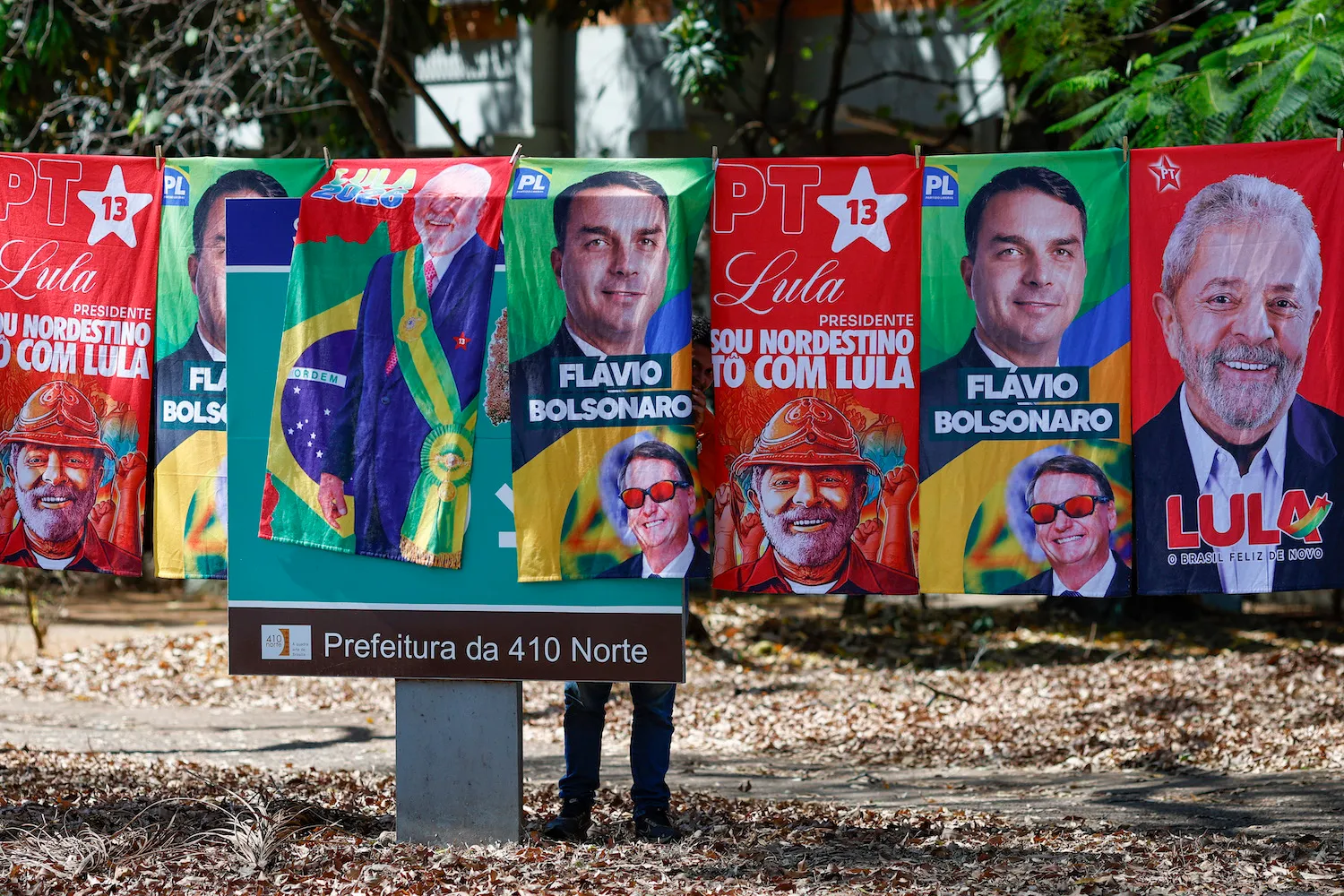
On Oct. 4, Brazilians will vote in the first round of a presidential election with two clear front-runners who appear to be opposites. Incumbent President Luiz Inácio Lula da Silva is running on a platform of economic populism, social liberalism, and political stability. His main challenger, Sen. Flávio Bolsonaro, is campaigning as the torchbearer of the socially conservative movement that his now-convicted father, President Jair Bolsonaro, launched in 2018.
Despite these competing visions, both candidates are unlikely to solve Brazil’s core issues: anemic long-term growth and entrenched corruption. Hastening growth requires structurally lower interest rates, which means deep fiscal reform. Addressing corruption and impunity, meanwhile, would require a wholesale reappraisal of Brazil’s post-dictatorship justice system.
Brazil’s problem is not an inability to reform. It is the country’s inability to institutionalize those changes into lasting solutions. The country has passed legislation attempting to address slow growth and corruption multiple times since redemocratization in the 1980s, but in most cases, politicians either later watered down those reforms or rolled them back entirely.
Brazil is trapped in a cycle of crisis, reform, and backsliding. Breaking out of this cycle is possible, but only if the country can overcome the fragmented political landscape that makes it difficult for voters to attribute policy outcomes to the politicians responsible for them.
Brazil has high levels of sovereign debt, facing steep borrowing costs from lenders. These higher rates propagate through the financial system and raise the cost of investment, which in turn slows growth.
The painful recessions that followed Latin American sovereign debt defaults in the 1980s are a reminder of the kind of danger that Brazil is flirting with by allowing high debt levels. In response to that upheaval, peer countries such as Chile, Colombia, and Peru enshrined rules that strictly limited deficits. This reduced the inflationary impulse and investor risk, allowing for structurally lower interest rates.
Brazil’s reform response was shallower, eventually forcing it to seek out the International Monetary Fund (IMF) for relief in 1998 and 2002.
In the early 2010s, rising deficits and a government-fueled credit boom engendered a massive debt crisis and led to Brazil’s worst recession in a century. That crisis also produced a once-in-a-generation reform process. Brazil’s Congress capped public spending growth at 0 percent in real terms and liberalized the country’s deeply dysfunctional labor market.
Experts widely credit these reforms—especially the spending cap—with bringing Brazil’s interest rates to record lows, reigniting private investment, and permanently increasing the economy’s employment potential. Jair Bolsonaro took office in 2019 and initially maintained this reform-minded momentum. Nevertheless, by 2021, ahead of a reelection bid the following year, he launched a massive expansion of Bolsa Familia, Brazil’s cash transfer program for low-income families.
The program was already a successful policy, but in tripling the budgetary outlay, Jair Bolsonaro converted it into a populist mechanism. Congress was only too eager to abandon its reform approach and return to unconstrained spending. Meanwhile, at the Supreme Court, justices struck down two key provisions of the labor reform that had been important disincentives for spurious litigation.
The cycle of crisis and reform is also present in Brazil’s continuous and largely unsuccessful fight against corruption. The most dramatic example of this is the derailed investigation into Operation Car Wash, which was among the largest public corruption scandals in modern history.
Spanning more than 10 years from 2003 until its exposure in 2014, the multisector scheme saw government-controlled oil giant Petrobras accept inflated contracts from around two dozen engineering firms that then paid kickbacks to the politicians pulling the strings at Petrobras. Though difficult to measure precisely, the graft extended into the billions of dollars and touched most of Brazil’s major political parties.
The resulting investigation into Operation Car Wash dominated Brazil’s news cycle for most of the next two years. Brazilians watched in awe as members of the political and business elite were led away in handcuffs, coming to lionize the man who led the investigation, Federal Judge Sergio Moro. Moro was empowered by a 2013 law that expanded the judiciary’s power to use plea bargaining to build cases. The probe reached so high that it eventually sent Lula to prison. Under Jair Bolsonaro, Moro became Brazil’s justice minister and submitted further anti-crime legislation to Congress in February 2019.
This was the peak of Brazil’s political reform cycle, but it was short-lived. In June 2019, leaked messages between Moro and federal prosecutors derailed the investigation. While communication between judges and prosecutors is normal and legal in Brazil, the messages showed that Moro had abandoned impartiality in his support of the investigation. The public conversation rapidly shifted from whether corruption occurred to whether the investigation involved due process violations.
Between 2018 and 2024, Brazilian lawmakers and judges became uncomfortable with how big the investigation into Operation Car Wash had grown. They supported rolling back numerous anti-corruption laws and legal rulings. Dozens of major defendants, including Lula and potentially hundreds of lesser defendants, went free from overturned convictions and cases that fell apart due to new plea-bargaining limits, statutes of limitations preventing retrials, and minor procedural errors.
Brazil is trapped in a cycle of corruption and disappointing economic outcomes because of its unique legal structure and political landscape. The country’s post-dictatorship legal system was designed to constrain state power, not maximize prosecutorial efficiency. Expansive defense rights, endless appeals, and fragmented accountability institutions often make it easier to uncover corruption than to punish it.
Economist Gary Becker famously argued that the deterrent effect of criminal law depends less on the severity of punishment than on the perceived probability of receiving it. In Brazil, the perceived probability of punishment for elite corruption is low. Legal institutions seemingly exist to feed a conveyor belt of accused but unsuccessfully prosecuted criminals. Data from the World Justice Project is damning: While Brazil is ranked 76th of 143 countries on absence of corruption, it is ranked 126th on government officials being sanctioned for misconduct.
However, the core of the problem is Brazil’s sprawling and ideologically ambiguous party system. Some 22 parties sit in Congress, many devoid of a political identity. Such a landscape undermines “clarity of responsibility,” a concept identified by political scientists G. Bingham Powell Jr. and Guy D. Whitten in 1993. In a system with significantly fewer parties, voters can often identify who is responsible for success or failure and reward or punish them accordingly.
But in a fragmented political system, both major reforms and major failures are typically the product of broad and often temporary multiparty coalitions, which makes it difficult for voters to attribute policy to party. The presidential election between Lula and Flávio Bolsonaro will not alter this paradigm.
Lula, for his part, is a known quantity. His first actions after winning the 2022 election were to kill the spending cap that Jair Bolsonaro had weakened and appoint political ally Aloizio Mercadante as president of Brazil’s state development bank. The first decision dismantled the most critical reform passed in 20 years and the second was a flagrant violation of the post-Operation Car Wash firewall between state-owned enterprises and politics.
Flávio Bolsonaro, on the other hand, displays almost no policy bent other than amnesty for his father and Jan. 8, 2023, rioters as well as impeachment for the judge who investigated them—Supreme Court Justice Alexandre de Moraes.
Although the election may have little or no influence on the crisis-reform cycle, other events may portend its next turn. Brazil’s latest corruption scandal, which revolves around the now-collapsed Banco Master, is growing toward the size of Operation Car Wash. The scheme was allegedly orchestrated by CEO Daniel Vorcaro and included selling fraudulent investment products to public and private entities while engaging in a criminal enterprise to bribe public workers to ignore it and intimidate anybody who could expose it.
Lula himself so far appears to be mostly insulated from Banco Master, but the scandal has recently spread to the Supreme Court—most notably to Moraes, who led the investigation into and trial of Jair Bolsonaro. Flávio Bolsonaro, meanwhile, has repeatedly changed the characterization of his relationship with Vorcaro. Flávio first denied any association with Vorcaro; then denied having sought funds for a documentary about his father from Vorcaro; then admitted that he had sought funds, received them, and even visited Vorcaro’s home after he was first arrested.
Flávio’s brother Eduardo Bolsonaro, an executive producer of the film, is also under investigation by Brazilian authorities for allegedly having used some of Vorcaro’s money to pay for his expenses in the United States while he lobbied the U.S. government for tariffs on Brazil and sanctions against Moraes.
Brazil’s fiscal and debt situation may come to a head at any moment, too, as foreshadowed by a mini currency crisis at the end of 2024, when the country’s currency shed 15 percent of its value over two months. Brazil is paying 8 percent of its GDP in interest to bondholders each year, the second-highest level in the world among similarly sized economies, representing 41 percent of total government expenditures; debt will increase to more than 86 percent of GDP the end of 2026, according to IMF estimates. Markets will eventually balk—the only question is when.
Despite these challenges, Brazil has passed durable reforms in the past. Changes to the country’s monetary framework could provide a road map for breaking out of the current crisis-reform cycle.
The country’s success in taming inflation in the past 30 years is one of its greatest achievements. Brazil endured chronically high inflation beginning in the 1970s, culminating in hyperinflation; annual inflation averaged more than 100 percent from 1980 through 1994 and exceeded 1,000 percent in several years. Beginning with the Real Plan in 1994 and continuing with inflation targeting in 1999 and central bank autonomy in 2021, Brazil instituted durable reforms that underpinned confidence in the country’s currency and eased economic pain on the poor.
These reforms were institutionalized because they stopped being associated with a transitory political coalition. Leaders tapped into a deep dissatisfaction with the status quo and made policy adjustments that resolved the issue. Popular approval of the reform created a critical mass of politicians who became perpetual champions of price stability.
This model is adaptable to the current economic and political challenges because they are easy to explain to ordinary voters. Extremely high interest rates triggered by high deficits are a burden on households; the median borrowing household spends 30 percent of income on debt service. And failing to prosecute public corruption allows widespread theft from taxpayers.
Any political group brave enough to platform these issues could form the base of a successful new movement in Brazil. When the country reaches its next crisis, it will once again have an opportunity to establish reforms that attack the root causes of its malaise. There will be a golden opportunity to win politically while simultaneously making critical improvements. This is the path of durable reform—and Brazil’s chance to escape the crisis-reform cycle.
