


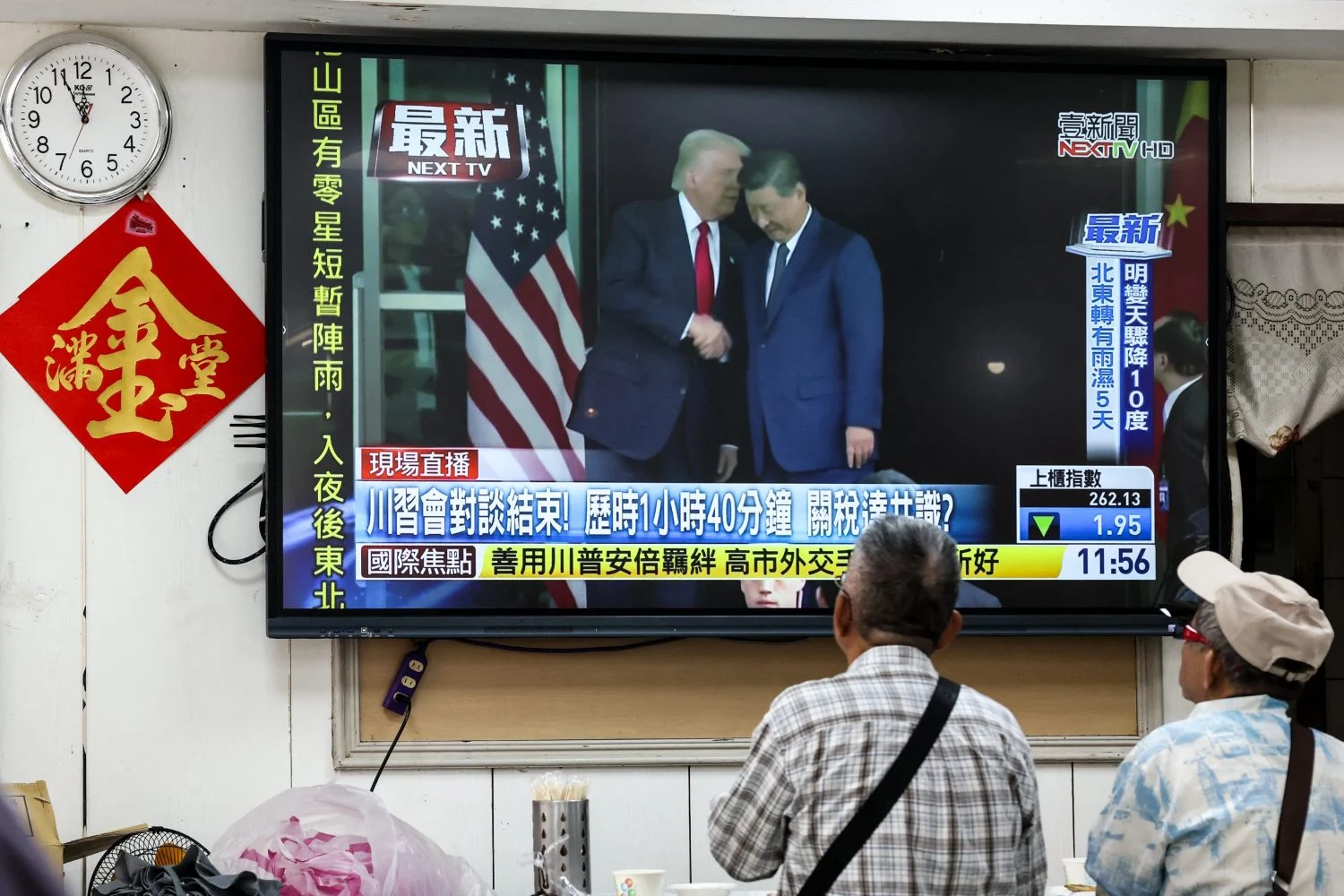
Chinese President Xi Jinping will meet with U.S. President Donald Trump at the White House on Sept. 24 for their second summit this year. The meeting is likely to bring now-familiar jitters both in Taipei and among Washington’s traditional China-policy community. These observers fear that Trump’s deal-making instincts and disinterest in strategy could lead to concessions over Taiwan’s security as a part of a fresh round of horse-trading with Beijing.
Yet even if U.S. policy toward Taiwan remains formally unchanged, a deeper worry should lurk beneath these immediate anxieties. Washington’s long-standing policy of “strategic ambiguity” over its intervention in any conflict over Taiwan appears to be gradually drifting toward a new posture of weaker support. The slow death of strategic ambiguity, in turn, risks miscalculation by China, bringing fresh instability into an already complex and dangerous regional balance.
Chinese President Xi Jinping will meet with U.S. President Donald Trump at the White House on Sept. 24 for their second summit this year. The meeting is likely to bring now-familiar jitters both in Taipei and among Washington’s traditional China-policy community. These observers fear that Trump’s deal-making instincts and disinterest in strategy could lead to concessions over Taiwan’s security as a part of a fresh round of horse-trading with Beijing.
Yet even if U.S. policy toward Taiwan remains formally unchanged, a deeper worry should lurk beneath these immediate anxieties. Washington’s long-standing policy of “strategic ambiguity” over its intervention in any conflict over Taiwan appears to be gradually drifting toward a new posture of weaker support. The slow death of strategic ambiguity, in turn, risks miscalculation by China, bringing fresh instability into an already complex and dangerous regional balance.
The upcoming meeting will be different from the duo’s last summit in May. Back then, the bulk of their agenda was consumed with hashing out an initial trade deal. With that now done, the next summit will focus on managing what both sides have called a relationship of “constructive strategic stability,” in which the basic contours are agreed—at least on the surface.
Taiwan came up only glancingly during the previous meeting in Beijing. American China hawks nonetheless fretted at the time that Trump had somehow absorbed Xi’s way of thinking. In an interview on the plane back home, the U.S. president noted that his Chinese counterpart “feels very strongly” about Taiwan, adding that “the last thing we need right now is a war that’s 9,500 miles away.”
The broader strategic ambiguity framework was developed to avoid just such a war. Designed in the late 1970s and 1980s, it formed part of a broader set of understandings following Washington’s diplomatic recognition of Beijing and became part of the bedrock of subsequent U.S.-China relations. At its simplest, it says that the U.S. will avoid giving a clear answer as to whether it would intervene militarily, were China to attack Taiwan, in effect keeping both sides guessing.
Ambiguity had twin aims. Most obviously it sought to deter China from taking the island by force. But it also restrained Taiwan from taking provocative steps of its own, by declining to hand Taipei a diplomatic blank check in the event of a conflict.
Whatever its merits when first devised, the policy was born in a quite different era, in which the U.S. was vastly stronger relative to China. Hawkish critics have argued for many years that it now does too little to deter a much more capable and confident Chinese military. Richard Haass, then president of the Council on Foreign Relations, wrote an influential essay in 2020, arguing for a new policy of “strategic clarity,” making it clear that Washington would in fact come to Taipei’s aid.
Former President Joe Biden sent signals in this direction, too, often noting in public that the U.S. would indeed support Taiwan, even as official policy remained unchanged. Now the risk is more in the other direction, namely that Trump’s instincts and statements give the impression (whether intended or not) that the U.S. is inching more toward a position of nonintervention.
Partly this is because Trump himself clearly cares so little for Taiwan. He treats the island with a suspicion normally reserved only for freeloading full U.S. allies. He suggests that the Taiwanese government “stole” America’s semiconductor industry, too. At the same time, Trump shows little patience for the kind of geostrategic arguments about defending the first island chain that have long animated Washington’s China hands. As he said after his meeting in May, “We’re supposed to travel 9,500 miles to fight a war? I’m not looking for that.”
Following those remarks and others in a similar vein, many observers worry that the new constructive stability doctrine would effectively hand Beijing a veto over anything it might regard as destabilizing, not least future arms sales. Trump announced a record $11 billion defense package to Taiwan last year, but a further $14 billion deal is now languishing and awaiting the administration’s approval. Trump has explicitly said that he views such arms packages as chips to play in negotiations with Beijing, marking a striking departure from the past U.S. practice of insulating Taiwan’s defense from broader China policy. In diplomatic terms, Trump has created a linkage between policies that past administrations, including his first, had deliberately siloed.
Trump’s instincts chime with broader thinking in his inner circle. Conservative intellectual Michael Anton, to take one example, had a leading role in drafting the 2025 National Security Strategy. Back in 2021, he wrote a widely read essay headlined “Why It’s Clearly Not In America’s Interest To Go To War Over Taiwan,” arguing against any military involvement over the island. “There is no core American national interest that would compel us to go to war over Taiwan,” he wrote. “Even if there were, there’s no guarantee we could win.”
Other Trump-linked thinkers make similar arguments—for instance, those linked to Defense Priorities, a restraint-oriented group with ties to the White House. Jennifer Kavanagh, a senior fellow there, wrote earlier this year that the United States should “replace strategic ambiguity with an explicit policy of nonintervention” while “restructuring” its military in ways that would prove less provocative to Beijing. Last week, she published a widely-discussed further report, arguing that the United States should do less to defend Taiwan, pulling back from its front-line position along the first island chain, which includes Taiwan and Japan. These used to be fringe arguments, but they are becoming more mainstream in Trump’s Washington.
Formally, there has been no change to U.S. Taiwan policy. Senior officials insist strategic ambiguity remains intact. U.S. Undersecretary of Defense for Policy Elbridge Colby recently gave a speech in Manila arguing that the Pentagon is still rebuilding deterrence against China along the first island chain, which includes Taiwan. The United States was “digging in” in Asia, he said, not disengaging.
In the ongoing Iran war and with Trump’s attention ever shifting, however, it is often hard to divine with confidence what U.S. policy on a given issue actually is. Even so, Trump’s fixation on deal-making and the new strategic stability framework with China heavily imply that support for Taiwan is something to be managed and hedged so as not to upset the delicate broader relationship with Beijing. He certainly seems willing to ignore acts of Chinese aggression, including reports that China’s provision of high-resolution satellite imagery to Iran may have caused American fatalities during the recent conflict.
Rather than a decisive shift toward strategic clarity, in which it becomes explicit that the U.S. would indeed support Taiwan, the more realistic prospect is a policy that drifts quietly in the opposite direction, toward not supporting Taipei at all. The danger is that a combination of Trump’s off-the-cuff rhetoric and the restraint-minded ideas circulating in Washington changes China’s calculations. If Beijing comes to believe that the risks of moving against Taiwan have fallen, it may be tempted, sooner than expected, to test that resolve directly. Strategic ambiguity had a deterrence effect that will now likely be lost.
The odds that China will test U.S. support for Taiwan with a takeover attempt in the short term are still low. Beijing seems content, for now, with the constructive and stable relationship it has only recently established with Washington. Xi is likely to be focused on his own succession next year, when he is widely expected to secure a fourth term at the Chinese Communist Party’s National Congress, leaving little appetite for a Taiwan crisis of his own making. Chinese intellectuals now talk about an “emerging U.S.-China détente,” in the words of Da Wei, a prominent thinker with close ties to Beijing’s security establishment.
For its part, though, China continues to signal its long-term goal of taking over Taiwan, including by means of military invasion. Back in May, Xi warned Trump against mismanaging Taiwan, noting that “the two countries will have clashes and even conflicts, putting the entire relationship in great jeopardy.” Signals from Washington suggest that the United States’ willingness to tolerate any clash with China is ebbing. Strategic ambiguity was initially designed to keep Beijing and Taipei guessing. Under Trump, it risks curdling into a different kind of clarity, in which China quietly concludes that the United States is now less committed to Taiwan than it once was.
