


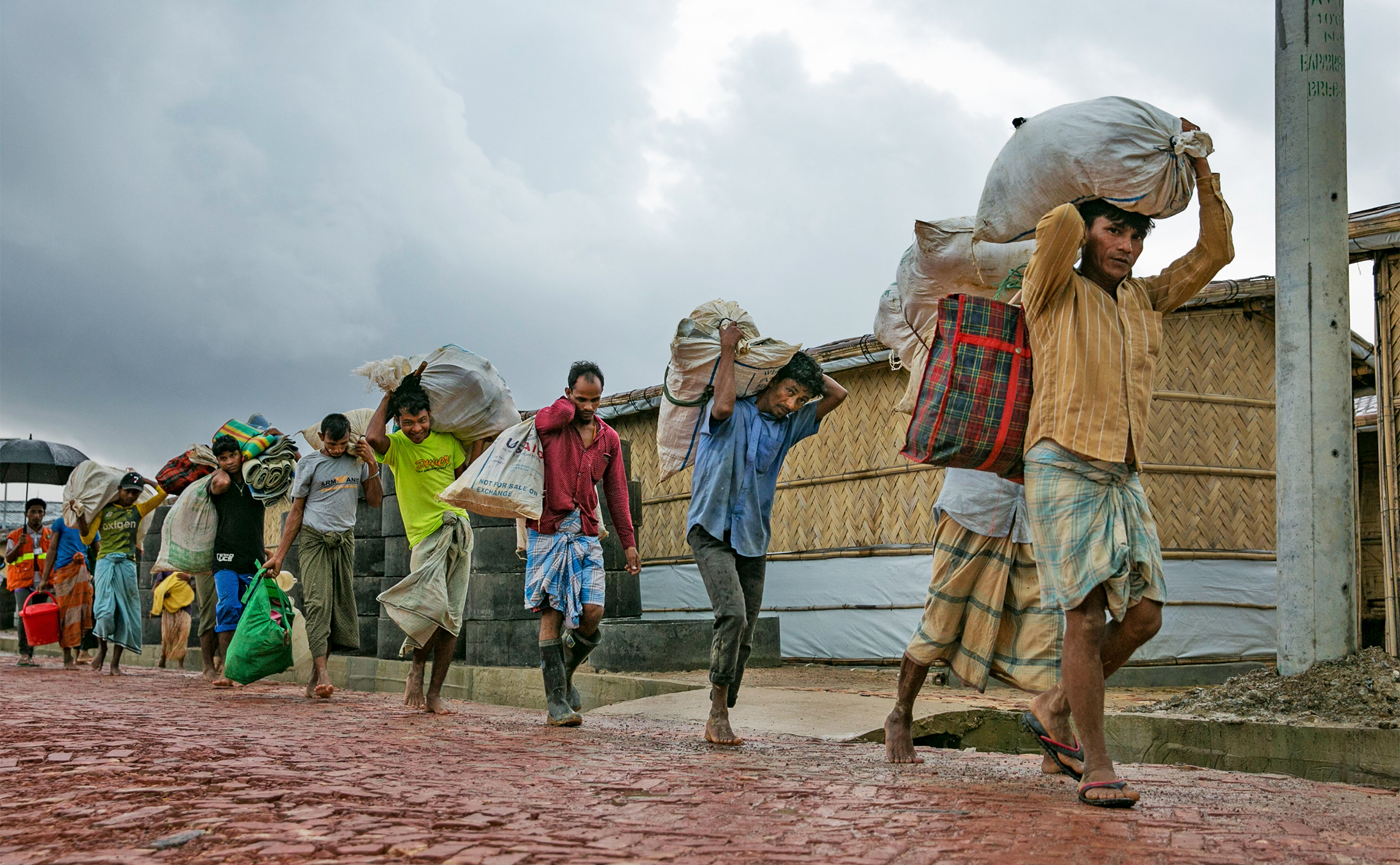
- Amid recurring landslides, a growing number of Rohingya refugees in Bangladesh are being forced to adapt to increasingly limited camp space.
- The refugee management authorities warn that expansions of Rohingya camps will accelerate further destruction of forests and biodiversity.
- A study recommends protection of the vulnerable hill slopes, but authorities cite fund shortages as a major obstacle.
According to a report by the Bangladeshi government, released on Sept. 16, more than 150,000 Rohingya people fleeing persecution in Myanmar have entered the country’s 33 Rohingya camps in Teknaf and Ukhiya areas of Cox’s Bazar in the last few months.
The camps, spread across roughly 24 square kilometers (9.2 square miles), officially host 1,170,978 dwellers — more than (more than 124,300 people per square mile) — making the densely packed settlements increasingly congested and vulnerable to collapse as new arrivals continue to enter the limited space, according to the report by the Office of the Refugee Relief and Repatriation Commissioner (RRRC).
Several studies show that the camps, built on sandy hill slopes after large areas of reserved forest were cleared, are also highly vulnerable to natural disasters.
Every year, heavy monsoon downpours trigger landslides in Rohingya camps. This year, between July 4 and 19, more than 200 landslides occurred in the Rohingya camps, killing at least 15 people, including five adolescent girls.
Mohammed Mizanur Rahman, the refugee relief and repatriation commissioner, told Mongabay on Sept. 8, “The refugee community demands camp expansion with continued influx from Myanmar. But any expansion means destruction of new forests and hills, and Bangladesh cannot afford it anymore.”
The Rohingya influx in 2017 initially caused a total destruction of 1,502 hectares (3,713 acres) of forest lands in Cox’s Bazar to accommodate the makeshift refugee settlements.
Two years later, the country’s Forest Department reported that the Rohingya settlements severely damaged biodiversity and depleted more than 3,230 hectares (8,000 acres) of reserved forest in Cox’s Bazar.
A 2020 study that analyzed landscape changes in Ukhiya noted that slope cutting and road and stair construction in the elevated part of Kutupalong, the largest refugee camp network in the world, were increasing the risk of landslides and flooding across several camps.
Mapping vulnerable slope units in the Kutupalong camps, a 2025 study found that 109 of the 1,726 studied slope units had moderate-to-high landslide susceptibility before the Rohingya influx. But the number increased to 291 by 2021.
The study noted that the rise suggests that landscape changes made to accommodate the large influx of Rohingyas have increased landslide susceptibility.
Co-author of the study Shamima Ferdousi Sifa, an assistant professor at the University of Dhaka’s department of disaster science and climate resilience, said landslide risk factors, including rainfall patterns, are changing as the influx of Rohingya refugees continues.
“As long as housing settlements continue to expand onto unstable slopes, Rohingya refugees will remain at risk of landslides,” Sifa said.


New refugees strain fragile camps
Cox’s Bazar is predominantly a floodplain, with a mean slope of about 4° and an average elevation of 17 meters (56 feet) above global mean sea level.
Its diverse geomorphological landscape includes flat floodplains, mudflats, dunes, tidal creeks, hillocks and sandy beaches.
The landscape is also characterized by extensive forest areas, including protected forests designated as wildlife sanctuaries.
A 2022 study, which assessed rainfall-induced landslide risk in Cox’s Bazar’s Kutupalong camps, found that most slope failures occurred in residual soils and weathered silty sandstone.
The study showed that the camps’ landmass — underlain mainly by Tipam sandstone, Girujan clay and Dupi Tila formations of fluvial sandstone, clay and beach deposits — faces recurring landslides due to steep slopes caused by unplanned settlements with fragile bamboo and plastic shelters, heavy rainfall, and inadequate disaster-risk reduction measures.
More than 3,100 landslide incidents were recorded across the Rohingya camps, affecting more than 73,000 people, between 2018 and 2025. This year, more than 200 landslides hit the Rohingya camps, displacing more than 13,000.

Rintu Bikash Chakma, in charge of Camp 8 West in Kutupalong, said that the remaining hill slopes are further cut to expand existing houses to shelter camp residents’ relatives when they arrive from Myanmar.
“This leaves the houses above and below the cut slopes vulnerable to landslides.”
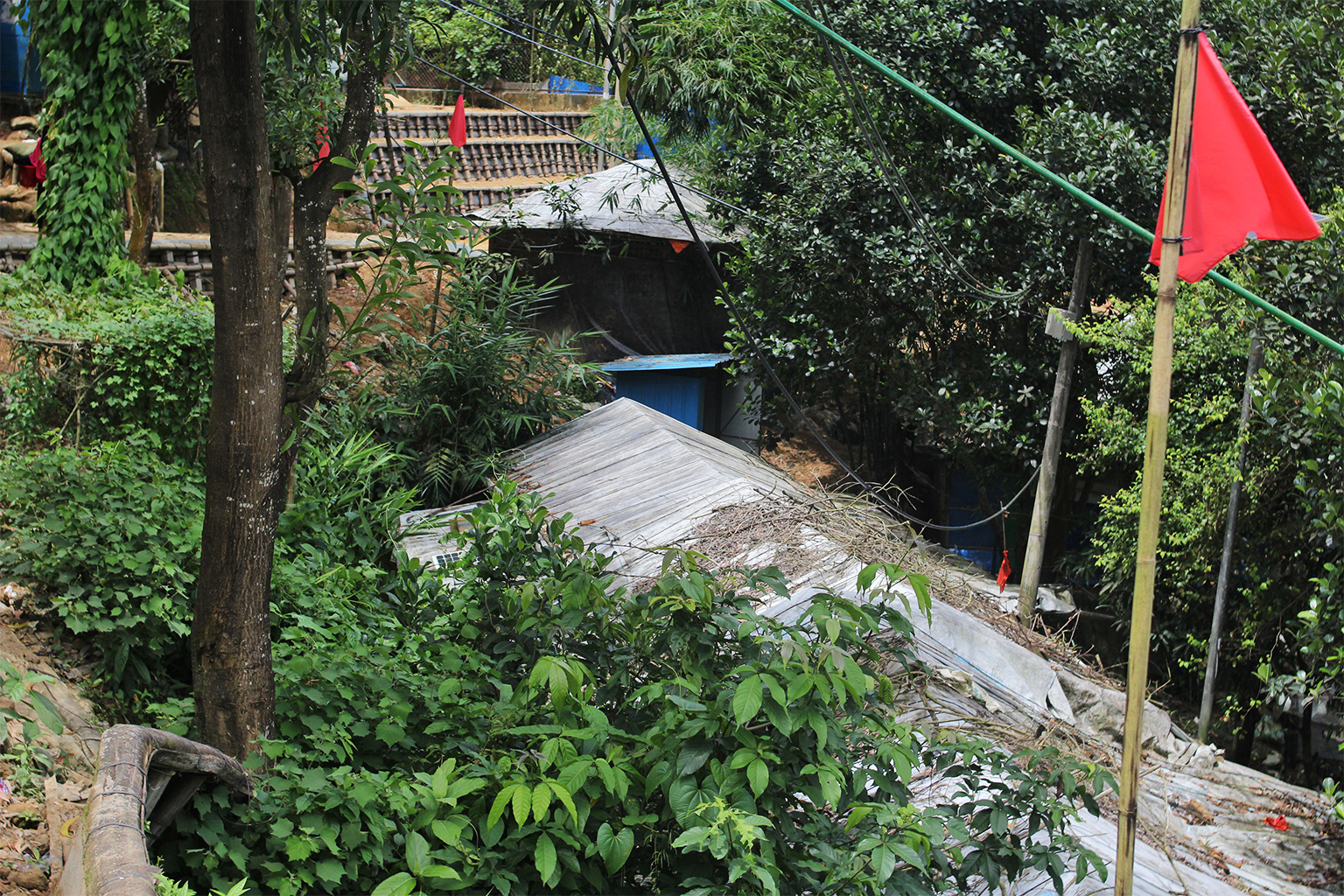
Other camp officials said that they hoist red flags at risky slopes every monsoon to avoid casualties, but some dwellers remain reluctant to relocate.
When a Mongabay reporter visited Camp 4 in Kutupalong earlier this month, several slope units marked with red flags were found to be still occupied by dwellers.
One such resident, Morium Begum, 55, said she would rather risk dying in a landslide than move from the place where she and her five family members have lived since 2017.
“The authorities may make the slope landslide-resistant or send us back to Myanmar,” she said.
Slope stabilization needs funding
The 2025 study recommended immediate stabilization of 287 slopes out of the 1,726 mapped slope units. It classified another 428 slope units as short-term priorities, while 505 are long-term priorities.
Refugee relief and repatriation commissioner Mizanur said, “Fund shortages severely impact disaster risk management in the camps.”
The access, safety and disaster risk management program — coordinated by the Rohingya Refugee Response collective through government collaboration with international organizations — for the Rohingya camps was only 40% funded until July 2026, leaving a $23.2–million shortfall against its $38.8-million requirement, according to an official document.
The wider Shelter and Camp Coordination Camp Management (SCCCM), also under the Rohingya Refugee Response, was 42% funded, with a further $73.9 million needed for emergency slope stabilization, drainage, watershed management and other disaster-risk measures.
Banner image: Families are relocated due to flooding and landslides in the Balukhali Rohingya refugee camp in Cox’s Bazar. Image by UN Women/Allison Joyce via Flickr (CC BY-NC-ND 2.0).
Climate-resilient housing models slow to gain ground in disaster-prone Bangladesh
Cameroon’s Nigerian refugees who degraded their camp are now vanguards of reforestation
Citations:
Quader, M. A., Dey, H., Malak, M. A., & Sajib, A. M. (2020). Rohingya refugee flooding and changes of the physical and social landscape in Ukhiya, Bangladesh. Environment, Development and Sustainability, 23, 4634-4658. doi:10.1007/s10668-020-00792-0
Haque, D. M. E., Roy, R., Tasnim, S., Sifa, S. F., Karunatillake, S., Kamal, A. S. M. M., & Lorenzo, J. M. (2025). Decoding dynamic landslide hazard processes for a massive refugee camp in Bangladesh. Environmental Challenges, 19, 101172. doi:10.1016/j.envc.2025.101172
Kamal, A. S. M. M., Ahmed, B., Tasnim, S., & Sammonds, P. (2022). Assessing rainfall-induced landslide risk in a humanitarian context: The Kutupalong Rohingya Camp in Cox’s Bazar, Bangladesh. Natural Hazards Research, 2(3), 230-248. doi:10.1016/j.nhres.2022.08.006
Feedback: Use this form to send a message to the author of this post. If you want to post a public comment, you can do that at the bottom of the page.
Cite this article
Sadiqur Rahman (2026). Bangladesh’s Rohingya refugee camps become increasingly vulnerable to landslides. Mongabay Conservation news. DOI: https://doi.org/10.66709/news-330815

