


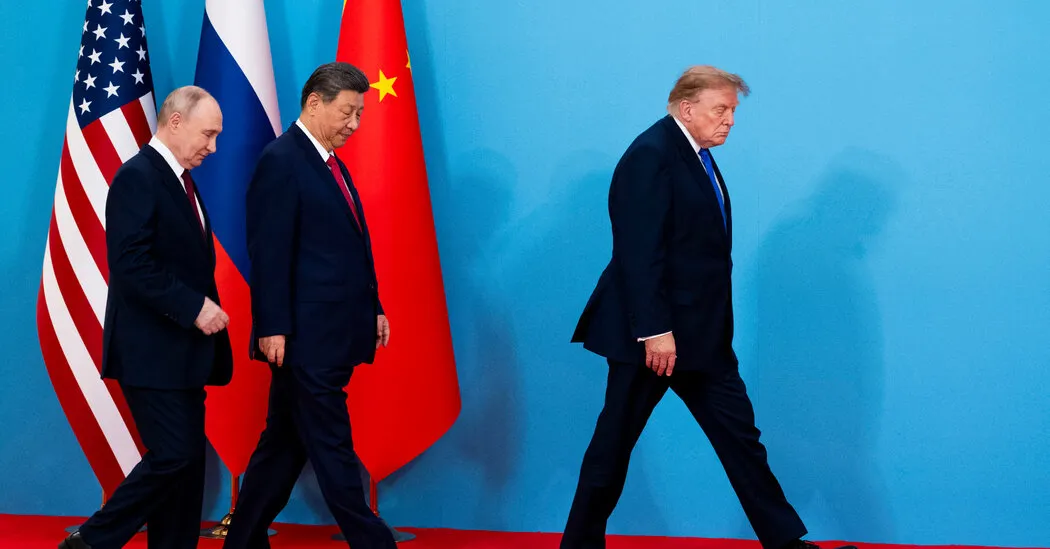
President Trump used his first-ever trilateral summit with Presidents Xi Jinping of China and Vladimir V. Putin of Russia on Thursday to say that their respective nations were “uniquely positioned to discuss how to reduce the number of nuclear weapons on earth.”
But after an 80-minute conversation at a lakeside villa in the city of Shenzhen, a Chinese technology hub, it was unclear whether the three leaders had agreed to return to the kind of arms control talks that for decades were a centerpiece of diplomacy among superpowers during the Cold War. On new threats, including artificial intelligence, the three leaders were largely silent.
Mr. Trump, who also met with Mr. Xi and Mr. Putin separately at the Asia-Pacific Economic Cooperation forum this week, appeared delighted to convene the world’s largest nuclear powers for a discussion about disarmament. But he did not come with a detailed plan for how to reduce the number of nuclear weapons, or outline a path to one.
Instead, Mr. Trump relished what amounted to a high-profile photo opportunity of the three leaders seated around a circular wooden table. For Mr. Trump, the main achievement seemed to be a mutual commitment to keep talking about peace — without taking meaningful steps toward it.
“Too often, past leaders avoided talking to nations with whom they had disagreements, and we feel the opposite.” Mr. Trump told Mr. Xi and Mr. Putin. “No peace was ever forged by declining opportunities for engagement and speech.”
After the summit, the leaders released a joint statement saying they had agreed to reform the United Nations, increase the production and supply of petroleum, oppose perceived abuses by the International Criminal Court against state officials, and continue their dialogue on reducing nuclear risks. “A nuclear war cannot be won and must never be fought,” the statement said.
While China, which has the fastest-growing nuclear arsenal on earth, agreed to participate in the three-way discussion of nuclear weapons, the leaders announced little concrete beyond agreeing to continue a dialogue on reducing nuclear risks. Mr. Xi has long been reluctant to agree to nuclear arms control because China’s arsenal remains a fraction the size of those belonging to Russia and the United States.
In the end, Mr. Trump’s whirlwind journey — two weeks after the Republican Party suffered a wipeout in the midterm elections and amid anxiety at home about widespread digital outages — amounted to a grand show of camaraderie.
As host of the tightly choreographed event, Mr. Xi flattered Mr. Trump and gave him an opportunity to ask for China’s assistance on matters ranging from ending global conflicts to spending more on U.S. agricultural goods. The summit also removed Mr. Putin from his status a global pariah over his invasion of Ukraine, elevating him to a leader deserving of equal diplomatic footing.
But for all of the talk of peace, there was no announcement of breakthroughs in the talks the Trump administration is engaged in to end that conflict. Nor did Mr. Trump appear to dwell on finding a way out of the its war with Iran.
“We don’t need any help,” Mr. Trump said, when asked by a Fox News reporter before the summit whether he would seek assistance from the other leaders in ending a conflict of his own making. In fact, the help Mr. Trump could ask for would involve demanding that China and Russia stop assisting Iran: U.S. intelligence has concluded that both countries provided either technology or targeting information that likely helped the Iranians strike American military bases in the Middle East.
On Fox News, Mr. Trump described the three-way conversation as a way to disrupt the growing “partnership without limits” that Mr. Xi and Mr. Putin say they have formed in recent years. Mr. Trump said that he hoped to break up that alignment and turn it into a three-way conversation, rather than a partnership focused on countering American influence.
China and Russia’s alignment, Mr. Trump said, “should have never been allowed to happen.”
Seeking his own path into Mr. Xi’s good graces, Mr. Trump has held three meetings with the Chinese leader this year, with the goal of cooling a tit-for-tat trade war and of building up a personal relationship through mutual flattery. Mr. Trump traveled to Joint Base Andrews to welcome Mr. Xi to Washington in May, and Mr. Xi responded in kind when Mr. Trump arrived in Shenzhen on Wednesday, treating the president to a military exercise and a fleet of U.S. and Chinese flag-waving dancers in a flurry of pink, blue and white outfits.
In Shenzhen, the heart of China’s robotics, telecommunications, semiconductor and software industries, Mr. Trump did not visit the chief technological competitors to the United States, or see coffee-serving robots near the city’s center.
Still, he marveled over the ceremonial welcome and held it up as evidence of a warming bond, telling an interviewer that “one of the great presidents of China” had greeted him. “He’s never gone to the airport to meet somebody,” Mr. Trump said.
The president, who spends much of his time in the United States on bombastic appearances and incendiary social media posts, was on his best behavior alongside Mr. Xi. (He was his old self on Fox News before the summit, when he threatened to wipe out Iran should it attack the United States directly.)
Mr. Xi, for his part, said a much improved relationship between China and the United States in recent months was “the right way” for the two powers to “get along.” But he also warned that the key to keeping ties stable “lies in taking concrete actions to implement the consensus reached by the two heads of state.” The remarks came days after Washington moved to close a loophole on Chinese access to advanced A.I. chips.
As for Mr. Putin, the summit was his first encounter with Mr. Trump since the two men met in Alaska last year. That meeting was a diplomatic flop, and the war in Ukraine has intensified since then. The peace mechanism Mr. Trump advocated — a direct meeting between Mr. Putin and President Volodymyr Zelensky of Ukraine, moderated by Mr. Trump — has yet to materialize.
This time, White House officials were modest in their predictions. Expectations were set so low that White House officials who previewed the trip last week initially said that Mr. Trump would not bring up the war in Ukraine at all, although he ultimately did.
In Shenzhen, Mr. Trump continued welcoming Russia back into the fold of great superpowers. He called Mr. Putin “my friend,” and insisted that all three leaders would like to see the war end quickly. The Russian leader reiterated after the meeting, however, that he would not be negotiating with Ukraine.
During the trilateral meeting, Mr. Xi and Mr. Putin embraced the idea of peaceful leadership, without making commitments that would be much of a burden to either of their countries. In his own remarks, Mr. Putin said that their nations were “united not only by the status of being the victorious countries in World War II, but most importantly by the joint responsibility for maintaining international peace and security.”
And Mr. Xi mentioned a utopian goal that has pretty much fallen off the agenda of superpowers. He described nuclear weapons as a “sword of Damocles hanging over humanity” that should be eliminated. But Beijing has typically called on the United States to take the first steps in arms control, a demand that Mr. Trump seemed to acknowledge earlier in the day.
“For me, it’s a hard thing,” he told Fox News. “And it’s probably hard for them to do also.”
It has been done before, by Mr. Trump’s predecessors. Today, the United States and Russia each have slightly more than 5,000 nuclear warheads, and only 1,550 deployed under the New Start treaty that expired earlier this year — down from tens of thousands on both sides during the Cold War.
China, however, was never a party to past nuclear reduction treaties, and it is now intent on building up to at least current Russian and U.S. levels.
Mr. Trump also said in Shenzen that he wanted to crack down on nuclear proliferation by smaller powers — his justification for attacking Iran — and restrain what he said were the excesses of “rogue” organizations like the International Criminal Court.
Mr. Putin is subject to an I.C.C. arrest warrant over alleged war crimes in Ukraine. Nevertheless Mr. Trump welcomed the Russian leader in Alaska last year and extending an invitation to the Group of 20 summit next month in Florida. Mr. Putin told reporters after the meeting that he was unsure if he would attend.
One topic that went missing from each leader’s remarks was artificial intelligence, as China and the United States are locked in fierce competition over the new technology.
Mr. Trump did not answer a question, shouted by a Bloomberg News reporter at APEC earlier in the day, if the former chief executive of Nvidia — a company that has been central to the A.I. boom — had been disloyal to the United States. The executive, Jensen Huang, resigned after he was found to have two extramarital relationships, including one with a woman who U.S. intelligence determined is a Chinese asset.
The reporter who shouted the question was admonished by Chinese officials and barred from the trilateral meeting. Mr. Trump seemed blasé about the matter of espionage earlier in the day, telling Fox News that “we spy on them too.”
As the president basked in flattery from an authoritarian whose iron-fisted leadership he has openly admired, he gently suggested that he had not received as much media coverage as he would have liked.
“It’s too bad the media couldn’t see some of it,” Mr. Trump said of his trip.
David Pierson contributed reporting.
