


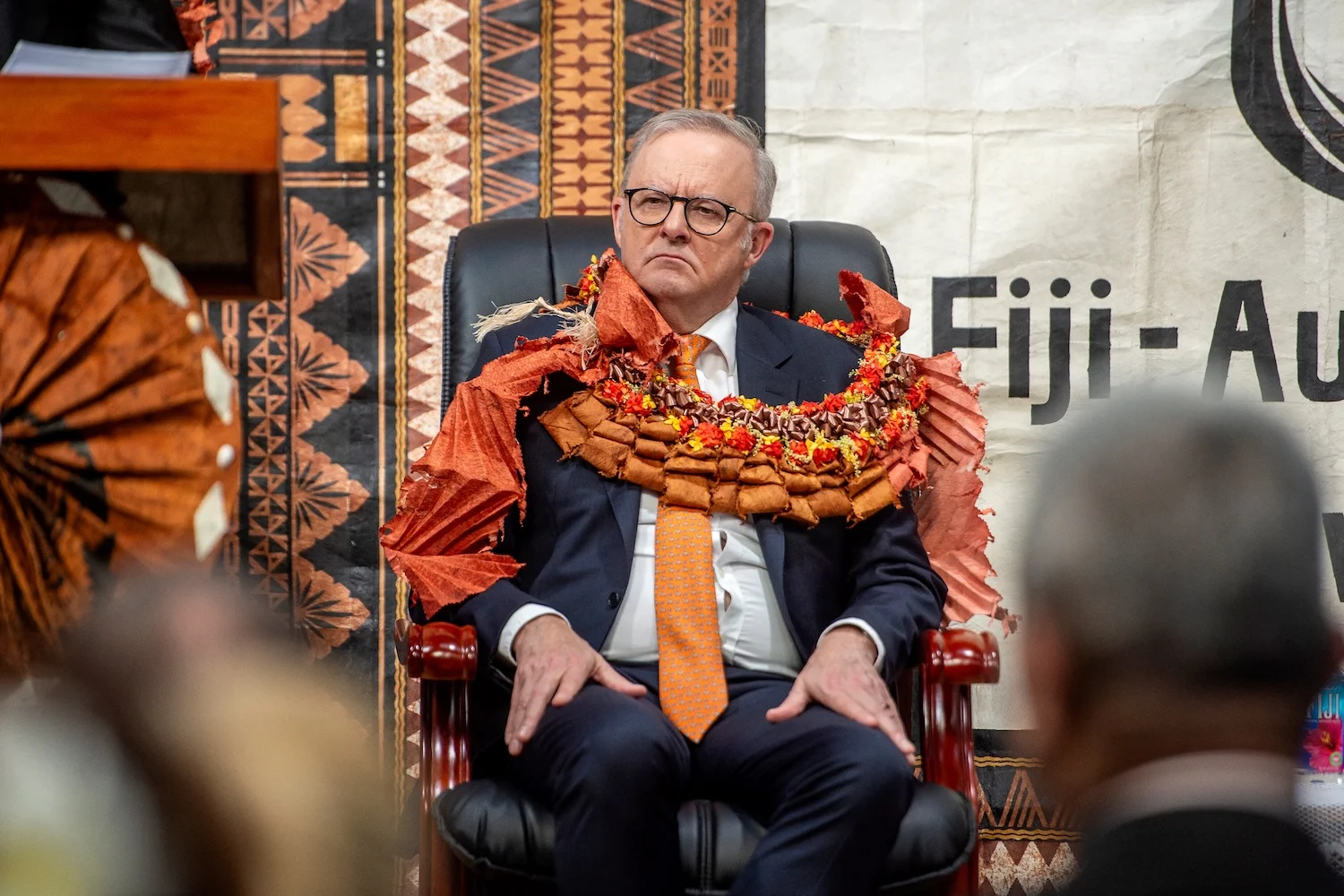
Since coming to office in 2022, the Australian Labor Party government of Prime Minister Anthony Albanese has championed the virtues of a “stabilized” relationship with President Xi Jinping’s China. The fruits of this approach—which dropped a mantra of “pushing back” against Beijing and instead deployed the careful rhetoric of “constructive” engagement—have been obvious. Under the previous, conservative government of Scott Morrison, China’s unreasonable economic coercion of Australia had resulted in punitive sanctions on Australian exports to China of wine, barley, lobster, and coal, among other products. In December 2024, this came to an end when China lifted its final Australian embargo, on lobsters.
Yet through this period of high diplomatic tension, the two countries’ economic complementarity continued, especially in the resources sector. Australia’s iron ore trade with China has largely underwritten its national prosperity for the past three decades, and neither Beijing nor Canberra’s hawks dared use it as leverage.
Since coming to office in 2022, the Australian Labor Party government of Prime Minister Anthony Albanese has championed the virtues of a “stabilized” relationship with President Xi Jinping’s China. The fruits of this approach—which dropped a mantra of “pushing back” against Beijing and instead deployed the careful rhetoric of “constructive” engagement—have been obvious. Under the previous, conservative government of Scott Morrison, China’s unreasonable economic coercion of Australia had resulted in punitive sanctions on Australian exports to China of wine, barley, lobster, and coal, among other products. In December 2024, this came to an end when China lifted its final Australian embargo, on lobsters.
Yet through this period of high diplomatic tension, the two countries’ economic complementarity continued, especially in the resources sector. Australia’s iron ore trade with China has largely underwritten its national prosperity for the past three decades, and neither Beijing nor Canberra’s hawks dared use it as leverage.
Indeed, despite the many targeted sanctions on Australia’s goods over that period, Canberra’s overall exports to China nearly doubled, from $116 billion in 2017 to $218 billion in 2023. With business booming, Labor took the off-ramp after its first election win in 12 years, and dialogue with Beijing was restored. So, too, were annual reciprocal leaders’ visits, which had been suspended since 2017.
Now well into its second term in office, the Albanese government had until recently remained extraordinarily disciplined in sticking to the stabilization mantra. Neither the circumnavigation of the country by a small fleet of Chinese naval vessels last year nor the decision by the Chinese to practice live-fire exercises without warning in the Tasman Sea between Australia and New Zealand could dislodge it.
“Stability” had understandable appeal in a world convulsed anew by great-power rivalry: Even Xi and U.S. President Donald Trump invoked the notion to describe the U.S.-China dynamic after their summit in Beijing in May this year.
Lately, though, there have been signs of trouble. Albanese’s tone toward Beijing is hardening. The prime minister has become more forthright in speaking about Beijing’s ambitions in the region, declaring in a recent interview with the New York Times that the Chinese are “interested in increasing their influence at a minimum, and hegemony in the longer term.” This was the first time that Albanese had spoken of China’s strategic ambitions in this way.
Shortly after that interview, Beijing tested a nuclear-capable missile in the Pacific and forced Albanese’s hand. The test coincided with Canberra’s signing of a new defense alliance with Fiji, following other similar agreements that the Australian government struck with Papua New Guinea and Vanuatu along with policing arrangements reached with the Solomon Islands and Tuvalu.
Albanese labeled the Chinese test a “provocative” act and bemoaned the mere hours of warning that Beijing had given. That statement contrasted sharply with earlier caution; last year, when a Chinese research vessel appeared off the Australian coast, the prime minister offered the mild remark that he would “prefer” it not to be there.
A July editorial in China’s state-run Global Times noted recently that the prime minister’s comments “inevitably recall the unpleasant period in China-Australia relations a few years ago.” Is this really where things are headed, though? And what explains the U-turn from Australia toward its biggest trading partner?
Albanese’s rhetoric about China isn’t yet at the level reached by his predecessors Morrison and Malcolm Turnbull, who both publicly confronted Beijing. But the change is nevertheless significant.
First, because this harder line coincides with Trump’s continuing erosion of U.S. credibility among Washington’s key Asia-Pacific allies, including Australia.
Second, because it suggests that the China threat narrative, still the prevailing view in Canberra’s national security establishment, is once more becoming the orthodoxy among its politicians. Not long ago, stabilization had been targeted as tantamount to appeasement by the former conservative opposition leader Peter Dutton, and an opinion piece published by a government-funded defense think tank, the Australian Strategic Policy Institute, called it a “softly, softly” approach that “leaves China holding the big stick.”
It is now becoming clearer that the two countries do not necessarily agree on what stabilization means. As Australian analyst Elena Collinson has argued, “Australia wants stability to provide the operating conditions for disagreement while Beijing wants the prospect of stability to discipline Australian disagreement.” For Canberra, the term “stabilization” was primarily about attaining relief from economic coercion and ending the diplomatic silence. It was never about expanding the relationship or returning to halcyon days of “engagement.”
The tougher tone also indicates the Albanese government’s increasing commitment to ensuring that Washington retains its predominant strategic foothold in Asia. Fellow U.S. ally Japan is a cautionary tale on this front. Canberra is watching as Tokyo bears the brunt of Chinese economic and diplomatic pressure. The arrest of two Japanese businessmen in China in May—alongside Beijing’s escalation of various economic measures against Tokyo in the first half of this year—show that China remains unreliable on trade.
Still, Tokyo feels that Washington has its back. (That’s not a feeling shared in Seoul, where the relationship with the United States is being pushed to breaking point by Trump’s seeming careless indifference to Seoul’s security concerns.)
Japan and Australia are exploring the limits of double hedging against both China’s strategic ambition and U.S. unreliability, Peter Varghese, formerly Australia’s top diplomat, told Foreign Policy. “Japan is doubling down on the rhetoric of the alliance while investing seriously in its own defence capability,” he said. Australia, meanwhile, is doing the opposite: “parroting the rhetoric of self-reliance while in practice doubling down on the alliance.”
Australia’s stance is surprising, perhaps, given growing public criticism of the AUKUS (Australia-United Kingdom-United States) agreement, and even doubts about its ultimate realization. But the U-turn in rhetoric underscores a political, if not popular, consensus on the Australian-American project at the heart of the Australian state. AUKUS, with its potential for unfulfilled expectations on both sides, has become the template for the alliance relationship as a whole. Australia may not receive the promised U.S. Virginia-class submarines in 2032, and Washington may not be able to count on Canberra’s support in a future contingency over Taiwan.
Even the Albanese government’s notable successes in its Pacific diplomacy can be interpreted through the prism of alliance maintenance with the United States—a new “great game” as some call it, where Canberra shows Washington that it is bolting the Pacific door, closing it off from China’s strategic reach.
To this point, former Australian Ambassador to China Geoff Raby noted to Foreign Policy that “much of the prime minister’s language on China in the Pacific is premised on China wanting bases.” In announcing deals with the Solomon Islands and Vanuatu, for example, Albanese expressed his confidence that both arrangements will ensure that China will not be able to establish a military foothold there.
But China has only one permanent overseas military base, located in Djibouti. A realistic conclusion might be that until China has bases in the Pacific that threaten Australia’s sea lanes, Canberra would do well to focus more on how it handles future economic intimidation from Beijing. But doing this would ignore the historically contingent and constantly recycled national trauma of invasion, an ongoing Australian fear of geographic vulnerability which largely drives its policy of alliance maintenance. Hence the imperative of proving intense loyalty to Washington, regardless of the tumult that Trump is causing elsewhere.
China, too, is toughening up its rhetoric toward Australia on a range of issues, most particularly over the vexed question of the ownership of Darwin port, the security pacts that Australia has been signing with Pacific countries, and its recent missile test. The outgoing Chinese ambassador to Australia, Xiao Qian, has said China will “take measures” to defend the interests of the Chinese-owned firm, Landbridge, which holds a 99-year lease on Darwin port, a site close to a U.S. marine training facility. The Albanese government’s desire to return the port to Australian ownership, the ambassador added, was “no way to do business.”
The Chinese Foreign Ministry has also criticized Canberra for what China described as “selfish political games” in signing a defense pact with Fiji, warning that the move threatened Chinese interests in the Pacific. And Chinese media outlets have said that Australia will have to get used to more missile tests in its region.
All of this casts a shadow over the economic complementarity in the Australia-China relationship. Since 2019, China’s share of all foreign direct investment into Australia has fallen from 4.6 percent to 2.8 percent. Lately, too, Beijing has been playing hardball on the iron ore price.
For the moment, Australian public opinion has not yet drifted back to the deep suspicions and antagonisms of the period from 2016 to 2022. In a recent Lowy Institute poll, for example, 61 percent of Australians said they viewed China more as an economic partner than as a security threat. Only four years ago, those percentages were reversed.
Moreover, this year, the same poll showed that Australians’ trust in China to act responsibly in the world rose 8 points from 2025, to 28 percent. That narrows the gap on trust in the United States to just 3 points. This points to a coming dilemma of divergence: a political elite in Canberra holding fast to the nostrums of the alliance while the Australian public gradually loses faith in the United States’ capacity to do good in the world.
Albanese’s shift may lead Canberra back to its fraught relationship with Beijing of the recent past. But is the national security establishment doing the hard thinking about how to live with a dominant China in the future?
The answer to this question is no. The Australian government remains locked into U.S. assumptions about Asia, even as Trump shatters the very basis on which Australia has staked its strategic policy. The same kind of hawkish language heard in much of Washington on China populates the corridors of the Australian Department of Defense and the Australian Defense Force: the rhetoric of tough, unflinching, and unending strategic competition.
For the time being, Australia remains something of an oddity among close U.S. allies, including Japan and South Korea: It is betting its entire strategic house on the belief that it can help an ailing Pax Americana prevail.
