


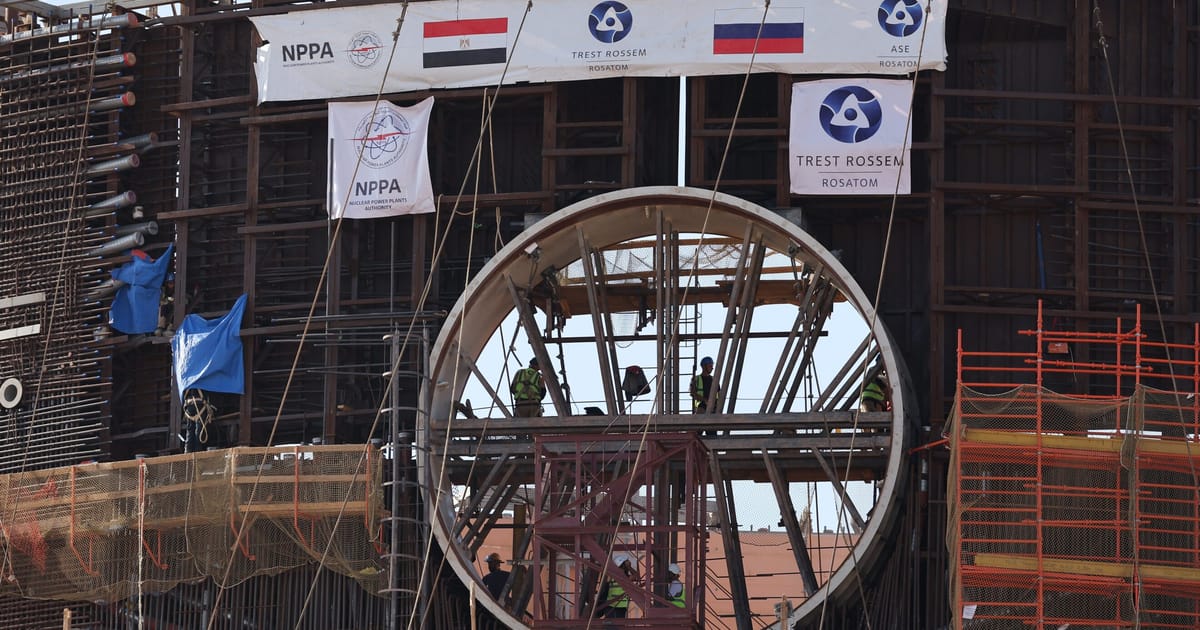
“There has been a re-emergence of serious concrete defects, including voids behind the metal cladding at Unit 4, defects in the foundation slabs of Units 1, 2 and 3, which took a year to repair, and defects in the cellular structure in the cylindrical wall of the reactor building at Unit 4,” details the letter.
The Egyptian agency then accuses Rosatom of “misleading methods” and “fictitious work” attempting to prove the plant’s construction is over halfway complete, “while a visual inspection at the site clearly shows that the main buildings of the nuclear island are still in the underground construction phase.”
Rosatom, the Egyptian authority alleges, also presides over an unprofessional workplace culture in which workers were caught in possession of “prohibited alcoholic beverages” on the work site, used “forged passes and impersonated others to gain unauthorized access,” and took several “photos and videos taken at the construction site” that ended up on social media, “which negatively affected the reputation of the project.”
The letter makes reference to a serious accident on the construction site, which resulted in a worker suffering “a severe open fracture” and then being smuggled to a private vehicle, not to an “equipped ambulance,” which the Egyptian authority claims was done “intentionally” to cover up the incident.
“Such behavior represents a serious disregard for both human well-being and professional responsibility, and constitutes a gross violation of workplace safety regulations, nuclear safety culture and reporting obligations,” said the letter.
Four additional internal Rosatom business documents reviewed by POLITICO reinforce aspects of the Egyptian authority’s concerns, detailing delays, construction-quality problems and project-management failures. One Rosatom draft audit prepared internally in 2025 warned of a “significant risk of failure to fulfill” the company’s contractual obligations and forecast that the preliminary schedule of El Dabaa’s first reactor unit could slip by 18 months, from September 2028 to March 2030.
