


President Donald Trump has handled the war with Iran in an unconventional fashion, to say the least. Based on the reporting that has emerged thus far, the president’s long-standing hostility toward Iran, dating back to the 1979 hostage crisis, combined with Israeli Prime Minister Benjamin Netanyahu’s determination to decapitate one of his country’s fiercest adversaries, helped drive the military operations that have now been underway for nearly six months at a cost of at least $37.5 billion.
Since the war began, negotiations over a resolution have been chaotic. Americans have witnessed announcements of ceasefires, violations of those ceasefires, and statements from the administration that bear little resemblance to what is unfolding on their screens. Changing and often contradictory administration statements have suggested that the goals of the war include toppling the governing regime, ushering in democracy, destroying the country’s nuclear and military capabilities, and, most recently, keeping open the Strait of Hormuz—which had been open until the war began. The president has never sought authorization for this war from Congress.
President Donald Trump has handled the war with Iran in an unconventional fashion, to say the least. Based on the reporting that has emerged thus far, the president’s long-standing hostility toward Iran, dating back to the 1979 hostage crisis, combined with Israeli Prime Minister Benjamin Netanyahu’s determination to decapitate one of his country’s fiercest adversaries, helped drive the military operations that have now been underway for nearly six months at a cost of at least $37.5 billion.
Since the war began, negotiations over a resolution have been chaotic. Americans have witnessed announcements of ceasefires, violations of those ceasefires, and statements from the administration that bear little resemblance to what is unfolding on their screens. Changing and often contradictory administration statements have suggested that the goals of the war include toppling the governing regime, ushering in democracy, destroying the country’s nuclear and military capabilities, and, most recently, keeping open the Strait of Hormuz—which had been open until the war began. The president has never sought authorization for this war from Congress.
Currently, the administration appears to be reduced to negotiating a deal that leaves the Iranian regime in place with degraded military capabilities, allows it to retain nuclear material, although in facilities that remain buried or difficult to access—and grants it greater control over the Strait of Hormuz, including, potentially, the ability to charge fees to ships passing through. As with much of Trump’s transactional approach to foreign policy, reports suggest there is no clear plan or coherent strategy within the White House. On any day, a Truth Social post could set the conversation in a different direction. Secretary of State Marco Rubio, who presides over a State Department that has been severely depleted of much of its expertise, has only gradually become more involved in the deliberations.
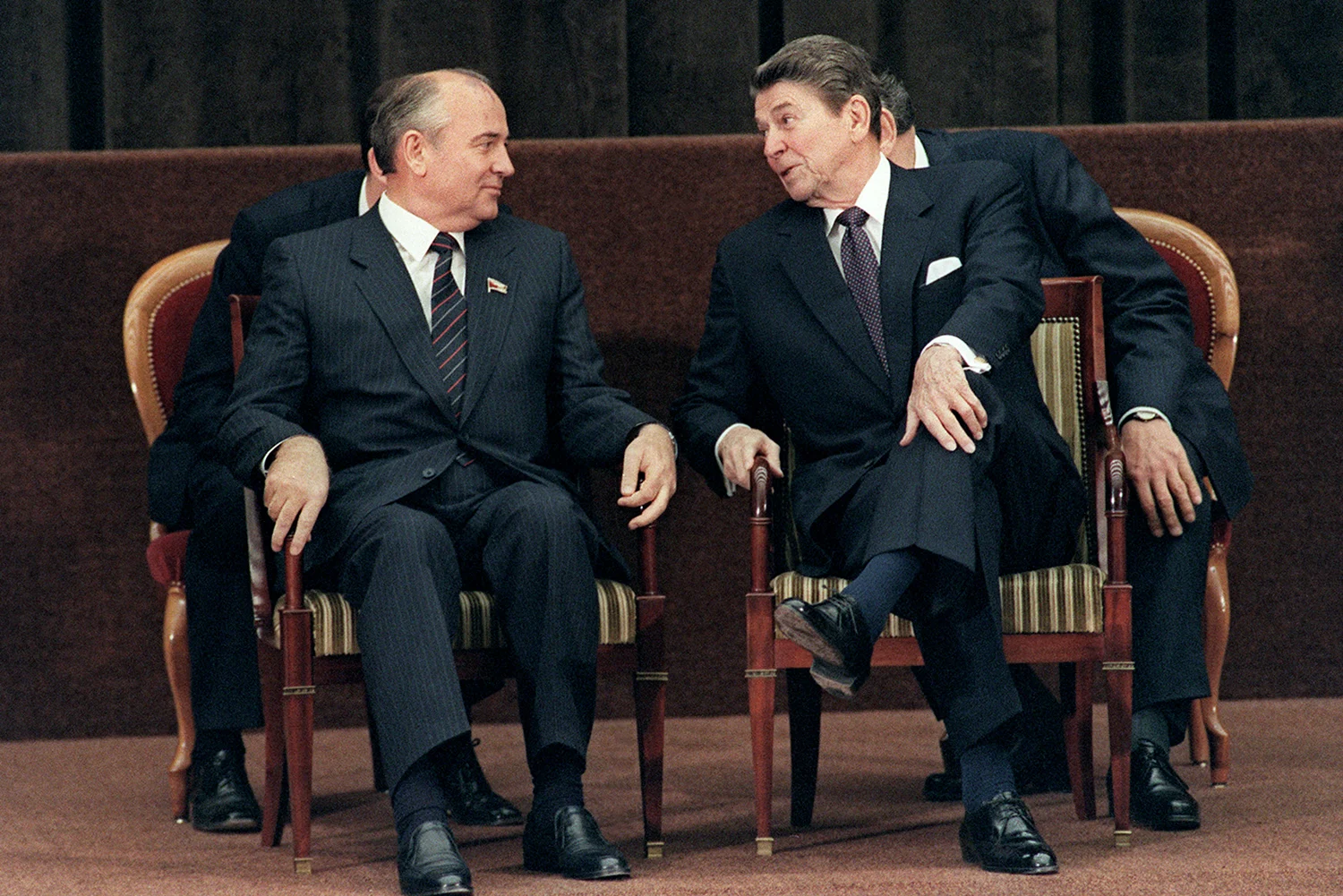
The chaos that has characterized efforts to end the conflict stands in stark contrast to the way most previous presidents have handled difficult negotiations with adversaries. Take, for example, the case of Ronald Reagan after 1985. As a new movie starring Jeff Daniels as Reagan, “The Brink of War,” illustrates, the emergence of Soviet leader Mikhail Gorbachev opened the door to a major arms-control agreement with the United States’ most formidable rival.
Few Americans could have predicted that Reagan would emerge as the president responsible for the most significant arms control breakthrough with the Soviet Union since 1972, when President Richard Nixon and Soviet leader Leonid Brezhnev signed the SALT I agreement. Throughout much of the 1970s, Reagan built his reputation by attacking Republicans who embraced Nixon’s policy of detente, which sought to ease relations with the Soviet Union through diplomacy and economic cooperation. In the 1976 Republican primaries, Reagan nearly defeated Republican President Gerald Ford by making detente—and its chief architect, Secretary of State Henry Kissinger—a central target of his campaign.
Upon taking office in 1981, Reagan filled much of his foreign policy team with officials who shared his opposition to detente and his support for a major expansion of the military budget. Although Reagan had contemplated the abolition of all nuclear weapons since the 1940s, he believed the path to that goal required building up a formidable military arsenal, isolating the Soviet Union to force it into concessions, and raising the level of rhetoric so that communist leaders understood he was not bluffing about being prepared to use overwhelming force.
During his first term, Reagan did not disappoint his supporters. Working with Secretary of Defense Caspar Weinberger, he dramatically increased defense spending. Reagan fought congressional opposition to helping anti-communist forces in Central America, and members of his national security team would later go so far as to undertake an illegal operation after Congress imposed restrictions on such aid. In 1983, Reagan famously labeled the Soviets the “focus of evil in the modern world,” employing the kind of charged rhetoric that previous presidents had generally avoided, while sharply reducing diplomatic engagement with Moscow. He also championed the “zero option,” an unrealistic proposal that called for the Soviet Union to dismantle all of its intermediate-range missiles capable of threatening Europe; in exchange, the United States would not deploy its own missiles to Western Europe.
In 1983, a series of incidents, including the Soviets shooting down a South Korean passenger airliner, fueled fears that the two superpowers were moving dangerously close to nuclear war. At the same time, the international nuclear freeze movement attracted millions of supporters, while the television movie The Day After—which depicted a fictional nuclear attack on a Kansas town—drew a massive audience.
The one notable addition to Reagan’s team during his first term was George Shultz, who became secretary of state in 1982 following the resignation of Alexander Haig. A highly respected economist, Shultz graduated from Princeton University and earned a doctoral degree at MIT. He arrived at the State Department with extensive government experience, having served as secretary of labor, director of the Office of Management and Budget, and secretary of the Treasury under Nixon. He was no dove: Shultz was a member of the neoconservative Committee on the Present Danger.
Unlike many of his colleagues, however, he also placed great value on multilateral diplomacy. Shultz viewed negotiation, diplomacy, and pragmatic statecraft as indispensable tools for maintaining international stability. Even as tensions between Washington and Moscow escalated during Reagan’s first term, Shultz quietly maintained channels of communication with Soviet officials. He convened weekly meetings with Soviet Ambassador Anatoly Dobrynin to engage in what he called “gardening,” by which he meant, getting “out little irritants so that they would not grow into unnecessarily major problems.” Shultz arranged a secret meeting between Dobrynin and Reagan in the White House in 1983.
The groundwork began to pay off in 1985 when, after a period of rapid leadership turnover caused by the deaths of aging Soviet leaders, a new figure emerged: Mikhail Gorbachev. Succeeding Konstantin Chernenko, Gorbachev was just 54 years old. He was younger than previous leaders, dressed in cosmopolitan Western suits, and was less wedded to the status quo. He represented a generational shift in Soviet leadership. Determined to save the Soviet Union, he pursued a program of reform that sought to open the economy, increase transparency in government, and engage in arms-control negotiations with the United States. Gorbachev hoped that reducing superpower tensions would improve the prospects for peace while allowing the Soviet government to direct resources away from the crippling economic burden of military spending.
Gorbachev and Reagan engaged in three high-level summits. The first took place in Geneva in 1985; the second in Reykjavik, Iceland, in 1986; and the final meeting in Washington in 1987. Reagan pursued these negotiations despite strong opposition from many conservatives, who believed that Gorbachev was merely a Kremlin trap set to lure Reagan into a dangerous agreement. Shultz had been most vocal in seeing that Gorbachev was different from his predecessors. It took the series of summits for Reagan and Gorbachev to work through their differences over the Strategic Defense Initiative (SDI), a proposal derided by critics as “star wars,” to create a missile defense shield around the United States, something most scientific experts believed unworkable. Gorbachev insisted that Reagan abandon the project to avoid an arms race in space, but Reagan refused to back down. In the end, Gorbachev agreed to separate the SDI dispute from the broader arms-control talks, paving the way for the two leaders to sign the Intermediate-Range Nuclear Forces (INF) Treaty in 1987.
Throughout the difficult negotiations, Reagan worked closely with highly skilled foreign policy experts in the State Department to prepare for each meeting. The various provisions under discussion were carefully drafted to ensure that both sides could feel confident in the durability of the agreement. Each proposed line was carefully vetted and reviewed to make sure that verification would be possible. Shultz played a central role in this process, working with the Soviet foreign minister to lay the groundwork for the first summit in Geneva. He consistently lobbied Reagan to prioritize arms-control negotiations despite resistance from hardline voices within the administration—and pushed Reagan to stick with the process even after negotiations broke down over SDI. After Reykjavik, Shultz remained crucial to the president understanding that, despite the failure to reach an agreement, the negotiations had in fact achieved significant progress. Shultz helped advance ambitious arms control proposals that helped shape the negotiations leading to the INF Treaty.
Reagan remained determined to reach an agreement even as he recognized the anger it provoked among hard-liners within his coalition. A breakthrough would allow him to remake his reputation after the Iran-Contra scandal had devastated his image and simultaneously create an opportunity to move toward his long-time hope of ending the threat of a nuclear holocaust. Despite moments of intense tension, the president focused on achieving an agreement. Throughout these crises, Reagan continued to view negotiation as essential to reducing the risk of superpower conflict and advancing their broader strategic goals. Each public statement, whether it was Reagan’s assertive message in Germany or Shultz’s conciliatory messages about negotiations, was carefully thought through, as the administration understood that words matter in successful diplomacy.
Reagan continued to push back against conservative Republicans who criticized him. He met with Republican senators who were wary about what he was doing, including the influential North Carolina Sen. Jesse Helms. Conservative activist Paul Weyrich argued that, “Reagan is a weakened president, weakened in spirit as well as clout and not in a position to make judgments about Gorbachev at this time.” But Reagan worked to ensure ratification, and on May 27, 1988, the Senate ratified the INF Treaty by a decisive margin of 93-5.
The success of the negotiations depended on many factors within the United States, in addition to Gorbachev’s skills and commitment. It rested on the leadership of George Shultz at the State Department and the experienced team of foreign policy experts he assembled around him. It also depended on Reagan’s willingness to reconsider earlier positions and his determination to persevere through repeated setbacks. Together, these efforts culminated in the INF Treaty.
Today, those key ingredients are largely absent. Trump is no Reagan, nor has he approached negotiations with Iran in comparable fashion. The absence of a coherent strategy, the transactional approach that has characterized each stage of the process, and a preference for bluster and displays of toughness have overwhelmed efforts to reach a durable agreement. Ironically, any eventual settlement is likely to resemble the framework that Trump himself abandoned in 2018 when he withdrew the United States from the nuclear agreement that President Barack Obama’s administration had helped put in place three years earlier.
As a result, the United States is likely to pay a high price for this war, yet it remains unclear whether it will achieve anything close to its vague objectives. Some observers would argue that, if current conditions persist, Iran could emerge with the stronger hand, including the ability to set fees for passage through the Strait of Hormuz, a vital waterway for international commerce.
The United States is living through an anti-institutional and anti-establishment era, one in which ad hoc, attention-getting bluster has become a prized commodity. Yet the long arc of history suggests a different lesson. Time and again, deliberative, patient, and expert-driven diplomacy has produced the kinds of consequential achievements that make or break presidential legacies.
