


Black Hat USA 2026 – Las Vegas – In bad news for financial institutions, online retailers, cryptocurrency exchanges, and people in the dating pool who rely on identity verification to make sure they’re not getting taken for a ride, global fraud gangs are aggressively industrializing their scam efforts.
That’s according to Eric Huber, senior manager for adversary intelligence and disruption at TD Bank, who said that major centers for organized crime specializing in financial fraud (notably in Southeast Asia and West Africa) are bypassing “know your customer (KYC)” rules and other identity-verification methods with an updated AI tool set that offers the ability to build completely believable synthetic identities capable of fooling even advanced AI-enabled behavioral defenses.
His research into fraud cartels dovetails with recent numbers from Interpol, which in March said that, since 2024, the number of fraud-related campaigns it tracks has increased by 54%, fueled by AI. Over the same period, Interpol-supported member countries in more than 1,500 transnational fraud cases lost assets valued at $1.1 billion; it also deduced that AI-enhanced fraud is 4.5 times more profitable than traditional methods.
Speaking from the stage of the AI Summit at Black Hat USA 2026, Huber pointed to a real-world example of the threat landscape: recent updates to three-year-old tradecraft used by Nigerian scam rings called ProKYC, which is a turnkey KYC-bypass kit that defeats document-plus-selfie customer onboarding with convincing forged IDs and deepfaked “liveness” videos.
ProKYC: West African KYC-Bypass Supercharges Its Chances
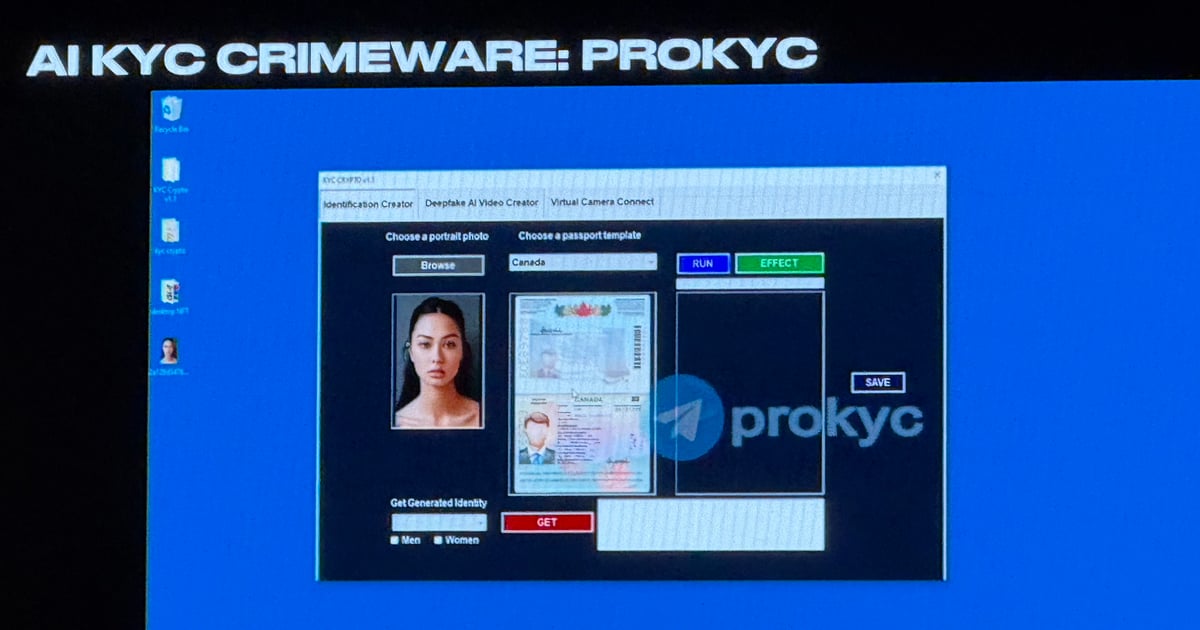
To show how ProKYC is iterating in concerning ways, Huber first demoed a legacy version of the tool, which takes any photograph and generates a non-existent person using stolen personally identifiable information (PII). It first creates a convincing facsimile of a passport (in the demo, it’s an Australian document), as well as a video showing a person moving their head around, which should satisfy liveness detection. If asked, it can also emulate a mobile camera feed, so the verifier “sees” a live session with the fake person.
“It’s very convincing, and yeah, I’m sure you’re going to see a successful attack at the end,” Huber said. “Are bad guys very pleased? Yes.”
ProKYC’s dashboard for ID creation. Source: Huber’s Black Hat USA 2026 presentation, via Dark Reading’s Tara Seals
That’s impressive enough, but in the age of deepfake detection and other AI fraud-rooting defenses, this baseline deepfaking isn’t as successful as it once was. So, newer versions sold via Telegram channels offer specifically tailored workflows for a broad target list across crypto-exchanges and fintechs, with new AI-enabled features that can match the verifier’s request flow automatically.
One of the more notable features is auto-generation of “selfie-with-ID” uploads (essentially, a person holding a “real” ID that was just purportedly uploaded for verification, featuring a desk, keyboard, or table in the background for verisimilitude).
“The thing is, if you were defending yourself, how are you going to defend yourself against a perfectly convincing [fake picture supposedly taken in real time]? One of the things you do is you’re going to look at the ID, and [ask for backup verification],” said Huber. “So ProKYC will go ahead and create that selfie, or even emulate the supposed customer taking a picture of the picture on a keyboard or a table.”
Other recent AI-enabled features include automatic geo-tailored EXIF metadata insertion on the fake images to evade origin checks. Thus, a selfie-with-ID picture “taken” in Nigeria can be made to say it was taken in Sydney, in the Australian example.
The new version of ProKYC also provides the ability to emulate specific target requirements for the liveness-check video, Huber noted. He showed a video where the target — in this case a cryptocurrency exchange — required someone to use their phone on the fly to film themselves moving around. Using AI, the tool emulated the look and feel of someone capturing video in real time.
“As far as the provider is concerned, they are seeing someone doing the liveness check,” Huber explained. “The tool knows what this particular provider is going to be looking for and delivers it on its own.”
Which brings up another added benefit: the new version of ProKYC speeds up the process significantly by removing much of the manual oversight required to get past the KYC checks; previously, a human had to be involved to get the timing right and match the uploading of the deliverables to the requests of the provider when they ask for various verification elements. Now, AI takes care of that.
It should be noted that the victims might be financial institutions in cases like this, but the ramifications are much wider. Interpol for instance found that in parts of Africa, terrorist groups have been found to use fraud schemes, especially crypto-based scams, as a source of funding.
Southeast Asian Trafficking Rings Embrace AI for Success
Speaking of speed, it’s an important consideration for the scammer sweatshops infesting Southeast Asia too, where victims of human trafficking have been corralled into work centers and made to carry out fraud schemes of various kinds, with quotas for how many victims per day they can rack up.
Here too, AI has been radically changing the threat landscape, both in terms of accelerating the victim total and eliminating the need for a lot of training for the newly kidnapped workers.
“It is super, super evil,” Huber said. “Compounds of people in places like Cambodia and Myanmar might hold thousands of people, and it’s slave labor to carry out a billion-dollar fraud industry, and some of the bad guys use all their money to do things like develop AI face-changing software.”
The face-changing software is more than taking a picture and creating a video from it, which Huber says is old hat by this point, if not exactly easy. The new frontier is software that can allow someone to be talking to a target on a live video feed, and an overlay will literally turn the attacker into someone else.
“Doing a live thing where you’re talking to someone and it’s showing you as being someone else is super difficult to get right,” Huber explained — for instance, if the scammer touches their face or moves the wrong way, the mask can glitch out and show the real person. However, the cybercrime syndicates are working on it all the time, because the efficacy, particularly for things like pig-butchering scams, would improve the success rate dramatically.
Huber offered a video example of this type of functionality in action in the real world, this one featuring a deepfake of actress and comedian Milana Vayntrub, aka “Lily” from the AT&T commercials. He explained celebrity impersonations are not uncommon in romance schemes.
The audio convincingly says in American English, “Yes, hello. I can hear you, Fred. Are you surprised? It’s me, Milana Vayntrub. So I’m just here thinking about you. I thought I should FaceTime with you real quick. My connection is pretty bad, right?”
The mark (who seems to be falling for it hook, line, and sinker) merely chuckles, but had he been more observant, he would have seen the video glitch — which is what the “connection” line was supposed to cover for.
Another tool that’s making its way into the ecosystem in the Southeast Asian region and beyond is AI translation software, Huber said, which is available as a completely innocuous tool for travelers or publishing organizations. In the wrong hands though, it becomes something entirely more malevolent.
“You’ve got the poor forced laborer sitting in the compound, and maybe they only speak a couple languages, one or two,” Huber explained. “This will hook them up to social media, and it’s going to do the translation for them. So, your victim says something, and your AI is going to generate the reply that you’re going to send to the victim.”
While the function isn’t agentic or autonomous, it does create responses for the trafficked worker that the AI thinks are the most effective, and it has controls in place so that the worker can’t accidentally or on purpose send something out that would blow the scam or communicate outside of its purview (a cry for help, say). And in some cases, he adds, the platform has voice cloning baked in, to enable believable voice calling.
“And so the theme here is de-skilling,” Huber said. “Your labor does not have to be skilled because they’ve got the AI.”
Other features make the job even easier, and the scams more convincing. Huber uncovered an AI-enabled customer relationship management (CRM) platform that keeps track of how the scammer contacted the person, where they left the conversation with the victim, personality traits, and more.
“You’re not going to say I’m sitting in the scam center,” Huber said. “You’re going to say oh, I’m somebody in South Korea or whatever, and you have a backstory for it. You put that into the CRM. You put your victim’s profile in there too. And the AI is going to help create responses that get more effective over time. Again, not autonomous, but this is making you more effective.”
Interpol noted that AI is also contributing leverage in some of these cases, with sextortion is now being systematically integrated into romance scams.
Fraud Enterprises Poised for Exploding Success
All in all, advancements in AI are making industrialized fraud easier than ever, Huber warned, and it’s clear that financial services security teams must take note and up their game when it comes to identity proofing, vetting liveness checks, and evolving trust signals.
Collaborating with law enforcement helps too, because this is no longer a case of a few enterprising scam artists carrying out basement operations. And things will likely only get more challenging: criminal networks are increasingly collaborating with specialized money laundering groups and sharing expertise and technology to scale up their operations globally, according to Interpol; local authorities are often bribed to look the other way.
“Enabled by artificial intelligence, low-cost digital tools, and increased global criminal collaboration, we are witnessing the industrialization of fraud,” Interpol Secretary General Valdecy Urquiza said in the March press release. “It is vital to remember that the cost of financial crime is not just money — it is people’s life savings, their dignity, and in the worst case, their life. Strengthening cooperation between law enforcement, the private sector and raising public awareness is key in tackling this global security threat.”
