


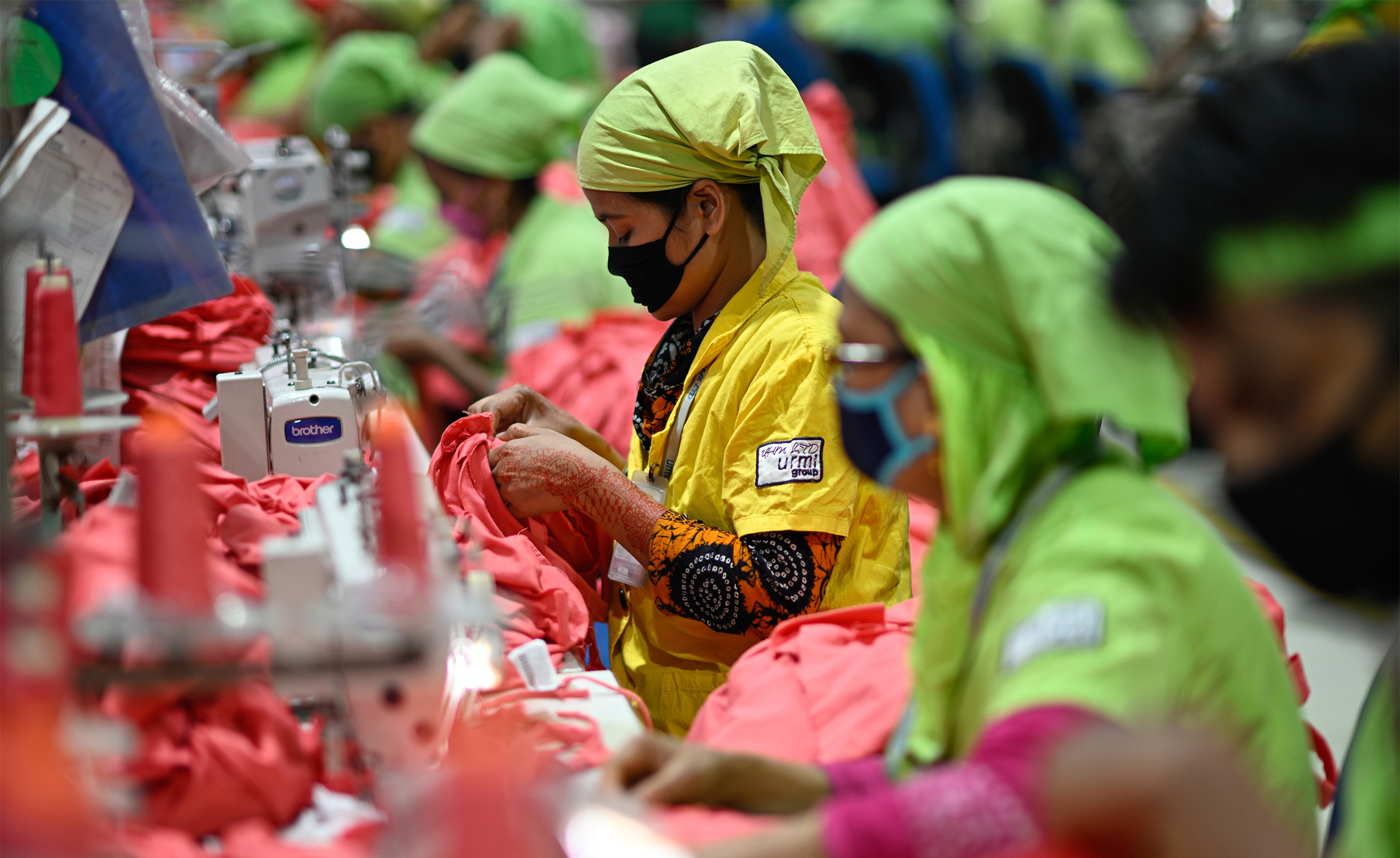
- Extreme heat is becoming a workplace health crisis for Bangladesh’s garment workers amid rising temperatures and prolonged heat waves, increasing concerns about occupational heat exposure.
- But comprehensive health data remain limited as experts say systematic monitoring of heat exposure is needed to understand the scale of the problem and identify workers most at risk.
- Besides health risks, extreme heat also creates economic losses for factories.
- Experts say protecting workers requires enforceable standards and shared responsibility among governments, garment manufacturers and international fashion brands.
One afternoon earlier this year, Mridula collapsed on the floor of the Dhaka garment factory where she works, overcome by dizziness in the heat.
The 20-year-old sewing operator, who works at a factory in Mirpur, northwest Dhaka, said summer heat often leaves her restless and “physically uncomfortable.”
“The heat can be very difficult to tolerate,” said Mridula, a pseudonym. Co-workers with high blood pressure seem to struggle even more during the hotter months, she has noticed.
After she collapsed, she was taken to the factory’s medical room. She said the doctor told her to rest, then sent her home. “He gave me leave from work,” she said. Mridula was eventually diagnosed with jaundice, which can be exacerbated by dehydration and physical exertion.
As temperatures climb, heat is becoming a serious concern for Bangladesh’s garment industry.
Dhaka’s summers are setting new records. On April 15, 2023, the city reached 40.6°Celsius (105° Fahrenheit), then its highest temperature in decades, according to World Weather Attribution. Then, the following year, the country sweltered through a heat wave that lasted 30 days without a break. A 2025 report by the World Bank shows that Bangladesh’s maximum temperature has risen about 1.1°C (about 2°F) since 1980.
Meanwhile, researchers are increasingly concerned about the health and economic consequences of rising temperatures, particularly for workers exposed to prolonged heat.
For Bangladesh’s 4.2 million garment workers, approximately 60% of whom are women, who work indoors, rising temperatures raise urgent questions about occupational health and workplace safety.
Rising heat, rising health risks
“Severe indoor heat is widespread across garment factories due to inadequate cooling infrastructure, causing excessive sweating, stress and reduced productivity,” said Md. Manirul Islam, deputy director of research, at the Bangladesh Institute of Labour Studies. He said their latest findings show that ready-made garment factories experience extreme heat during the summer, often reaching uncontrollable levels, regardless of their location or certification status.
“Although the Labour Act mandates heat control, weak enforcement and reliance on superficial measures such as roof-watering and saline distribution leave the root causes unaddressed,” he noted. Roof-watering is an indoor cooling technique that uses evaporative water spray on metal roofs. Some factories distribute oral saline to workers in order to prevent dehydration.
A study evaluating sustainable cooling strategies in a garment factory in Dhaka found that peak indoor temperatures exceeded 35°C (95°F) on 37% of monitored days. During the hottest months, from April to June, temperatures occasionally rose above 40°C (104°F).
As factory temperatures climb, workers face the risk of heat-related illness, often while under pressure to meet production targets.
According to the World Health Organization, workplace heat stress refers to the overall strain on the worker’s body when it cannot adequately cool itself under hot conditions. It is influenced by factors such as temperature, humidity, physical exertion, clothing and ventilation. Heat illness refers to the health conditions that can develop as a result of heat exposure, including heat cramps, heat exhaustion and in serious cases, heatstroke.

A 2025 qualitative study published in Environmental and Occupational Health Practice found that workers at two garment factories in Dhaka reported a range of symptoms they attributed to workplace heat, including headaches, dizziness, fatigue, nausea and excessive sweating.
The study also identified potential safety risks associated with heat exposure where factory medical staff reported an increase in workplace injuries during hotter months, particularly needle injuries and falls.
“Factory clinics are already seeing warning signs,” Aaron Bach, a co-author of the study and a senior lecturer at Griffith University in Australia, told Mongabay. “Doctors we interviewed described dehydrated workers with very low blood pressure on hot days, and an increase in needle injuries and falls in the hotter months.”
These records do not necessarily capture the cumulative effects of repeated heat exposure. “But those [factory] clinics are set up to handle acute problems. We found no [facilities for] screening for chronic conditions that heat can make worse, so the long-term picture simply isn’t being captured,” he said. The gaps in reporting may also mean that workers most affected by heat disappear from the data.
Bach pointed to a “survivor bias” problem. “People whose health suffers tend to leave, so the workforce still on the floor can look healthier than the people who were actually exposed,” he said.
This makes it harder to assess the full health burden among garment workers, particularly as workplace heat continues to increase.
Research models suggest that, under a scenario of high greenhouse gas emissions, the number of working hours above 35°C (95°F) inside a typical factory could double by 2050.
“If we’re not recording health effects now, we’ll have no way of knowing how much harm is building up as conditions get hotter,” Bach said.

The data gap hiding the harm
Despite the risks, comprehensive data on heat exposure and its health effects among Bangladesh’s garment workers remain limited. When asked about why, Bach replied: “Mostly because no one is systematically collecting it. There’s no centralised reporting of heat-related illness in the [garments] sector, and Bangladesh’s 2024 National Guideline on Heat-Related Illness, while a welcome step, focuses on outdoor workers and doesn’t specifically address indoor workplaces like garment factories.”
Bangladesh’s heat-health guideline leaves a gap when it comes to protecting garment workers. The 2024 national guideline, issued by the Directorate General of Health Services with support from UNICEF, outlines how to identify and manage heat-related illness, but does not provide specific guidance on reducing heat exposure or managing heat-related illness among indoor workers in the ready-made garment sector.
That gap matters, Bach said, because the conditions inside factories can be severe even at the better end of the industry. “Even in above-average factories, the ones willing to open their doors to independent researchers, indoor temperatures can exceed 40°C, with high radiant heat coming off concrete roofs and machinery like irons. If that’s happening in the better factories, it’s reasonable to assume conditions are worse in places we can’t get into,” he added.
After the 2013 Rana Plaza garment factory collapse, compliance efforts focused heavily on structural, fire and electrical safety. He argued that this left less room for addressing workplace hazards like extreme heat. Buyers and regulators have continued to prioritize structural and fire safety, leaving heat lower down the list, particularly for smaller subcontracting factories. “Heat hasn’t had the same scrutiny, so measuring it, keeping health records or investing in cooling is not top of the list,” Bach said.
All of this creates a “disconnect,” according to Bach. “Workers, managers and factory doctors told us heat is affecting health and output. But some government officials we spoke to didn’t see it as a significant concern, and said they hadn’t heard about it from factory management. Without widespread record keeping and data, it fails to reach policymakers,” he said.
But heat illness is easy to miss, according to Bach. Symptoms like headaches, dizziness and nausea have many possible causes without anyone linking them to heat.
“With [work] quotas to meet, people tend to push through rather than report it,” he said, explaining why heat-related illness among garment workers goes unrecorded.

But the risks of extreme heat do not depend on temperature alone. Workers’ ability to protect themselves also depends on whether they can slow down, take breaks or stop working when conditions become dangerous.
Extreme heat poses particular challenges for garment workers, who may have limited control over their working conditions. Even when workers know how to protect themselves from heat, workplace rules can prevent them from doing so, said Cara Schulte, a researcher at Climate Rights International.
“One of the key findings of my research was how labor rights abuses are functionally acting as barriers to climate adaptation,” she said. “You can tell a worker to drink more water, but that recommendation isn’t meaningful if she doesn’t have access to potable water at work, or can’t leave her production line to use the bathroom.”
Workers may also be unable to rest when they begin to overheat if production targets or workplace practices prevent them from taking breaks, she said.
Bach shared a similar observation. “After speaking with workers, we found that knowing what works sometimes isn’t enough. Workers knew they should drink more, yet quota pressure and, in some cases, supervisors telling them off for taking breaks meant they often didn’t.”
In interviews conducted for Schulte’s report in Bangladesh, she noted workers reported dehydration, headaches, nausea, vomiting, temporary vision loss, muscle paralysis and repeated fainting during the summer months. These symptoms also affected workers’ livelihoods, she said. Reduced productivity could mean lower pay, while some workers went into debt, adding to the mental-health toll of working in extreme heat.
Beyond the health risks to factory workers, heat stress is reducing productivity and resulting in financial losses for the factories as well. Cornell University’s Global Labor Institute reported in September that heat stress was linked to a roughly 4.1% drop in annual revenue at one participating Bangladeshi factory.
However, measures to improve workplace cooling can be commercially viable, paying for themselves within 1-4 years. Through investments in measures such as reflective roof paint, roof insulation and better ventilation to improve airflow, companies could sustainably increase worker productivity and factory output, according to Schulte’s research.

Addressing gaps in worker protection
Documenting the cases of heat-related illness is essential to securing better protections for vulnerable workers.
However, establishing the scale of heat-related illness among garment workers requires measuring three things together: workplace heat, the physical demands of workers’ jobs and their health outcomes, according to Bach.
“When we monitored a Dhaka factory for a full year, the biggest lesson was how much conditions vary within one building. The top floor, directly under the concrete roof, was consistently the hottest,” Bach said.
A single thermometer or outdoor weather data, therefore, would not capture the conditions workers experience. Researchers need continuous measurements across different floors and work areas, using a heat-stress index that accounts for air speed, humidity and radiant heat, not just air temperature.
But the temperature alone does not determine how much strain workers experience. The physical demands of a job also matter, Bach said. “That means the same section of a factory can be acceptable for someone sitting at a sewing machine and unsafe for someone standing and ironing all day. … We saw this [difference] in our climate-chamber trial, in identical conditions, people doing ironing tasks had a bigger rise in body temperature and heart rate than those sewing,” he added.
Researchers would also need to account for differences in work pace, shift length, breaks and clothing to understand workers’ cumulative exposure, according to Bach.
Given the practical challenges of collecting all these data, Bach recommended prioritizing workers facing the highest risks, including those working on top floors beneath uninsulated roofs, those performing physically demanding or heat-generating tasks and those working during the hottest afternoons between April and June.
Schulte also agreed that workplaces need enforceable heat protections.“This will require that governments, brands and suppliers come together to develop measurable heat standards, including work-to-rest ratios consistent with real-time temperature, humidity and work intensity; stop-work thresholds in dangerous conditions; acclimatization protocols; adequate ventilation; access to clean water on the job; the ability to take short breaks when needed; and support of the right to collective bargaining,” she said. “This is a shared responsibility of all stakeholders. Suppliers will not be able to do this alone.”
Banner image: Factory workers operate machines to make garments at UHM Ltd. in Narayaganj, Bangladesh, 2025. Image by AP Photo/Mahmud Hossain Opu.
From Bhutan to Nigeria & Kenya, women endure climate change differently than men
Bangladesh’s green building drive grows beyond factories amid climate pressures
For women on Bangladesh’s coast, rising seas pose a reproductive health dilemma
Citations:
Zachariah, M., Vautard, R., Arulalan, T., Schwingshackl, C., Chaithra, S., Kimutai, J. J., … Otto, F. E. (2026). Attributing extreme humid heat in South and Southeast Asia in April 2023 to climate change and its implications for vulnerable and disadvantaged communities. Global Environmental Change Advances, 7, 100035. doi:10.1016/j.gecadv.2026.100035
Smallcombe, J. W., Ranhotty, R. N., Bach, A. J. E., Palutikof, J. P., Tonmoy, F. N., Joarder, A. R., Hossain, M., Morris, N. B., Capon, A., Mavros, Y., & Jay, O. (2025). Sustainable cooling strategies for workers in the ready-made garment factory industry in Bangladesh under simulated extreme heat: a randomised crossover trial. The Lancet Planetary Health, 9(9), 101317. doi:10.1016/j.lanplh.2025.101317
Yeasmin, F., Bach, A. J. E., Palutikof, J. P., Tonmoy, F., Tofail, F., Rahman, M., & Rutherford, S. (2025). Heat impacts on health and productivity: the case of two ready-made garment factories in tropical Bangladesh. Environmental and Occupational Health Practice, 7(1), n/a. doi:10.1539/eohp.2024-0009

