


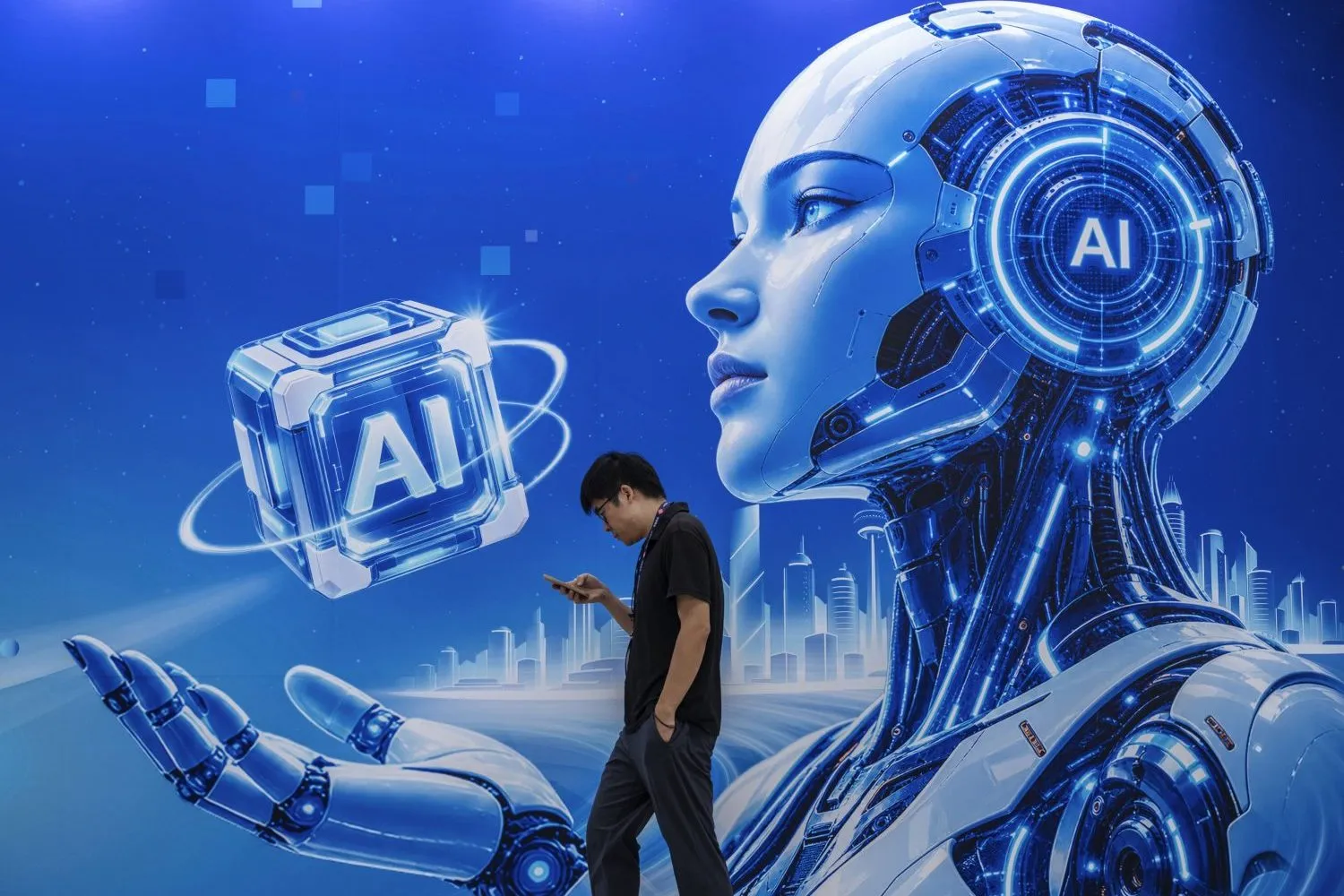
It is well known that at least part of Washington’s reluctance to regulate artificial intelligence comes from wanting to make sure the United States stays ahead of China. But what exactly are the two countries racing for? How do we define “winning”? What would victory actually entail?
On the latest episode of FP Live, I spoke with Matt Sheehan, a senior fellow at the Carnegie Endowment for International Peace, where he co-directs its China AI Initiative. Sheehan lived and worked in China for six years and has helped host unofficial U.S.-China dialogues on AI. He is also the author of The Transpacific Experiment: How China and California Collaborate and Compete for Our Future.
The full conversation is posted on the video box atop this page, as well as on the FP Live pages on Apple, Spotify, and YouTube. What follows here is a lightly edited and condensed transcript, exclusive to FP Insiders.
Ravi Agrawal: I want to start with the very basics here. If the United States is said to be ahead of China on AI, by how much and on what metrics?
Matt Sheehan: It’s useful to define what we mean by “ahead” or “winning.” The simplest way to do that is to distinguish who can build the most powerful and capable models—what we call frontier capabilities—versus broader applications of AI, such as how you are diffusing AI into your economy to enhance economic growth, drug discovery, or scientific research.
The place where the United States is clearly ahead, or at least has a defined lead, would be in the frontier capabilities. That lead isn’t huge. Most people would estimate it being a lead of six to nine months, which essentially means that if U.S. companies like Anthropic or OpenAI come out with a model today, Chinese models will probably match that capability about six to nine months from now. There are a lot of open questions about why China is so close. Are they using illicit methods of copying the U.S. models? Are they getting close due to the strength of their own research? Those are all open questions.
When we look at the diffusion of AI into the economy, we don’t know who is in the lead just yet. This type of thing takes a while to show up in the data, and that data is very diffuse—there’s no centralized database. We’re not seeing AI showing up in, for example, enhanced growth statistics in China. In the United States, it might be showing up in those ways, but mostly in terms of how much computing power or data centers are being built. We have hunches about what the United States and China are respectively good at when it comes to diffusing a technology, but at this point we don’t have a clear picture of how that’s going to play out.
RA: Fascinating. Now, when we think of a race, it’s important to also think about a finish line. I’m curious how the United States defines winning in this race. I use that word because it comes up a lot. [U.S. President Donald] Trump has said that winning is a must. Treasury Secretary Scott Bessent has warned that if China wins, “nothing else would matter.” So, explain to us, what is the race, and what does winning really mean, at least from the American perspective?
MS: I’ll center this on the leading U.S. labs and companies—OpenAI, Anthropic, maybe Google DeepMind. For a long time, these companies have had a pretty clear narrative of where AI is going. Capabilities will keep getting better and more general, until we get to a point of artificial general intelligence (AGI)—a model that can do everything a human can—or artificial superintelligence (ASI), which is a model that can outperform humans at essentially every task. One key moment in this theoretical chain—or, increasingly, real chain—is what’s called “recursive self-improvement” (RSI). This is when the model is so good that it can start building its successor itself. The model is essentially creating the next model and the one after that, and the pace of advancement skyrockets. AI development is already on an exponential growth curve, but that curve gets more and more exponential once we reach RSI.
The long-term conception in the U.S. research community, or at least in parts of it, is that whoever gets to these lines first—AGI, RSI, ASI—can lock in a permanent advantage. In a geopolitical context, this is sometimes referred to as “decisive strategic advantage”—essentially, when models take off with capabilities that can’t even be imagined, allowing you to lock in geopolitical advantages that last indefinitely. There are a lot of steps in that chain, particularly that last step toward decisive strategic advantages. People in the nuclear realm might say, “You think that just because you have the most powerful model, suddenly nothing else matters? That my nuclear weapons don’t matter?” There’s a lot of debate around that, and I’m pretty skeptical of that decisive strategic advantage theory, but that is one vision of it. When Treasury Secretary Bessent says that if China wins, “nothing else would matter”—I think he referred to Iron Dome and other defense capabilities not mattering anymore—that’s an implicit argument for this type of decisive strategic advantage. It’s a powerful concept that has a lot of pull on people, but it’s one that requires a lot of investigation.
RA: Is something like AGI and everything it seems to promise real or a mirage?
MS: It’s a big question. The research community is divided on this, and for a long time, I’ve tried to stay agnostic. Some of the smartest, foundational AI scientists think that this is far off, or something of a mirage, and some of them disagree and say we’re talking about a timeline of one to three years. For a long time, I thought that if they can’t sort it out, I’m not going to be the one to sort this out, either, which remains true. But the balance of evidence is starting to tilt significantly toward the people who think that this might be on the horizon in the near term. Predictions that some of these scientists have been making for a long time have continued to play out and be confirmed in different ways. That doesn’t mean the debate is closed. There are so many open questions about recursive self-improvement. But the idea that these models are going to surpass human capabilities in core domains that really matter, and do it in a relatively generalizable way—the same model that is solving mathematical equations is also now the best hacker in the world, and it also can write a halfway decent doctoral thesis on a different subject—that does seem to be coming into focus now, whereas maybe three years ago, there was a much more open question about whether we would get there.
Read More
-
An overhead view of four white, humanoid robots competing in a track race on a blue surface with white lane markers and white numbers painted on each lane. One robot runs along lane 1, another stumbles or falls in lane 2, a third sprints in lane 4, and a fourth falls near lane 5. Sponsor logos are visible on the perimeter wall in the background. An overhead view of four white, humanoid robots competing in a track race on a blue surface with white lane markers and white numbers painted on each lane. One robot runs along lane 1, another stumbles or falls in lane 2, a third sprints in lane 4, and a fourth falls near lane 5. Sponsor logos are visible on the perimeter wall in the background. China Might Lap the United States on AI Adoption
Beijing’s collaborative approach is winning over other states.
-

A person wearing a dark cap, black t-shirt, and dark pants carrying a red backpack walks past a large indoor advertisement. The wall banner displays large blue and black Chinese text above a lineup of eight white and silver humanoid robots shown side-by-side, each labeled with names and logos underneath. The floor below is polished and reflective. A person wearing a dark cap, black t-shirt, and dark pants carrying a red backpack walks past a large indoor advertisement. The wall banner displays large blue and black Chinese text above a lineup of eight white and silver humanoid robots shown side-by-side, each labeled with names and logos underneath. The floor below is polished and reflective. China’s AI Rollout Has No Off Switch
Beijing may talk about safety, but its model of AI diffusion is made to go rogue.

RA: OK, so if we have a sense of what America’s finish line looks like—or perhaps we can call it a new starting point—how is China’s perception or conception of winning different?
MS: I like what you said about a new starting point, because it’s important to keep that in mind. There’s this concept that the first past the post wins and then it’s over, but that actually just might be the start of a brand-new game that we’re not prepared for in another way.
How does China conceptualize this? I’d say it’s divided—the companies, founders, and research community are different from the government, engineers, the population. But broadly speaking, across all of those buckets, they are significantly more skeptical of the idea that once we achieve AGI, use RSI, and reach artificial superintelligence, then the game is over. They have longer potential timelines until any of these milestones might be passed.
The Chinese government tends to focus more on a diffusion question: How do we apply AI to our economy writ large? Within the companies, there are certainly founders—at DeepSeek and Moonshot, other start-ups people might have heard of—that are much closer to the Silicon Valley conception, but they seem to feel a little less urgent about it; they feel like it’s maybe further off, and they don’t seem quite as convinced about this first-past-the-post, exponential improvement, game-over type of thing. That might be them responding, in some ways, to the reality of, say, their limited computing power. A lot of this depends on scaling the amount of compute exponentially going forward, and if you don’t see that on the horizon for your company, you might not be as all-in on some of these theories of the case.
Generally, the level of focus on AGI and ASI is significantly lower in China than it is in places like OpenAI and Anthropic. And I should say, this is divisive within the United States. It’s not just the scientists who are divided; a lot of the venture capital community in the United States—the people who are often the most anti-regulation because they believe in AI—tends to be much more focused on applications, because that’s what makes money for their companies. So there’s debate in both places, and it’s a moving target, especially in China. But China’s level of focus and urgency on these questions is significantly lower.
RA: So, one more way to think about winning is how your products are adopted globally and the way it sets a standard. And there’s a sense that while the United States may have more advanced proprietary models, China’s AI models are open. So in other words, anyone can use it, tweak it, create other models with it. How do you think about the trade-offs that the United States and China are making here? And if indeed China’s more open models end up being adopted much more by countries across the global south, how does this end up shaping which of the two—the United States and China—have a geopolitical advantage?
MS: I’ll start with the simplified or standard conception of this and then complicate that a little bit and talk about the impacts. The standard narrative for a while has been that the U.S. companies might have the best models, but you have to pay them $20 a month as an individual or hundreds or thousands of dollars if you’re a company, whereas the Chinese models are open-weight, meaning anyone with technical capabilities can download and run those models without paying any money to the company. They have to pay for the computing power they use, but they don’t have to pay DeepSeek to use the model.
The conception, and the reality to a certain extent, has been that people who are very focused on having the absolute best capabilities will pay for U.S. models if they can. But a lot of companies, even start-ups in the United States such as Airbnb, have just plugged Chinese models into their system. With Airbnb, if you’re doing customer service inquiries, you’re going to effectively be talking to a Chinese model. It’s fully controlled by Airbnb; DeepSeek can’t control the model anymore because Airbnb has localized it. But that’s one worldview, where the U.S. companies will make a ton of money, and the Chinese companies will have their products diffuse more widely—especially in the global south, where people cannot afford to pay the costs of U.S. models.
That story is getting a little bit more complicated. Just in the last week or so, there’s been a lot of new research around the cost of using Chinese models versus the cost of using U.S. models. For a long time, China was doing very well on algorithmic improvements for model efficiency; they have less computing power, so they want to make their models more efficient, which drives down the price. That picture—that the Chinese models are just more efficient—is not so clear anymore. There’s still this question of their open weight: Are they going to be diffused more widely? But some of this long-term narrative, and even the reality around this, is shifting under our feet.
With that said, one potential—I’d even say likely—world that we might come to is one in which the developing world relies primarily on Chinese models, and richer countries rely primarily on U.S. models. If you’re a start-up or an individual in Indonesia, you’re not going to be pulling that money out of your pocket to pay Anthropic and OpenAI because they’re quite high fees, and you’re willing to take a hit on performance or absolute capability by using an open-weight Chinese model. That means U.S. companies are going to derive a lot more revenue, because they make money off of people paying them. The Chinese companies don’t necessarily make money when people use their open-weight models (although they’re exploring alternative revenue streams).
Chinese companies might be able to spread their models, which in some ways carry ideas and ideology, to influence a wider swath of people around the global south. A lot of people would ask what we care about more: the revenue and the use in rich countries, or the impact on ideas and discourse in the rest of the world? That’s an open question, and people will come down differently on it, but that’s one quite possible world.
RA: Going back to where we began, and the White House meeting between Trump and all of these tech executives where they collectively agreed to police themselves, is self-policing enough?
MS: I don’t think so. The question of how you actually regulate these companies is extremely complicated, not just from the regulatory design perspective, but from the actual science of how to control or hedge on these models. For a long time, one of the go-to regulatory interventions was mandatory testing and evaluation of models for certain risks: Does it enable bioweapons development, lose control, or try to escape containment? The problem these days is that the models are increasingly aware of when they are being tested. They try to give the right answers to the test and then behave differently in the real world. So the science of how to do this is already such a complicated question, even if we had the perfect regulatory design.
Self-policing is not enough for a variety of reasons. Right now, a very small number of actors are able to produce these leading models, and those actors—for all of their many faults—are at least trying on these safety questions. I think that they are going to do a lot voluntarily; I would not be surprised if one or both of the leading U.S. companies voluntarily pause or slow down development in the coming year because they come to the conclusion that this is just too dangerous; we cannot ensure the safety of the next model that we build. That’s not a hard prediction, but I wouldn’t be surprised.
RA: But wouldn’t China need to follow for that to actually have a global effect?
MS: Ultimately, yes, but again, it’s a complicated picture. A lot of it goes back to that initial question about distillation and the role of computing power. Right now, Chinese models are not that far behind the U.S. models, in significant part because they are distilling the best U.S. models. If the best U.S. models slow down or pause, there’s good reason to believe that the Chinese models will at least significantly slow down.
