


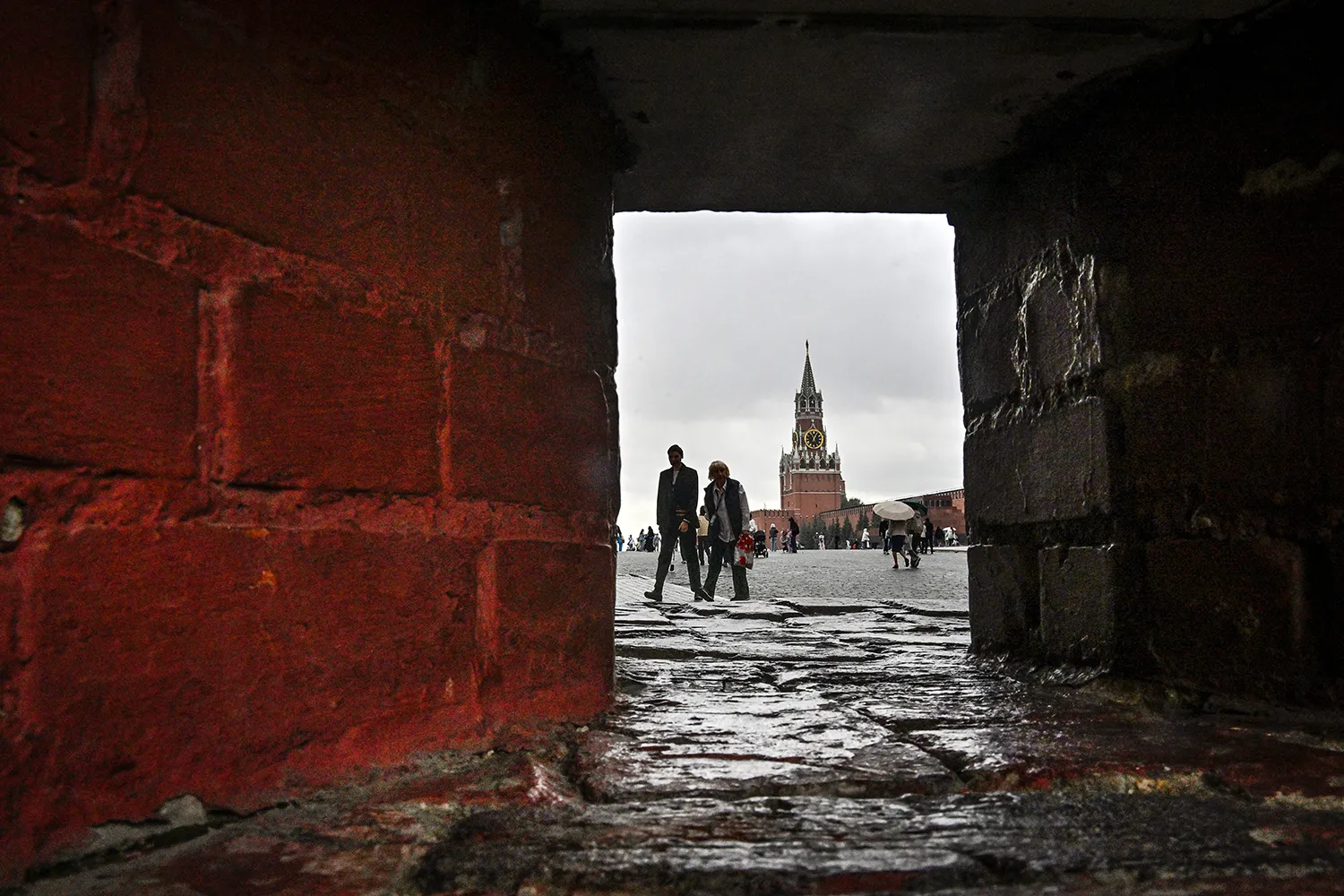
When asked “how’s it going,” average Russians usually respond with one word—normalno. Life is normal when you’re doing neither exceptionally well nor exceptionally poorly. The English-language equivalent might be somewhere between “hanging in there” and “I’m OK.”
Normalnost—or the condition of normalcy—is obviously a relative notion. What is normalno for a Russian pensioner eking out an existence is not normalno for President Vladimir Putin and his minions. Even so, most Russians would probably agree that life is normalno when you’re getting by financially, your kids don’t hate you excessively, your spouse drinks too much only occasionally, and the authorities mostly ignore you.
When asked “how’s it going,” average Russians usually respond with one word—normalno. Life is normal when you’re doing neither exceptionally well nor exceptionally poorly. The English-language equivalent might be somewhere between “hanging in there” and “I’m OK.”
Normalnost—or the condition of normalcy—is obviously a relative notion. What is normalno for a Russian pensioner eking out an existence is not normalno for President Vladimir Putin and his minions. Even so, most Russians would probably agree that life is normalno when you’re getting by financially, your kids don’t hate you excessively, your spouse drinks too much only occasionally, and the authorities mostly ignore you.
Putin’s fascist regime has put normalnost to the test. Life was fine for your average Russian—and for Russian elites—before Putin launched his full-scale invasion of Ukraine in 2022. Now, four and a half years into a bloody war that is killing or wounding around 1,100 Russian soldiers per day while pushing the country’s militarized economy to the brink of collapse, life is anything but normalno for Russians living outside the protected bubbles of Moscow and St. Petersburg. Now, even the residents of these two cities have begun experiencing first-hand what seemed for so long to be a faraway, fantasy conflict.
At a minimum, a return to normalnost presupposes the end of the war. That, in turn, more or less presupposes the end of Putin. Although Putin’s removal in a coup is possible even as the war continues, it cannot end as long as Putin remains committed to it for the sake of his own personal and political survival.
But the relationship between normalnost and war goes deeper than Putin and his determination to destroy Ukraine. Unfortunately for Russia and its neighbors, normalnost will always be susceptible to breakdown—and Russian aggression will always be possible—as long as two structural factors remain in place.
The first is Russia’s political culture and sense of national identity. Central to Russians’ self-perception is the culturally sanctioned, deeply ingrained belief that their country is uniquely predisposed to greatness with a quasi-right to dominate others. Russia’s world-historical mission is thus the very opposite of normalno: Its mission is not to rest on its laurels and enjoy life within its borders, but to fulfill its historical destiny and spread Russian civilization—a messianic concept that is deeply rooted in Russian Orthodoxy but largely devoid of any religious content today.
Soldiers march as part of Russia’s National Flag Day celebrations in St. Petersburg on Aug. 22.Olga Maltseva/AFP via Getty Images
Variants of these views were held by imperial Russian officials and cultural figures (such as Fyodor Dostoevsky), as well as anti-communist dissidents (including Aleksandr Solzhenitsyn). These same views are currently held by Putin; Patriarch Kirill, the head of the Russian Orthodox church and reputed former KGB agent; Putin’s propaganda attack dog Dmitry Medvedev (known for his eagerness to incinerate European capitals with nuclear weapons); the crackpot philosopher Aleksandr Dugin; the rabid television personality Vladimir Solovyov, and scores of other propagandists. Most Russians espouse them as well—if not explicitly, then as part of the cultural waters in which they swim. The fact that these views have been dominant in Russian discourse over decades and even centuries suggests that we’re dealing with a deeper structure—a stable political-cultural norm, not a set of transient views.
Given this tenacious political culture, the many Russians who strive for normalnost in their everyday lives are hard-pressed to resist that culture’s claims about the greatness of their nation. In the final analysis, this undermines Russians’ desire for quotidian normalnost. Could these cultural mindsets change? Other nations with megalomaniacal views of themselves were able to abandon them and focus their attention on daily life only after suffering humiliating military defeats. Britain and France lost empires; the once-aggressive Germans and Japanese were bombed into pacifism during World War II and afterward refocused on domestic prosperity. The United States may be getting its comeuppance today.
These examples suggest that Russia can finally embrace normalnost if and only if it suffers a clear defeat by Ukraine. A mere ceasefire won’t do. Neither will Putin’s departure. Defeat would have to be of such a magnitude as to get even the most vociferous supporters of greatness to question their assumptions. Right now, it is difficult to imagine that anything short of a spectacular collapse would finally enable Russians to do what the Germans did after 1945: Accept responsibility for their leader’s crimes and become average citizens of the world.
The second factor standing in the way of Russia becoming a normal nation is the Russian state—not the type of regime, whether imperial, Soviet, fascist, or something else, but the size and complexity of a political entity that spans 11 time zones and is populated by a plethora of nations with different cultures, religions, histories, and identities. Such a state is structurally imperial, with defined metropoles and outlying colonies whose residents have the choice of being voiceless subjects, de facto collaborators, or persecuted oppositionists.

A massive burial site for Russian soldiers in Russia’s rural Volga region of Kostroma on Oct. 20, 2025.Andrey Borodulin/AFP via Getty Images
Tsarist Russia was openly imperial; the Soviet Union, with its hyper-centralized political and economic systems, was arguably the apotheosis of empire; and Putin’s Russia certainly remains an empire both domestically and in terms of its grand ambitions in its region and beyond. All three empires adopted repressive policies toward their non-Russian subjects, ranging from cultural repression to imprisonment to deportation to genocidal war.
With just a few exceptions, the ethnic Russian majority appears to be perfectly happy with the imperial state. How many protested Putin’s Chechen wars or invasion of Georgia? How many managed to restrain their glee at Crimea’s becoming “ours” in 2014? How many Russians truly believe that Ukraine is an independent state entitled to go its own way? How many are refusing to fight in a genocidal war that is killing them at an extraordinarily high clip? (Surely arrest for draft evasion is not worse than death within an estimated 30 minutes of being sent into battle.) The supposedly liberal oppositionist Alexey Navalny supported Russia’s invasions of Georgia in 2008 and Ukraine in 2014, spouting various nationalist and openly racist views toward non-Russians before reevaluating only in 2022. Ukrainians are fond of pointing out: Scratch a Russian liberal and find a Russian imperialist. That doesn’t apply to everyone, but it does address an unfortunately common Russian trait.
Empires inevitably decline, and Putin’s project will be no exception. The reasons for decline are many, but central is the dynamic between the imperial nation that vies for greatness and the colonized nations who invariably question that claim upon attaining some degree of identity. It was the Soviet revolutionary Vladimir Lenin, after all, who said that Russian chauvinism gave rise to non-Russian nationalism and separatism. But how are Russians committed to their nation’s greatness supposed to respond to non-Russian demands for greater autonomy and cultural identity that threaten the unity and size of the mighty imperial state and the political culture that sustains it? As the tsars, communists, and now Putin have consistently done, greatness demands that non-Russians be silenced. (That some of these leaders—such as Joseph Stalin—were non-Russians themselves does not invalidate the structure of their rule.)

Russian President Vladimir Putin greets soldiers at a training ground in Nizhny Novgorod, Russia, on Sept. 16, 2025, in a photo distributed by the Russian state-owned news agency Sputnik. Valery Sharifulin/AFP via Getty Images
Ironically, Russians are trapped in a vicious circle of their own making. Abandoning the political culture of greatness and imperialism would pave the road to normalnost, but it would also upend a key source of affective empowerment and national pride. Dismantling or at least slimming the imperial state would go a long way to making more normalnost possible, but that too would require either a massive Ukrainian victory that undermines the current state’s integrity or a Gorbachev-style perestroika that loosens the internal bonds of empire.
Normalnost isn’t just a desirable goal for Russia. It’s also of great importance to Russia’s neighbors. Although neither the culture of greatness nor the imperial state are necessary or sufficient for Moscow to start wars, both facilitate war-mongering and make aggression much easier to sell to Russian elites and the public. They thus make war more likely. Imagine a counterfactual: Would a normal Russia bereft of its imperial culture and all-powerful, centralized state have embarked on a genocidal war against Ukraine? Possibly, but not likely.
The sad but inescapable truth is that Russia will be an existential threat to its many neighbors, especially Ukraine, as long as its infatuation with greatness persists—as long as normalnost is only a quotidian aspiration, not a political goal.
A modern-day Cato, echoing his Roman predecessor’s insistence that “Carthago delenda est,” might be right in saying that “Russia must be destroyed.” But who, besides the Ukrainians, Balts, and Poles, would agree? The Trump administration appears committed to Russia’s revival as a great power. The Europeans are only just beginning to realize that Russia has already declared “hybrid war”—or, more honestly, war without a mitigating adjective—on them. Much of the rest of the world sees the United States as more of a threat today than Putin’s Russia.
That’s the bad news. The good news is that, while Putin may be killing Ukrainian civilians in greater numbers, Ukraine’s determination to achieve victory remains undiminished, as does its ability to kill Russian soldiers faster than Putin can recruit them. The even better news is that Putin is putting into practice Cato’s demand by continuing a war that is undermining the economy, exterminating Russian soldiers in staggering numbers, demoralizing and angering his population, and demonstrating to the world that Russia is a has-been great power. Putin is destroying Russia.
Putin promised to make Russia great again. Instead, he’s making it weak—so weak that its disintegration due to his self-destructive policies becomes more likely each day. Russians may take heart: Once they let go of the conviction that their country and state have a special destiny of imperial greatness, they will finally be able to enjoy the normalnost to which they aspire.
