


In 1965, as the United States began to ramp up its war in Vietnam, President Lyndon B. Johnson authorized a massive increase of draft numbers. Ron Amen, the son of Lebanese immigrants in Dearborn, Michigan, was one of the young men called up to serve that year. When he received his dog tags before being deployed, he was surprised to find that, even though he had spelled out “Islam” for the bemused official in the recruitment office, his religion was listed as “none.”
Seasons of Fury: Four Families and the Rise of Islamophobia in America, Rozina Ali, Crown, 464 pp., $32, August 2026
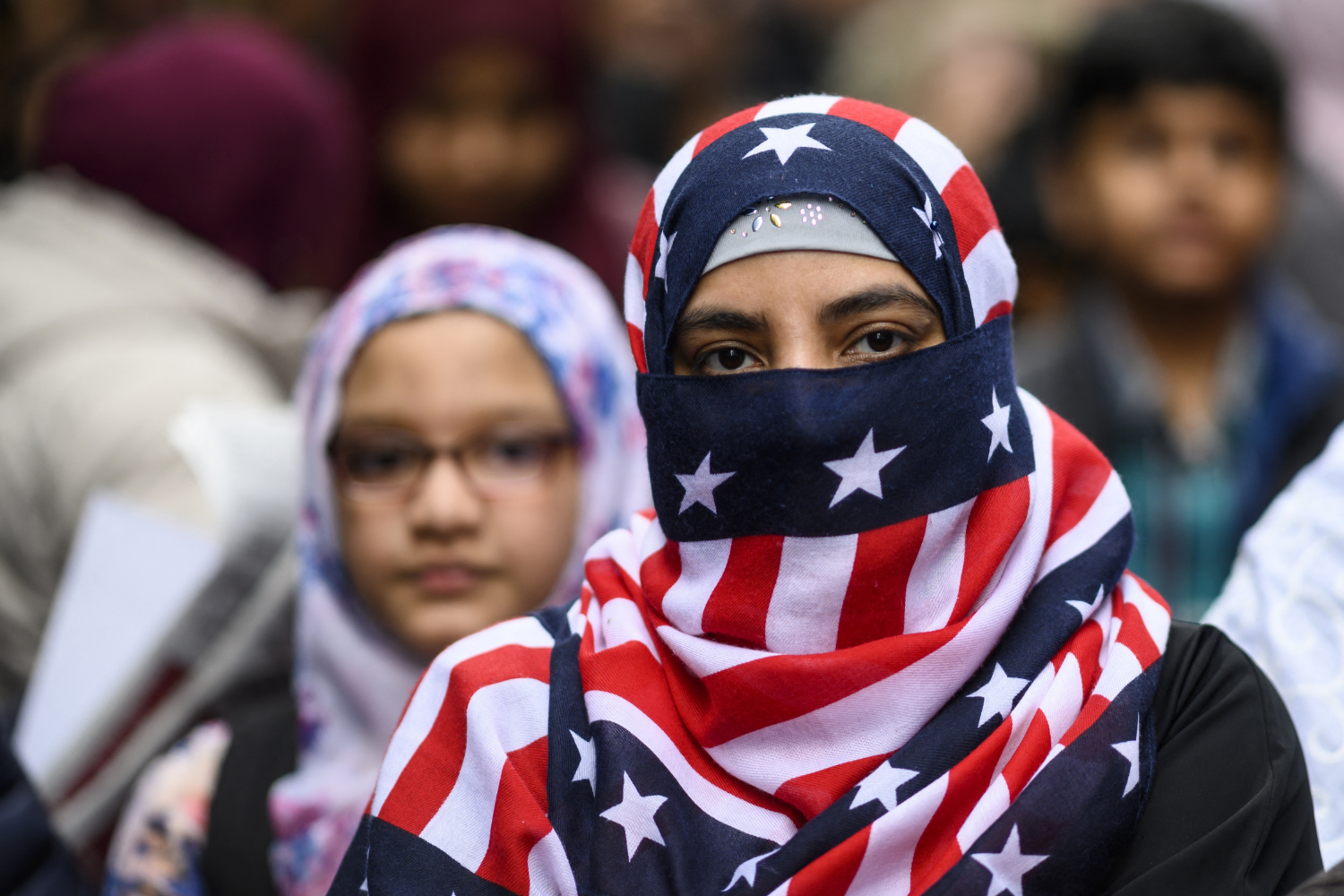
Amen’s dog tags offer an early glimpse of what would grow into the widespread anti-Muslim sentiment that journalist Rozina Ali traces in her new book, Seasons of Fury: Four Families and the Rise of Islamophobia in America. For generations, Muslims occupied a small and largely overlooked place in U.S. life, even if the country rarely accepted or acknowledged their identity. But after 9/11, a small group of politicians and activists seized on the tragedy to scrutinize Muslims and openly question whether they should be in the United States at all.
Ali’s book documents that shift, illuminating the policies and practices that shaped Americans’ suspicion of Muslims decades both before and after 9/11. Unlike much of the literature on the attacks and their aftermath, Ali does not ask whether the so-called war on terror succeeded or failed. Instead, she examines what it did to Muslims in the United States—and, in turn, to the country itself—through the stories of four families, all of whom experienced Islamophobia in different ways yet refused to relinquish their claims to American life.

Firefighters try to extinguish a burning building set aflame during the riots in Detroit, Michigan, on July 25, 1967.AFP via Getty Images
Seasons of Fury begins with Abdeen Jabara, an attorney whose parents emigrated to the Midwest in the early 20th century from what was then called Greater Syria. Jabara recounts one striking moment in 1967, when he was watching the race riots that rocked Detroit from the city’s Cadillac Tower. He was there for a gathering of the local chapter of the National Lawyers Guild. Yet rather than focusing on the chaos taking place just below, the chapter’s leader called for the condemnation of the Soviet Union for arming Arab states against Israel, which had recently captured more territory in the Six-Day War, leading to its occupation of the West Bank, East Jerusalem, and Gaza. Jabara pushed back, saying that the situation was more complicated—to no avail.
Soon after the guild meeting, a friend who was a professor called Jabara to invite him to a dinner with fellow Arabs to discuss how to better inform Americans about the Israeli-Palestinian conflict. There, along with other attendees, Jabara formed the Association of Arab American University Graduates, an organization that sought, in Ali’s words, to “win over American minds.” For a time, the group’s vice president was Columbia University scholar Edward Said.
In doing so, Jabara caught the attention of the FBI, which admitted in 1974 that it had been monitoring him since 1967 and sharing his information with Zionist organizations and foreign governments. Under J. Edgar Hoover in 1956, the FBI had launched a covert surveillance program called COINTELPRO to monitor “radical” groups—or at least what the agency deemed radical. It initially targeted communists but expanded to civil rights leaders and anti-war activists. Organizing around Palestine—and against Israel—eventually landed on its radar, even as the government’s own intelligence assessments found “little evidence that Arab groups were plotting attacks against the United States,” Ali notes.
Jabara’s experience was not isolated. By the 1970s, Arabs in the United States increasingly came under surveillance, including by the National Security Agency, which Ali writes was “then a little-known part of the Defense Department.”
Two decades later, laws helped institutionalize government suspicion and surveillance. President Bill Clinton approved two pieces of legislation in 1996 that, as Ali describes, “would forever shape the country’s criminal and immigration landscape.” One was the Illegal Immigration Reform and Immigrant Responsibility Act, which “gave the government power to deport more immigrants, by expanding the list of deportable offenses.”
The other, the Antiterrorism and Effective Death Penalty Act, stretched the definition of who could be implicated in terrorism under a new “Foreign Terrorist Organization” list. Anyone providing “material support” to any of the listed groups, including Hamas and Hezbollah, could be found guilty of abetting terrorism. Furthermore, the government could offer classified evidence in court that the defendant could not see. Ali notes that “Congressman David Bonior, from Michigan, called it ‘one of the most pernicious laws I’ve seen in my 28-year profession.’”

U.S. President Bill Clinton signs the Antiterrorism and Effective Death Penalty Act during a ceremony on the South Lawn of the White House, on April 24, 1996.Mark Reinstein/Getty Images
He would see just how pernicious shortly after 9/11, when Congress passed the Patriot Act, which broadened the definition of “material support” to include those who offered “advice or assistance” to a supposed terrorist, effectively allowing the government to investigate and prosecute anyone it deemed vaguely suspicious. The law sparked widespread fear that Muslims would become targets, not just of the government but of an angry public eager for revenge.
Indeed, in the aftermath of 9/11, Ali’s own father told her not to tell anyone that she is Muslim. “If a stranger asked, we were Hindu,” she recalls him saying. For good reason. The FBI reported that anti-Islamic incidents grew by more than 1,600 percent between 2000 and 2001. Official suspicion validated public fear, and public fear enabled aggressive government action.
Ali gives a human face to these statistics through Jabara and three other families, whose stories before and after 9/11 are the heart of Seasons of Fury. Like a descent into Dante’s inferno, each family history reveals a particular layer of Islamophobia.
In an effort to separate the terrorists from Muslims, six days after the attacks, President George W. Bush visited the Islamic Center in Washington, where he spoke about how Islam was a religion of peace. That gave Mohammad “Ali” Chaudry—a Pakistani immigrant who was elected to New Jersey’s Bernards Township council in 2001—hope. His election to mayor in 2004—which made him the first Pakistani-born Muslim mayor in the United States—seemed to indicate to Chaudry that despite 9/11, Americans were heeding the president’s call for tolerance.
But the Bush administration’s actions spoke louder than his words. In an effort to identify threats, whether credible or not, the White House shifted counterterrorism efforts into overdrive. By the end of 2002, it had championed the Patriot Act, which expanded mass surveillance and curtailed civil liberties; formed the Department of Homeland Security; and rolled out both a “no fly list” and the National Security Entry-Exit Registration System, more commonly known as the Muslim registry, which required visa holders from specific countries—almost all of which were predominantly Muslim—to register with law enforcement.

U.S. President George W. Bush speaks following the 9/11 terrorist attacks during a visit to the Islamic Center of Washington, D.C., on Sept. 17, 2001.Mark Wilson/Getty Images
All of this ensured that the mood in the country locked into vigilance, something Chaudry witnessed a decade later when he moved to build a mosque in Basking Ridge. His neighbors subjected the proposal to years of review and 39 public hearings, repeatedly invoking zoning and planning objections to block the project. (Construction of the mosque was eventually allowed to move forward in 2017.)
While Chaudry’s neighbors did not want a mosque in their midst, the Omars—a pseudonym Ali uses for a family of five due to concerns over their safety—came across a neighbor who did not want them, period. Shortly after 9/11, they moved to an unnamed U.S. suburb, where a neighbor began a relentless campaign of harassment: stalking, vandalism, and intimidation. He placed nails on the Omars’ walkway and a lawn ornament of a pig between his house and theirs.
When the family sought help, with a meticulously documented record of incidents, local authorities repeatedly dismissed the harassment as an ordinary dispute between neighbors—not a sustained campaign directed at a Muslim family. Racial bias, authorities told the Omars, requires proof beyond a few claims. It took many years for the family to get a protective order in place.
Read More
-

A person stands facing away from the camera amid heavy debris, dust, and rubble from destroyed buildings. In the background stand skeletal steel structures of collapsed high-rises, surrounded by damaged vehicles, scattered papers, and an American flag. A person stands facing away from the camera amid heavy debris, dust, and rubble from destroyed buildings. In the background stand skeletal steel structures of collapsed high-rises, surrounded by damaged vehicles, scattered papers, and an American flag. Why 9/11 Baffles Us 25 Years Later
It’s the strategic disaster that keeps on giving.

-

A dimly light photograph shows U.S. President George W. Bush in profile, looking out the window of Air Force One while he speaks on the phone. The plane behind him is dark, leaving his back in shadow and his face lit up by the window. A dimly light photograph shows U.S. President George W. Bush in profile, looking out the window of Air Force One while he speaks on the phone. The plane behind him is dark, leaving his back in shadow and his face lit up by the window. What Was the War on Terror?
A defining period in U.S. foreign policy has ended, but it remains misunderstood.
As Ali documents, that is the exact opposite problem that the Siraj family encountered from a national-security apparatus determined to find a threat from Muslims. Shahawar Matin Siraj, a 20-something Pakistani American, became entangled with a government informant who encouraged him to follow through with the idea of bombing a subway station—a bombing that never took place. He went to trial, believing that he would be found innocent, but was sentenced in 2007 to 30 years in prison. A day later, U.S. immigration officials detained his mother, father, and sister, who were later released. Siraj’s mother continues to maintain her son’s innocence.
If authorities were reluctant to recognize the menace facing the Omars, in Siraj’s case they were willing to go extraordinary lengths to identify, cultivate, and prosecute a potential danger—even if they had to manufacture it themselves.
Manufacturing fear against Muslims was not only ideological, but profitable. Tens of millions of dollars went into endeavors claiming to educate Americans about the supposedly dangerous nature of Islam. The Clarion Fund, which helped distribute Raphael Shore’s 2005 documentary Obsession: Radical Islam’s War Against the West, received $17 million from a single donor in 2008 alone. Right-wing commentator David Horowitz received more than $8 million for his eponymous Freedom Center, which housed Robert Spencer’s Jihad Watch blog and hosted Islamofascism Awareness Week on college campuses. Other conservative donors joined in. Banking and oil-fortune heir Richard Mellon Scaife was among several who put more than $42 million into anti-Muslim efforts in the years following 9/11.

Anti-Islam demonstrators hold a “Crusader” rally against the city’s first Muslim mayor, Zohran Mamdani, in front of New York City Hall, on Sept. 11.Selcuk Acar/Getty Images
By the end of the Bush administration in 2008, Islamophobia no longer needed a terrorist attack to sustain it. Individuals and institutions with a financial interest in anti-Muslim sentiment kept it alive. Perhaps that, along with the massive bureaucracy that sustained Islamophobia, is what made it difficult for Bush’s successor to fight it.
Ali points out that although President Barack Obama spoke about civilization’s debt to Islam in a 2009 speech in Cairo in an attempt to reset relations between the United States and the Muslim world, his administration did little to correct Bush’s overreach. In fact, she writes, during the first two years of his presidency, “the number of Islamic terrorism-related prosecutions ticked upward.” A Democratic president may speak more acceptingly of Islam, but anti-Muslim bias had already become ingrained in U.S. politics.

Mamdani celebrates his victory on election night in New York City, on Nov. 4, 2025.Michael M. Santiago/Getty Images
Despite the racism and fearmongering on display in Seasons of Fury, Ali’s subjects do not reject the United States or the institutions that have failed to protect them. They turned to courts, free speech, activism, and public service to insist on the rights the United States promises its citizens. As Ali notes, the country may not deem Islam compatible with it, but Muslims have shown that their faith in the American experiment is unwavering. By the time she finished writing her book, Zohran Mamdani was elected New York’s first Muslim mayor. The night of the vote, Ali writes in the epilogue, “felt electric with possibility, charged by the promise that the American experiment was not yet worth giving up on.”
